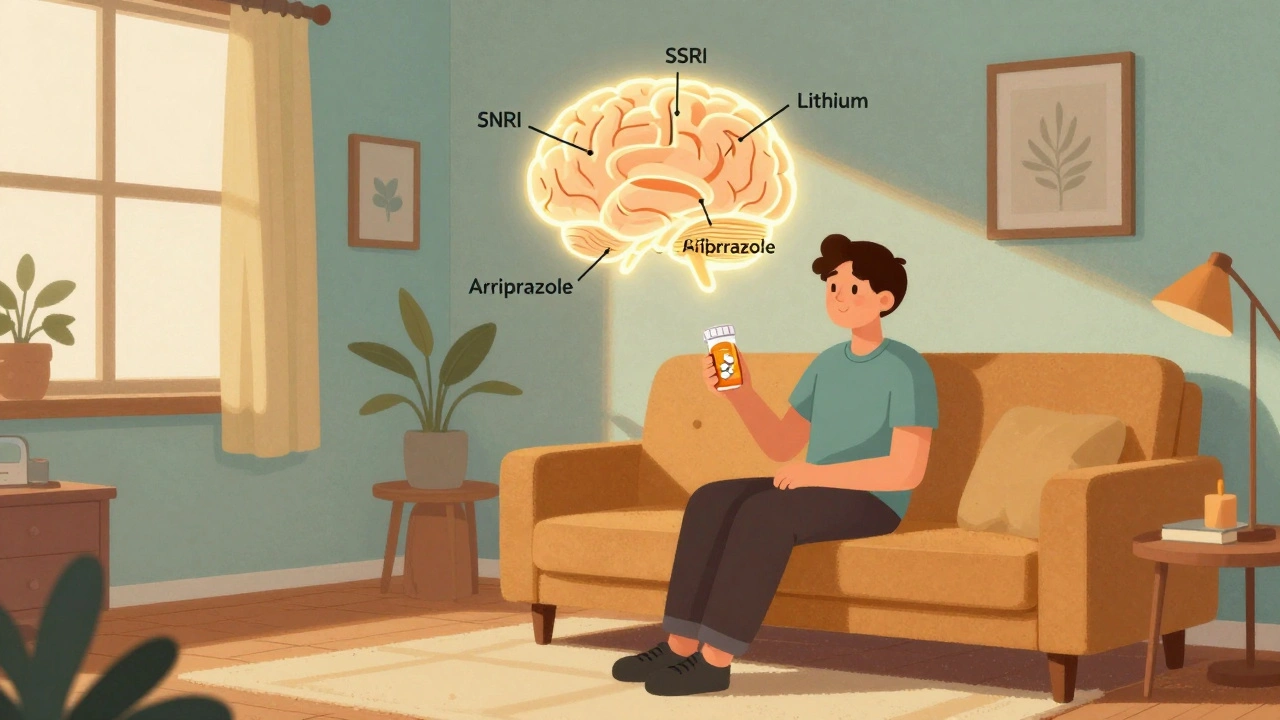
When antidepressants don’t work, it’s not because you’re weak or failing. It’s because depression isn’t one disease-it’s many. About 30 to 40% of people with major depression don’t get relief after trying two different antidepressants. This is called treatment-resistant depression, or TRD. And if you’re one of them, you’re not alone. But you might feel like you’re out of options. You’re not.
What Makes Depression Resistant?
TRD isn’t a diagnosis you get from a quick checklist. It’s a label that comes after real, adequate trials. That means taking the right dose for long enough-usually 6 to 8 weeks-without improvement. Many people stop too soon because side effects kick in, or they think it’s not working fast enough. But if you’ve tried two different classes of antidepressants-like an SSRI and an SNRI-and still feel stuck, that’s when you enter the TRD zone.
It’s not just about medication. Underlying issues like chronic stress, trauma, thyroid problems, or even inflammation can block antidepressants from doing their job. Some people have high levels of inflammatory markers in their blood, which studies show can make depression harder to treat. One 2022 study found that adding an anti-inflammatory drug called infliximab helped people with high inflammation, leading to a 30.5% remission rate versus just 13.7% in the placebo group.
Augmentation: Adding Something to Make It Work
Augmentation means sticking with your current antidepressant and adding something else to boost its effect. This avoids the risk of stopping what’s already working, even if it’s only partially helping.
The FDA has approved five augmentation options specifically for TRD:
- Aripiprazole (Abilify) - 2 to 15 mg/day. Works well for people who struggle with fatigue or low motivation. Side effects? Restlessness (akathisia) in up to 25% of users.
- Brexpiprazole (Rexulti) - 0.5 to 3 mg/day. Similar to aripiprazole but often better tolerated. Less likely to cause shaking or jitteriness.
- Quetiapine extended-release (Seroquel XR) - 150 to 300 mg/day. Helps with sleep and anxiety, but weight gain and drowsiness are common. One study showed 48% response rates when added to SSRIs.
- Olanzapine-fluoxetine (Symbyax) - a combo pill. Effective but can cause significant weight gain-up to 5-7% of body weight in some cases.
- Lithium - not FDA-approved for this use, but widely used off-label. Requires blood tests every few months. Target level: 0.3 to 0.6 mEq/L. Too low? No effect. Too high? Dangerous.
A 2022 analysis of 65 studies found that liothyronine (a thyroid hormone), nortriptyline, and lithium all had strong results. But not all augmentations are created equal. Ziprasidone and cariprazine had higher dropout rates because of side effects. Aripiprazole had the best balance of effectiveness and tolerability in real-world use.
And then there’s bupropion. It’s not FDA-approved for augmentation, but the VAST-D trial showed it worked almost as well as aripiprazole-21.3% remission rate-and it’s often chosen for people with sexual side effects or extreme fatigue from other antidepressants.
When Augmentation Isn’t Enough: Advanced Therapies
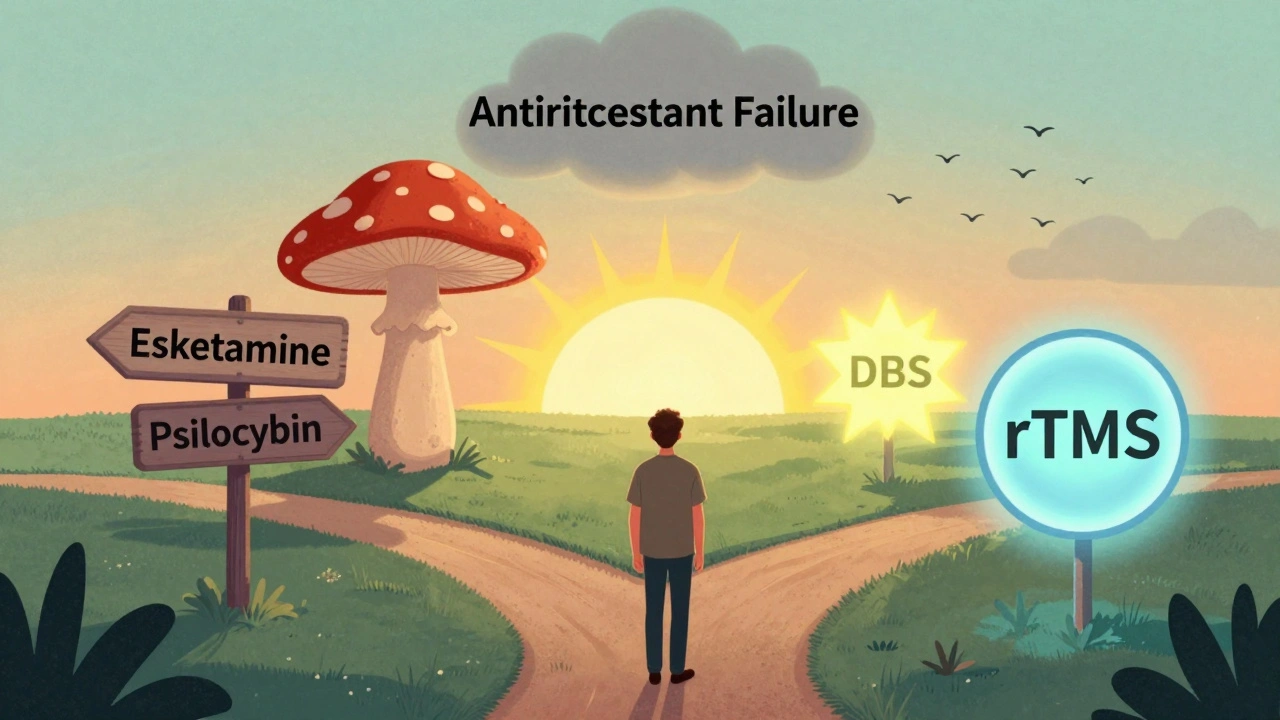
If you’ve tried two or three augmentation strategies and still feel the same, it’s time to think beyond pills.
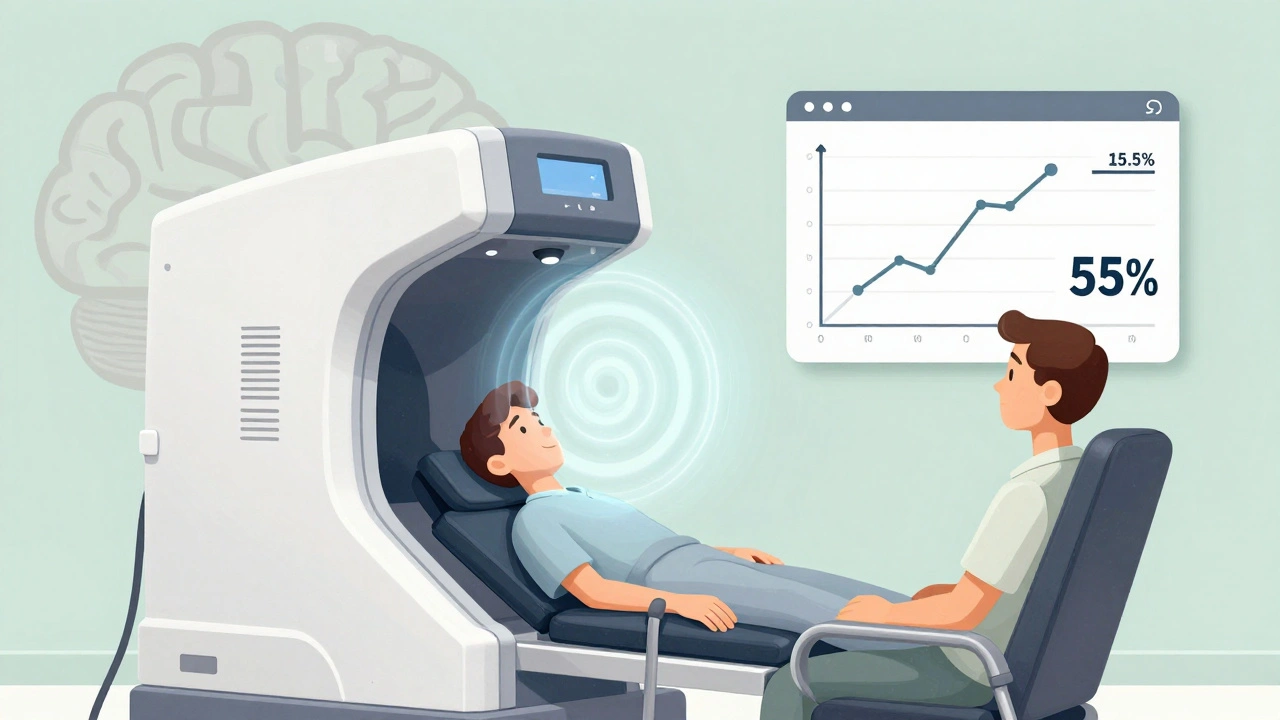
Repetitive Transcranial Magnetic Stimulation (rTMS) is one of the most reliable next steps. It uses magnetic pulses to stimulate areas of the brain involved in mood. No anesthesia. No memory loss. No hospital stay. You sit in a chair for 20 to 40 minutes, five days a week, for four to six weeks. Over 50 clinical trials show a 50-55% response rate and 30-35% remission rate in TRD patients. It’s covered by most insurance plans in the U.S. and Canada now.
Esketamine nasal spray (Spravato) is the first rapid-acting antidepressant approved by the FDA. You get it in a certified clinic, under supervision, because it can cause dissociation-feeling detached from your body or surroundings. In one trial, 70.3% of people responded within four weeks, compared to 47.5% on placebo. The effect can kick in within hours. But it’s expensive, requires ongoing clinic visits, and isn’t meant to be used alone-it’s always paired with an oral antidepressant.
Electroconvulsive Therapy (ECT) is still the gold standard for severe, life-threatening depression. It’s effective in up to 70-80% of TRD cases. But many people avoid it because of the stigma and fear of memory loss. Modern ECT is much safer than in the past, with shorter treatments and better anesthesia. Still, rTMS is often preferred for its lack of cognitive side effects.
Deep Brain Stimulation (DBS) is experimental but promising. Tiny electrodes are surgically implanted in the brain, targeting the subcallosal cingulate cortex. One small 2017 study found 92% of patients responded after two years. But it’s invasive, expensive, and only available in research centers. Not a first-line option-but for those who’ve tried everything else, it’s a lifeline.
What’s on the Horizon?
Science is moving fast. Psilocybin-the active compound in magic mushrooms-is showing incredible results. A 2020 JAMA Psychiatry trial with 24 people found a 71% response rate after just two doses, compared to 9.4% in the placebo group. It’s not legal yet, but Phase 3 trials are underway. Many experts believe it could be approved within the next few years.
Other emerging options include:
- Modafinil - a wakefulness agent that boosts energy and focus. Works best for people with severe fatigue.
- Lisdexamfetamine - a stimulant used for ADHD, but studies show it helps with motivation and anhedonia in TRD.
- Anti-inflammatory drugs - like infliximab or celecoxib - for people with high CRP levels.
The future of TRD treatment is personalized. Not everyone needs the same thing. Blood tests for inflammation, genetic markers for drug metabolism, even brain scans may soon help doctors pick the right treatment faster.
What Works Best for You?
There’s no single answer. But here’s a simple way to think about it:
- If you’re fatigued and unmotivated → try bupropion or modafinil.
- If you’re anxious and sleepless → quetiapine or brexpiprazole.
- If you need fast relief → esketamine.
- If you want something non-drug → rTMS.
- If you’ve tried everything and still feel hopeless → talk to a specialist about DBS or psilocybin trials.
The Canadian Network for Mood and Anxiety Treatments (CANMAT) recommends matching treatment to your symptoms, side effect history, and lifestyle. Want to avoid weight gain? Skip olanzapine. Hate daily pills? rTMS might be better. Need quick results? Esketamine.
Real-world data from the EU-NEURD registry shows that only 28.4% of TRD patients reach full remission with standard treatments. That means over 70% still struggle. But that doesn’t mean hope is gone. It means we need to keep trying-smartly.
What to Do Next
If you’ve been stuck for months or years:
- Confirm your diagnosis. Is it really depression? Or could it be bipolar disorder, PTSD, or a medical condition?
- Review your past treatments. Were doses high enough? Were they taken long enough?
- Ask for a referral to a mood disorder clinic. These specialists see TRD every day.
- Request a blood test for thyroid function and inflammation (hs-CRP).
- Discuss rTMS or esketamine with your doctor. Insurance often covers them now.
- Consider therapy. CBT has an effect size of 1.58 in TRD-stronger than most medications.
TRD isn’t a dead end. It’s a signal that your brain needs a different kind of help. The tools are here. You just need to ask for them.
What counts as an adequate trial for antidepressants?
An adequate trial means taking a standard dose (like 20 mg of sertraline or 150 mg of venlafaxine) for at least 6 to 8 weeks. Many people give up too early because they don’t feel better in the first week or two. But antidepressants take time. If you didn’t reach the full dose or stopped before 6 weeks, it doesn’t count as a true trial.
Can I take multiple augmentation agents at once?
It’s possible, but risky. Combining two antipsychotics or adding lithium with an SSRI and an SNRI increases side effects without clear proof of better results. Most guidelines recommend trying one augmentation at a time. If one doesn’t work after 6 to 8 weeks, then move to the next. More isn’t always better.
Is esketamine safe for long-term use?
Esketamine is approved for maintenance use, but long-term safety data is still limited. The biggest concerns are dissociation during dosing and potential for abuse. It’s only given in certified clinics under supervision. Most people use it for 8 to 12 weeks, then taper off if they respond. It’s not meant to be a lifelong solution-it’s a bridge to recovery.
Does rTMS hurt?
No, it doesn’t hurt. You’ll feel a tapping or knocking sensation on your scalp during treatment. Some people get mild headaches or scalp discomfort, especially at first. These usually fade after a few sessions. No needles. No anesthesia. No recovery time. You can drive yourself home afterward.
Why aren’t psilocybin and other psychedelics available yet?
Psilocybin is still in clinical trials. While results are strong-71% response in one study-it’s not yet approved by Health Canada or the FDA. Regulatory approval requires larger trials, long-term safety data, and standardized dosing protocols. But it’s likely to become available within the next 2 to 5 years, especially for TRD.
Can therapy help if medications failed?
Yes. Cognitive behavioral therapy (CBT) has been shown to be as effective as medication for some people with TRD. It helps rewire negative thought patterns and build coping skills. When combined with medication, it boosts remission rates. Even if you’ve tried therapy before, it’s worth trying again with a therapist who specializes in treatment-resistant depression.



ATUL BHARDWAJ
3 December 2025 - 11:53 AM
TRD is not a failure. It's a signal your biology needs a different map. In India, we say 'dard ka ilaj nahi, dard ka samajh hona chahiye'. You don't fix depression with pills alone. You listen to the silence behind the pain.
Elizabeth Grace
3 December 2025 - 17:08 PM
I’ve been on 7 meds and still cry in the shower. rTMS saved me. No magic, just science. My brain finally stopped screaming. If you’re still reading this? Keep going. You’re not broken. Just under-treated.
Jay Everett
3 December 2025 - 22:25 PM
Bro. I was in the ER last year because I couldn’t get out of bed. Tried everything. Then I got rTMS. 3 weeks in? I laughed at a dog wearing sunglasses. That’s the moment I knew. Not cured. But alive again. 🙌 Science is not a myth. It’s the quiet hero no one talks about.
Steve Enck
3 December 2025 - 22:46 PM
While the article presents a clinically coherent framework for TRD management, it conspicuously omits the epistemological limitations of pharmacological paradigms. The reductionist model of depression as a neurochemical imbalance is a 1960s heuristic that has outlived its utility. Neuroplasticity, epigenetic modulation, and the gut-brain axis remain grossly under-integrated into clinical protocols despite overwhelming evidence.
Ella van Rij
5 December 2025 - 06:37 AM
So… we’re now prescribing esketamine like it’s a Starbucks latte? 🙄 And calling it ‘progress’? Meanwhile, people are still waiting 6 months for a therapist. We’re treating symptoms like widgets. Brilliant.
Zed theMartian
5 December 2025 - 19:31 PM
Oh wow. Another ‘hopeful’ article from the pharmaceutical industrial complex. Let me guess - next they’ll tell us psilocybin is ‘safe’ because a 24-person trial showed ‘71% response.’ That’s not science. That’s a marketing brochure with a DOI. And don’t get me started on ‘inflammation markers’ - next they’ll say your depression is caused by bad tacos.
Laura Baur
6 December 2025 - 13:52 PM
It’s not about the drugs. It’s about the unspoken trauma that never got named. You can augment your serotonin all you want, but if your childhood was a silent war, no pill will ever heal the echo. Therapy isn’t a ‘bonus’ - it’s the foundation. And if your doctor doesn’t treat it that way, they’re not treating you at all.
Roger Leiton
8 December 2025 - 06:10 AM
Just got my first rTMS session today. Felt like my brain was being gently nudged awake. No pain. Just… quiet. I cried after. Not sad tears. Just… relief. Thank you for this post. I needed to know I’m not the only one still fighting.
मनोज कुमार
8 December 2025 - 22:20 PM
Augmentation protocols are overhyped. Most docs just shotgun meds. No biomarkers. No personalization. Just trial and error until you’re broke and exhausted. We need precision psychiatry not placebo protocols. CRP levels should be mandatory before prescribing SSRIs.
Joel Deang
9 December 2025 - 05:16 AM
psilocybin is gonna be huge. like… huge. i mean, imagine if your depression just… reset after 2 sessions? no more pills? no more side effects? i know people who did it underground and they’re basically new people. the system is slow but the future is here. 🌱✨
Arun kumar
9 December 2025 - 08:05 AM
in india we dont have rTMS in small towns. but we have chai and silence. sometimes that is enough. i dont need a drug to feel less alone. just someone who sits with me. no advice. no fix. just presence.
dave nevogt
9 December 2025 - 10:28 AM
There’s a quiet dignity in enduring when no one sees your struggle. The system wants quick fixes - pills, pulses, procedures. But healing isn’t linear. It’s a spiral. You circle back. You try again. You get tired. You cry. You try again. This isn’t a checklist. It’s a life. And you’re still here. That matters more than remission rates.
Jack Dao
11 December 2025 - 00:07 AM
Anyone who takes esketamine is just chasing a high disguised as treatment. You’re trading one dependency for another. And you call that recovery? Wake up. Real healing doesn’t come from a nasal spray. It comes from facing the darkness without a chemical crutch.
Steve World Shopping
12 December 2025 - 15:07 PM
TRD is just capitalism’s way of monetizing despair. rTMS costs $10k. Esketamine $1k per dose. Meanwhile, your therapist makes $30/hour. This isn’t medicine. It’s a profit engine. And you’re the product.