
Thyroid Medication & Ashwagandha Risk Calculator
Calculate Your Risk
Risk Assessment
Click Calculate to see your resultsYour risk assessment will appear here after calculation.
If you're taking thyroid medication like levothyroxine and thinking about adding ashwagandha for stress or sleep, stop. What sounds like a natural boost could be quietly pushing your thyroid into dangerous territory - a condition called over-replacement.
What is over-replacement, and why does it matter?
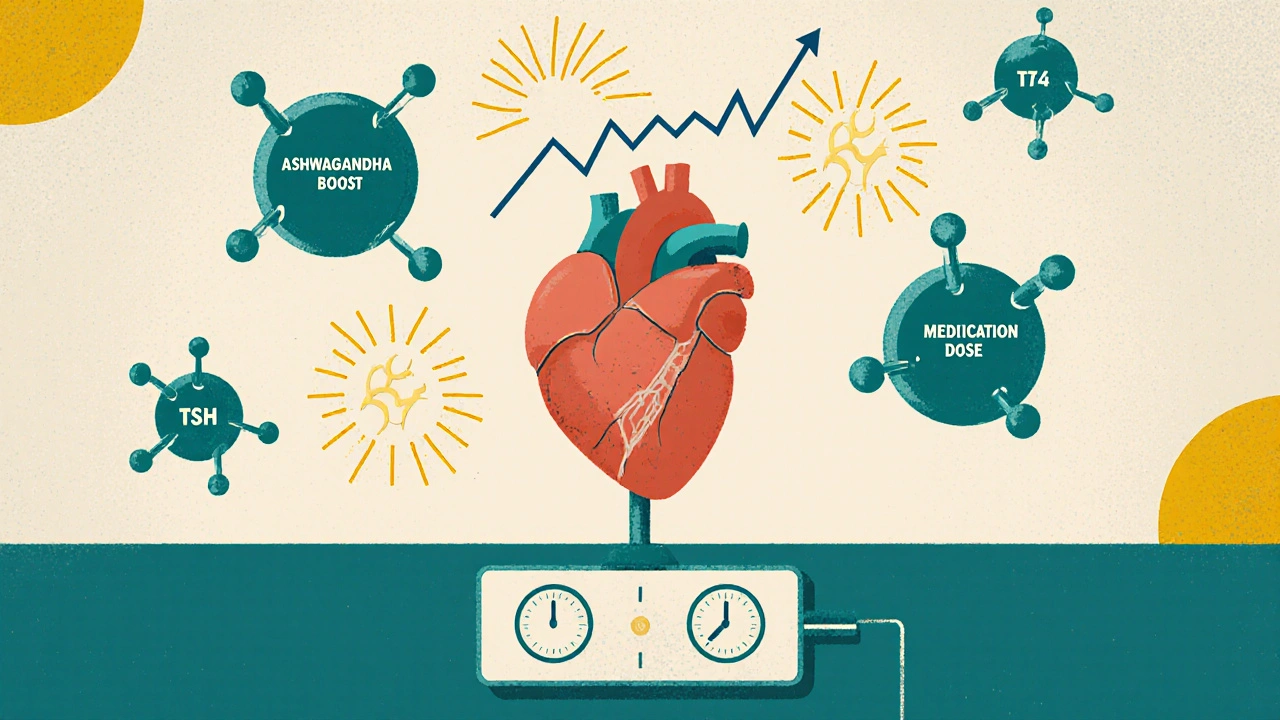
Over-replacement happens when your thyroid hormone levels climb too high because you're getting too much hormone from both your medication and something else - like ashwagandha. It’s not rare. In fact, the American Association of Clinical Endocrinologists documented 12 cases of thyrotoxicosis (dangerously high thyroid hormone levels) directly linked to people taking ashwagandha along with their thyroid pills. One patient had a T4 level of 25 mcg/dL - more than double the normal range. Their TSH, the hormone that normally tells your thyroid to slow down, dropped below 0.01 mIU/L. Normal is 0.4 to 4.0. This isn’t a lab anomaly. It’s a medical emergency.When your thyroid hormones run too high, you don’t just feel "a little off." You get heart palpitations, insomnia, unexplained weight loss, tremors, and in severe cases, atrial fibrillation - a type of irregular heartbeat that can lead to stroke. These aren’t side effects you can ignore. They require urgent medical attention.
How does ashwagandha affect thyroid hormones?
Ashwagandha isn’t just a calming herb. It’s a powerful endocrine modulator. In a double-blind, eight-week study of 50 people with subclinical hypothyroidism, those who took 600 mg of standardized ashwagandha daily saw their TSH rise by 17.5%, T3 by 41.5%, and T4 by 19.6%. That’s not a subtle effect. That’s a measurable, clinically significant shift in thyroid function.The active compounds in ashwagandha - withaferin A and withanolide D - appear to stimulate the hypothalamic-pituitary-thyroid (HPT) axis. Recent research from the University of California, Irvine, even found that ashwagandha can increase thyroid peroxidase (TPO) activity by up to 38% in lab tests. TPO is the enzyme your thyroid uses to make hormones. More activity? More hormone production. And if you’re already on medication to replace what your thyroid can’t make, you’re doubling down on hormone levels without realizing it.
Why isn’t this common knowledge?
Because supplements like ashwagandha aren’t held to the same standards as prescription drugs. The FDA doesn’t test them for purity, potency, or safety before they hit store shelves. A 2021 ConsumerLab.com analysis of 15 popular ashwagandha products found withanolide content ranged from 1.2% to 7.8%. Two bottles with the same label could have wildly different effects.One person takes a 500 mg capsule with 2% withanolides - barely enough to move the needle. Another takes the same dose from a different brand with 7% withanolides. That’s nearly four times the active ingredient. And if you’re on levothyroxine, even a small change can throw your entire hormone balance off.
Thyroid medication is one of the most precisely dosed drugs in medicine. A single pill contains 25 to 300 micrograms of synthetic T4. Your doctor calibrated that dose based on your weight, age, lab results, and symptoms. Add an unregulated herb that can boost your natural hormone production by nearly 40%, and you’re playing Russian roulette with your metabolism.
Real stories from real patients
On the Thyroid Help Forum, a user named "ThyroidWarrior" shared that after six weeks of taking 500 mg of ashwagandha daily with 100 mcg of levothyroxine, their TSH plummeted from 1.8 to 0.08 mIU/L. They developed palpitations and couldn’t sleep. They ended up in urgent care needing a medication adjustment.A 2022 survey by the American Thyroid Association of over 1,200 patients on thyroid meds found that nearly 19% who took ashwagandha experienced symptoms of hyperthyroidism. Nearly 30 of them were hospitalized for heart rhythm problems.
On Reddit, someone named "HypoThyroidHope" reported their T4 rose from 5.2 to 8.7 mcg/dL after three months on ashwagandha alone - no medication. They felt better, but they also admitted: "This isn’t a substitute for proper medical care." And they’re right. What worked for them might be a disaster for someone on levothyroxine.
What do doctors say?
The consensus among endocrinologists is clear: don’t mix them.Dr. Angela Leung from UCLA’s Endocrine Clinic says ashwagandha can "tip the delicate balance" of thyroid replacement therapy, leading to iatrogenic hyperthyroidism - meaning the treatment itself caused the problem.
The Endocrine Society’s 2023 clinical guidance states bluntly: "The risk-benefit ratio currently favors avoiding ashwagandha in patients requiring thyroid hormone replacement therapy."
Even Dr. Mary Hardy, who supports integrative approaches, warns: "The therapeutic window for thyroid medication is narrow. Adding an unregulated herbal supplement creates unacceptable risks."
There’s no safe middle ground here. Some people suggest taking ashwagandha four hours apart from thyroid meds. But a 2022 review in Thyroid journal found no clinical evidence to support this strategy. The interaction isn’t just about timing - it’s about systemic hormone stimulation.
What should you do if you’re already taking both?
If you’re currently taking ashwagandha and thyroid medication, don’t stop your medication. But do stop the supplement - immediately.Then schedule a thyroid function test. TSH, free T4, and free T3. Ashwagandha’s effects can linger for 2 to 3 weeks after you stop taking it because of its long half-life (about 12 days). Testing too soon might not show the full picture.
Many labs now recommend discontinuing ashwagandha for at least 30 days before thyroid testing, per the American Association of Clinical Chemists’ 2023 guidelines. Why? Because if you don’t, your doctor might think your dose is too low - when in reality, the supplement is artificially boosting your numbers.
If you’ve had symptoms like racing heart, anxiety, or weight loss you can’t explain, tell your doctor you’ve been taking ashwagandha. Don’t assume they know. Most aren’t trained in supplement interactions.
Is there any safe way to use ashwagandha with thyroid meds?
Not really. The risk isn’t worth it.Even if you’re under close supervision with biweekly lab tests, the variability in supplement quality makes it nearly impossible to predict how much your hormones will rise. One batch might nudge your levels up a little. Another might send them soaring. And if you’re one of the 3.4 million Americans taking both thyroid meds and ashwagandha - according to NHANES data - you’re part of a growing, poorly monitored experiment.
The NIH is funding a $2.3 million study to look into this exact issue, with results expected in late 2024. Until then, the safest choice is avoidance.
What are safer alternatives for stress and sleep?
If you’re taking ashwagandha for stress, anxiety, or sleep, there are other options that don’t interfere with thyroid function:- Magnesium glycinate - helps calm the nervous system and improve sleep quality without hormonal effects.
- L-theanine - an amino acid found in green tea that promotes relaxation without drowsiness.
- Valerian root - a well-studied herb for sleep, with no known interaction with thyroid meds.
- Cognitive behavioral therapy (CBT) - proven to reduce stress and anxiety long-term, with no side effects.
These alternatives don’t promise miracles. But they also don’t risk your heart, your bones, or your metabolic health.
Why the FDA hasn’t acted
The Dietary Supplement Health and Education Act of 1994 (DSHEA) prevents the FDA from requiring pre-market approval for supplements. That means ashwagandha can be sold without proving it’s safe to take with thyroid meds. The FDA has issued 12 warning letters to manufacturers for making false thyroid claims - but no product recalls. No mandatory labels. No black box warnings.The American Medical Association has pushed for black box warnings on ashwagandha products, citing over 47 adverse event reports to FAERS between 2019 and 2022 - 32 involving thyroid medication. So far, the supplement industry has resisted. The Council for Responsible Nutrition has lobbied against stricter labeling, arguing it would stifle consumer choice.
In the EU, the European Medicines Agency already requires warning labels on ashwagandha products. In the U.S.? Still nothing.
The bottom line
Ashwagandha isn’t evil. It’s not a poison. But when you’re on thyroid medication, it’s a wildcard. You’re already managing a delicate hormonal balance. Adding an unregulated herb that can spike your T3 and T4 levels by nearly 40% is like adding a second gas pedal to your car while driving on ice.If you’re taking levothyroxine, liothyronine, or any thyroid medication - avoid ashwagandha. Period. The risks are real, documented, and serious. The benefits? They’re not worth the danger.
For stress, sleep, or fatigue - choose alternatives that don’t threaten your thyroid. Your heart will thank you.





Jennifer Griffith
26 November 2025 - 04:59 AM
so like... ashwagandha makes your thyroid go brrr? i just bought a bottle last week bc my friend said it cured her insomnia. now im scared to open it. lol
Roscoe Howard
27 November 2025 - 03:15 AM
It is both lamentable and deeply concerning that the United States continues to permit the unregulated sale of phytochemical agents with demonstrable endocrine-disrupting properties. The absence of mandatory labeling, clinical warnings, and FDA oversight constitutes a systemic failure of public health governance. One must ask: how many iatrogenic thyrotoxicoses must occur before legislative action is taken?
Kimberley Chronicle
28 November 2025 - 18:56 PM
This is such a critical piece of clinical pharmacology awareness. The HPT axis modulation by withanolides is well-documented, but the real issue is the lack of pharmacokinetic data in polypharmacy contexts. Most patients assume 'natural' = 'safe' - but bioavailability, enzyme induction, and TPO upregulation are non-linear. We need standardized dosing labels and mandatory interaction alerts on supplement bottles. The EU’s approach is the baseline minimum we should adopt.
Erika Hunt
28 November 2025 - 23:51 PM
I’ve been on levothyroxine for 12 years, and I swear, I felt better after starting ashwagandha - less anxiety, slept like a baby. But now I’m wondering… was it just placebo? Or did I accidentally push myself into hyperthyroid territory without knowing? I’ve been having those weird heart flutters lately… I guess I’ll get my labs redone after a 30-day break. Thanks for the warning - I didn’t realize how many people are doing this without knowing the risks.
Srikanth BH
29 November 2025 - 04:33 AM
Bro, this is why we need to educate people in India too. Everyone thinks ashwagandha is just 'powerful chai' - no one tells you it can mess with your hormones. I saw a guy in my village take it with his thyroid pills and ended up in the hospital. He didn’t even know what TSH was. We need community health talks, not just ads on Instagram.
Dolapo Eniola
30 November 2025 - 14:29 PM
LMAO america lets anyone sell poison as a 'supplement' 😂. Meanwhile, in Nigeria, if you take something without a prescription, they call the cops. This is why your healthcare system is a joke. Ashwagandha? More like ash-wa-gotta-die. 🤡
Agastya Shukla
2 December 2025 - 00:58 AM
Interesting that the study cited used 600mg of standardized extract - but most commercial products don’t specify standardization. The variability in withanolide content is terrifying. A 2% vs 7% difference isn’t just 'stronger' - it’s a 3.5x increase in pharmacological activity. No wonder people are getting erratic lab results. We need batch-specific labeling. Period.
Emily Craig
3 December 2025 - 04:43 AM
OMG I’m so mad I didn’t know this sooner 😭 I’ve been taking ashwagandha for 8 months with my Synthroid… I thought I was being SO healthy… now I’m scared I gave myself heart problems?? I’m deleting my bottle right now. Who else feels like a guinea pig??
Elise Lakey
4 December 2025 - 05:03 AM
I’ve been researching this for weeks after my endocrinologist mentioned it. I was taking ashwagandha for sleep, and my TSH dropped from 1.2 to 0.1 in three months. I didn’t feel ‘hyper’ - just ‘more awake.’ Turns out, that’s exactly how it starts. I stopped it, waited 4 weeks, and my levels normalized. It’s scary how subtle the symptoms are until it’s too late.
Sharley Agarwal
4 December 2025 - 11:00 AM
You’re all overreacting. Ashwagandha is ancient medicine. If your body can’t handle it, you’re weak. Stop blaming herbs. Take responsibility.
prasad gaude
5 December 2025 - 01:07 AM
In India, we’ve used ashwagandha for centuries - but we also had gurus who told us when to take it, with what, and for how long. Now it’s just a Walmart shelf item. The wisdom is gone. The herb isn’t the problem - it’s the loss of context. Maybe we need to bring back the teacher, not just the capsule.
Patricia McElhinney
5 December 2025 - 16:18 PM
This is why I refuse to trust any supplement company. The FDA is a joke. I checked my bottle - it says 'standardized to 5% withanolides' - but the third-party lab report? Totally different. I’m filing a complaint. Someone needs to get sued. This is criminal negligence.
Pallab Dasgupta
7 December 2025 - 05:11 AM
Look, I get it - ashwagandha can be dangerous with thyroid meds. But let’s not throw the baby out with the bathwater. I’ve seen patients on low doses of ashwagandha, with close monitoring, do fine. The real villain here is the lack of doctor education. Most endos don’t even ask about supplements. If we just trained providers to ask, and labs to flag supplement use - we could manage this safely. It’s not black and white. It’s about responsibility - from both ends.