When a panic attack hits, time doesn’t slow down-it vanishes. Your heart slams against your ribs. Your breath turns shallow. Your mind screams that something terrible is happening, even when everything around you is perfectly safe. You’re not losing control. You’re experiencing a false alarm in your nervous system. And the good news? There’s a clear, proven way to stop it in its tracks: a simple, personalized panic attack action plan built on three pillars-breathing, grounding, and medication.
Why Your Body Feels Like It’s Under Attack
Panic attacks aren’t just "bad anxiety." They’re sudden, intense surges of fear that trigger your body’s fight-or-flight response-without any real danger. Your heart races. Your hands go numb. You feel like you’re choking or dying. It’s terrifying, but it’s not dangerous. The National Institute of Mental Health says about 4.7% of U.S. adults will have at least one panic attack in their lifetime. What makes it worse is the fear of the next one. That’s why having a plan isn’t optional-it’s lifesaving.
The most effective plans come from cognitive behavioral therapy (CBT), the gold standard for panic disorder treatment. Research from Harvard Health Publishing and the American Psychological Association shows that people who use structured action plans reduce panic attack frequency by 70% or more over time. And unlike medication alone, these plans teach your brain to stop reacting to fear like it’s a life-or-death situation.
Step 1: Breathing to Reset Your Nervous System
When you panic, you start breathing too fast. This drops carbon dioxide levels in your blood, which makes your fingers tingle, your vision blur, and your chest tighten. Your body interprets this as a lack of oxygen-so it panics even more. Breathing correctly breaks that cycle.
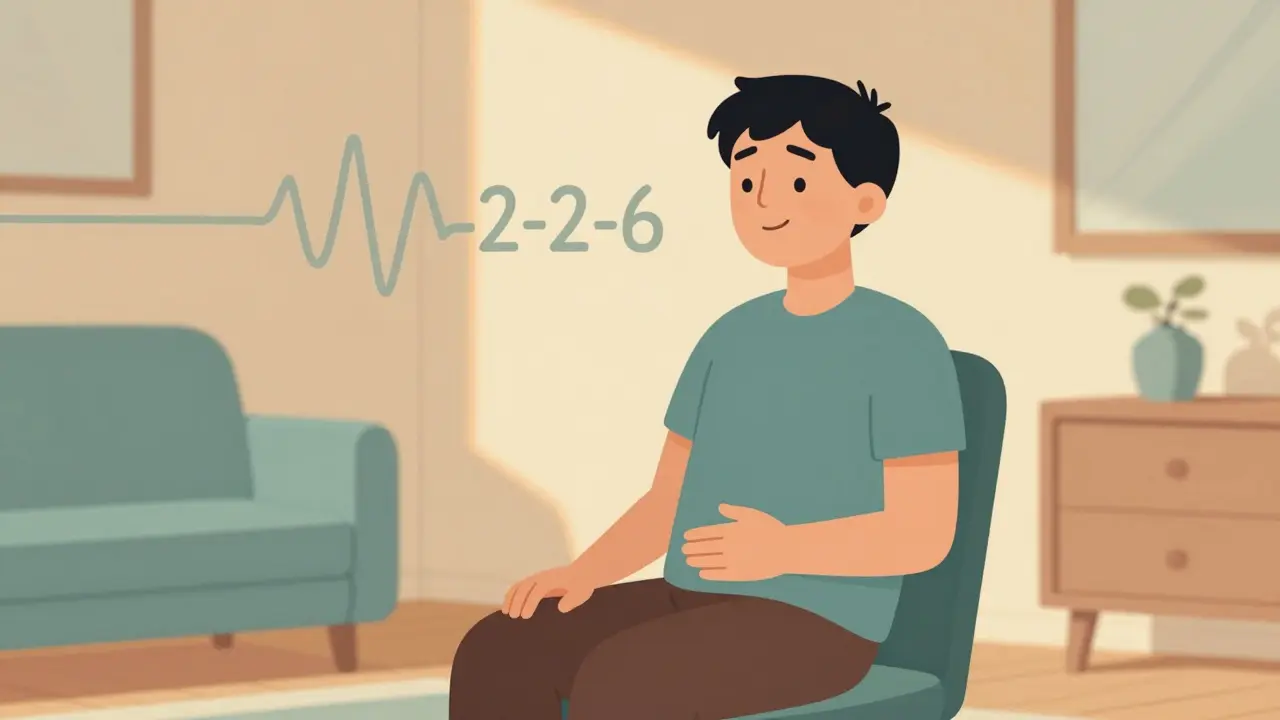
The 2-2-6 method is one of the most effective techniques. Breathe in through your nose for 2 seconds. Hold for 2 seconds. Then exhale slowly through your nose for 6 seconds. Pause briefly before the next breath. Repeat for 2 minutes. It sounds simple, but doing it during a panic attack? That’s the challenge.
Don’t wait until you’re in the middle of an attack to learn this. Practice it daily for 10 minutes-while sitting quietly, waiting in line, or before bed. Studies show that people who practice breathing exercises daily for eight weeks cut their panic attacks in half. Why? Because your body learns the rhythm. When panic strikes, your muscles remember what to do before your mind catches up.
Another popular option is the 4-7-8 technique: inhale for 4 seconds, hold for 7, exhale for 8. It’s not in every clinical guide, but Reddit’s r/anxiety community reports 78% of users find it works better than other methods. Try both. Keep the one that feels most natural.
Step 2: Grounding to Pull Yourself Back to Reality
During a panic attack, your mind spirals into catastrophic thoughts: "I’m having a heart attack," "I’m going to pass out," "I’m losing my mind." Grounding techniques help you reconnect with the present moment. They don’t stop the panic-they give you something real to focus on instead.
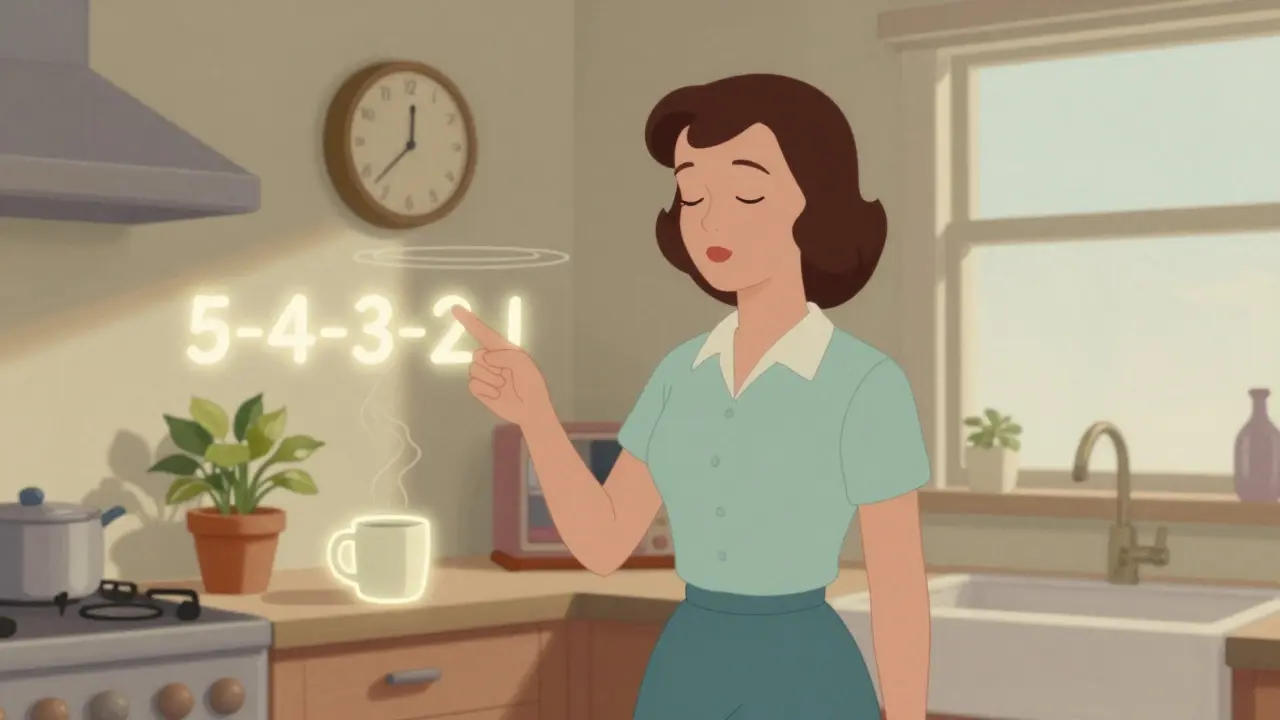
The 5-4-3-2-1 method is widely used and easy to remember:
- 5 things you can see (a lamp, your shoes, a crack in the wall)
- 4 things you can touch (your shirt, your phone, the chair, your own arm)
- 3 things you can hear (a fan, distant traffic, your breath)
- 2 things you can smell (coffee, soap, fresh air)
- 1 thing you can taste (your lips, toothpaste, or sip of water)
If that feels too complicated when you’re overwhelmed, try something simpler: focus on one object. Pick a pen, a tree outside the window, or a pattern on the carpet. Study it. Count the ridges. Notice the color shifts. Name every detail. This redirects your brain from panic to observation.
Another powerful tool? Personalized affirmations. Write down three short phrases that feel true to you: "I’m safe," "This will pass," "I’ve felt this before and I’m okay." Save them in your phone’s notes or carry them on a small card. When panic hits, read them aloud-even if you don’t believe them yet. Repeating them trains your brain to replace fear with facts.
Research from the Anxiety and Depression Association of America found that closing your eyes during an attack reduces symptoms by 32% in under 90 seconds. Why? Less visual input = less sensory overload. Try it next time. Sit down, shut your eyes, and focus on your breathing. You might be surprised how fast it helps.
Step 3: Medication-When and How to Use It
Medication isn’t a cure, but it can be a crucial bridge while you build long-term skills. Two types are commonly prescribed:
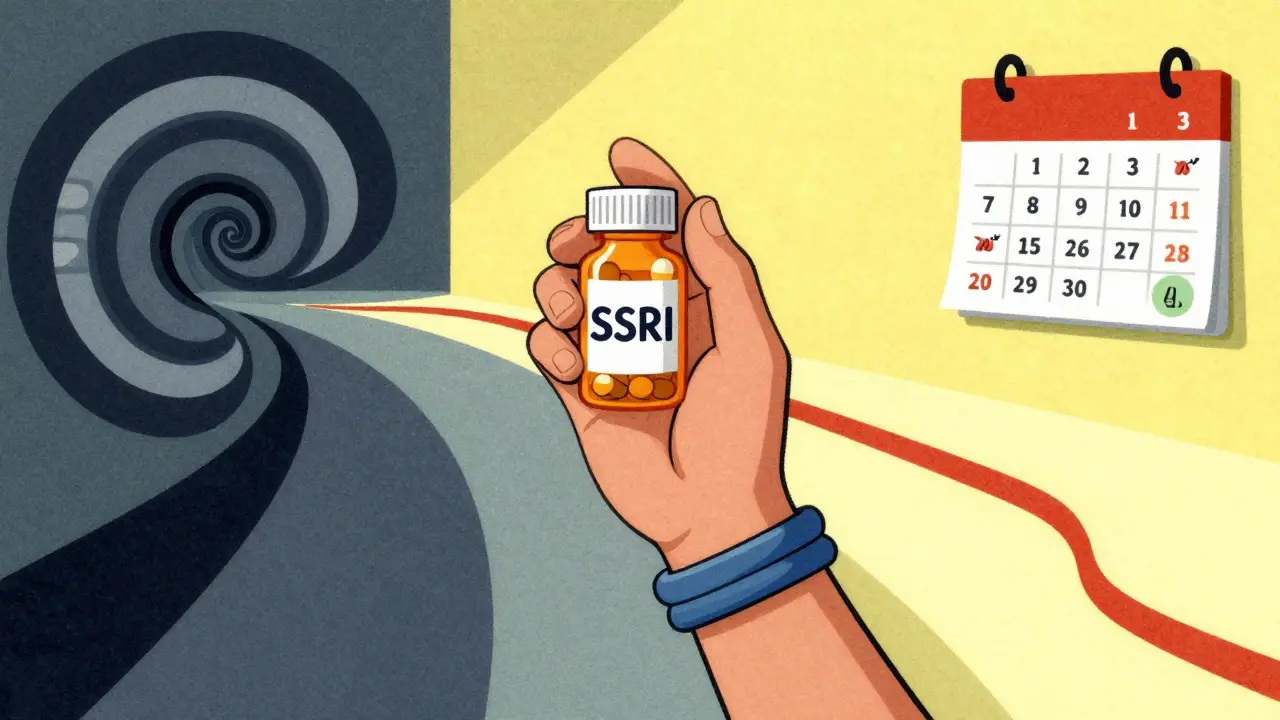
SSRIs (like sertraline and paroxetine) are first-line treatment. They don’t work overnight. It takes 6 to 12 weeks to see full effects. But once they kick in, they reduce panic frequency by 60-70%. Side effects like nausea or sleep issues are common at first-about 57% of users report them-but 79% stick with it because the long-term relief is worth it.
Benzodiazepines (like alprazolam and clonazepam) work fast-within 15 to 30 minutes. They’re great for emergencies. But here’s the catch: they’re not meant for daily use. The FDA reports that 23% of people who take them daily for 4-6 weeks develop tolerance. That means they stop working, and you need more to feel the same effect. Dependence is real. That’s why experts say: use them only when absolutely necessary, never as your only tool.
Studies from Kaiser Permanente show that combining medication with CBT gives you the best shot at recovery. People using both approaches had a 68% remission rate. Those using meds alone? Only 42%. Medication helps you survive the attack. CBT and breathing help you stop having them.
How to Build Your Own Action Plan
Here’s how to make this real:
- Choose one breathing technique and practice it daily for 10 minutes. Set a reminder.
- Write down three grounding statements. Keep them where you’ll see them: your wallet, phone lock screen, or bathroom mirror.
- If you’re considering medication, talk to your doctor. Track your panic attacks for two weeks-note when they happen, how long they last, and what you were doing. This helps your doctor decide if meds are right for you.
- Use an app like "Panic Relief" from UCSF. It offers guided breathing and grounding exercises. Over 1,850 users rate it 4.3 out of 5.
- Don’t wait for the next attack to try this. Practice when you’re calm. That’s when your brain learns the path.
Many people struggle to remember their plan during panic. One trick? Wear a rubber band on your wrist. Snap it gently when you feel the first signs of panic. The small pain snaps your attention back to the present. It sounds odd-but it works.
What to Expect in the First Few Weeks
You won’t fix this overnight. Most people take 2-3 weeks to get comfortable with breathing and grounding. Full control? That takes 8-12 weeks. That’s why consistency matters more than perfection.
Here’s what to expect:
- Week 1-2: You’ll still have attacks. But they might last 5-10 minutes less.
- Week 3-4: You’ll catch the panic earlier. Maybe you notice your heart racing before the fear hits.
- Week 5-8: You’ll use your breathing without thinking. Grounding will feel less forced.
- Week 9-12: Attacks become rare. When they do happen, you’ll feel more in control.
A Mental Health America survey found that people who used grounding statements for eight weeks cut their average panic attack length from 22 minutes to 14 minutes. That’s a huge win.
Common Mistakes to Avoid
- Only using techniques during panic. Practice when you’re calm.
- Believing you need to "stop" the panic. You don’t. You just need to ride it out.
- Using benzodiazepines too often. They can make long-term recovery harder.
- Waiting until it’s "bad enough" to get help. Early action prevents chronic panic.
- Comparing your progress to someone else’s. Everyone’s timeline is different.
One of the biggest barriers? Shame. People think they’re weak for having panic attacks. They’re not. They’re human. Your nervous system is overreacting. That’s biology-not weakness.
Final Thought: This Is a Skill, Not a Cure
You won’t wake up one day and never have another panic attack. But you will learn how to handle them without fear. You’ll know what to do. You’ll have tools. You’ll trust yourself. And that’s the real victory.
The World Health Organization says 73% of high-income countries now include panic attack action plans in primary care. That’s because they work. You don’t need a perfect plan. You just need a plan-and the courage to use it, even when it feels impossible.
Can you stop a panic attack once it starts?
Yes, you can reduce its intensity and shorten its duration. Breathing and grounding techniques don’t prevent panic attacks, but they help your body and mind return to calm faster. Most people notice improvement within 2-5 minutes of using these tools. The goal isn’t to make the panic disappear-it’s to stop it from controlling you.
Is medication necessary for panic attacks?
Not always. For many people, breathing and grounding alone are enough, especially if practiced daily. Medication is most helpful when attacks are frequent (more than twice a week), severe, or interfere with daily life. SSRIs are preferred for long-term management. Benzodiazepines should only be used occasionally as a rescue tool under medical supervision.
Why do grounding techniques work?
Panic attacks hijack your brain’s focus, trapping you in internal fear. Grounding techniques shift attention to external, neutral stimuli-like textures, sounds, or objects. This activates the parasympathetic nervous system, which calms your body’s fight-or-flight response. It’s like hitting a reset button on your panic circuit.
How long does it take to see results from breathing exercises?
You may feel calmer after just one session. But to rewire your brain’s response to panic, you need daily practice for at least 4 weeks. Studies show that after 8 weeks of 15-minute daily sessions, participants reduced panic attack frequency by nearly half. Consistency beats intensity every time.
Can you use these techniques if you’re on medication?
Absolutely. In fact, combining breathing, grounding, and medication gives you the best chance at long-term recovery. Medication helps manage symptoms, while behavioral techniques teach your brain to stop reacting. Research shows that 68% of people who use both approaches achieve remission, compared to 42% who rely on medication alone.
What if I forget my plan during an attack?
You’re not alone. Most people struggle with this. Keep reminders simple: a note on your phone, a bracelet, or a keychain with your grounding phrase written on it. Some people use a rubber band snap as a physical cue to start breathing. The goal isn’t perfection-it’s progress. Even one deep breath can make a difference.
Start small. Practice daily. Trust the process. You’ve already taken the hardest step-you’re looking for help. Now, take the next one: breathe, ground, and know that this doesn’t define you.



Chiruvella Pardha Krishna
14 February 2026 - 22:26 PM
The body doesn't lie. When it screams, it's not because you're weak-it's because your autonomic nervous system is stuck in a loop written by evolution for saber-toothed tigers. You're not having a heart attack. You're having a misfire. The real tragedy isn't the panic-it's how we've been taught to fear the fear itself. We treat symptoms like enemies when they're just messengers. The breathing, the grounding-it's not magic. It's neurology. You're retraining a reflex. Not curing a disease. Just returning to baseline. And baseline isn't perfect. It's just quiet.
Kaye Alcaraz
16 February 2026 - 07:52 AM
This is one of the clearest, most compassionate breakdowns I've seen on this topic. Thank you for not sugarcoating but also not scaring people. The 2-2-6 method is gold. I’ve used it for years and taught it to clients. Consistency is everything. Even five minutes a day builds neural pathways. You don’t need to be perfect. Just present. And if you’re reading this during a panic? Breathe. Just one cycle. Then another. You’ve got this.
Charlotte Dacre
18 February 2026 - 00:50 AM
Oh wow. A panic attack guide that doesn’t end with 'just love yourself more' or 'try crystals.' Revolutionary. I almost cried. Also, the rubber band trick? Genius. I’m stealing that. My therapist would be proud. Or maybe just confused. Either way, it works. Now if only the pharmaceutical reps would stop pushing benzos like candy…
Esha Pathak
19 February 2026 - 19:26 PM
Man, this hits different. I’ve been riding the panic rollercoaster since I was 14. The 5-4-3-2-1? I do it in the shower. I name the soap scent, the tile cracks, the way my hair sticks to my neck. It’s my ritual. Medication? SSRIs saved me. Took 11 weeks. Felt like I was slowly waking up from a coma. But the breathing? That’s when I felt like *me* again. Not the ghost. Not the panic. Just… me. And yeah, I use emojis sometimes. 😌
Mike Hammer
21 February 2026 - 10:10 AM
bro i used to think panic attacks were just anxiety being extra. then i had one in a subway and thought i was dying. turned out i was just breathing wrong. now i do the 2-2-6 while waiting for coffee. no one knows. i look chill. turns out your body just needs a little nudge to stop panicking. also the rubber band thing? i tried it. it works. weird as hell. but works.
Daniel Dover
23 February 2026 - 07:42 AM
Simple. Effective. No fluff. I’ve used all three pillars. Breathing first. Then grounding. Then meds when needed. No shame. This isn’t weakness. It’s strategy. You wouldn’t ignore a broken leg. Why ignore a misfiring nervous system? The 8-week timeline is real. I saw improvement at week 6. Not before. Patience isn’t passive. It’s active discipline. And yes, I’ve snapped a rubber band. Twice. It helped.
Mandeep Singh
24 February 2026 - 15:31 PM
Ugh. Another 'just breathe' article. Like that’s the solution to everything. Have you considered that panic attacks are a symptom of a broken society? Capitalism, social isolation, the erosion of community-this isn’t a personal failure. It’s systemic collapse. You can’t breathe your way out of wage slavery. You can’t ground yourself out of a culture that rewards burnout. This plan is a Band-Aid on a hemorrhage. But hey, at least it makes people feel better while the world burns. #ZenCapitalism
Josiah Demara
24 February 2026 - 19:58 PM
Let’s be real. 78% of Reddit users say the 4-7-8 works? That’s not science, that’s confirmation bias. And you cite 'studies' without linking them. Who funded them? Who were the subjects? 500 people in San Francisco? Also, benzodiazepines aren’t 'dangerous'-they’re misunderstood. 23% tolerance? So what? That’s not addiction, that’s pharmacokinetics. And you call SSRIs 'first-line'? Try telling that to someone who’s tried 3 different ones and still can’t get out of bed. This isn’t a guide. It’s a pamphlet for people who want to believe they can fix this with apps and rubber bands.
Sarah Barrett
26 February 2026 - 11:25 AM
I appreciate the nuance here. The distinction between medication as a bridge versus a crutch is vital. I’ve been on sertraline for 18 months. The first six were brutal. Nausea. Insomnia. Emotional numbness. But then, slowly, the panic attacks became… manageable. Not gone. But manageable. And the grounding? I keep a small stone in my pocket. Cold. Smooth. Real. I touch it when the world starts to spin. It’s not poetic. It’s practical. And that’s what matters.
Erica Banatao Darilag
27 February 2026 - 01:34 AM
i had a panic attack at work last week and i used the 5-4-3-2-1 thing and it helped a lot. i didnt even know i was doing it right until i read this. thank you. also i think the breathing thing is so simple but so hard to do when you’re scared. i practice when i’m calm now. it feels like building a muscle. and yeah, i use the rubber band too. it’s dumb but it works. sorry for the typos. i’m still shaking a little.
Joe Grushkin
1 March 2026 - 00:07 AM
Oh great. Another article that treats panic as a solvable equation. Breathing. Grounding. Medication. As if it’s a math problem and not a neurological earthquake. You think people don’t know how to breathe? We’ve been told this for decades. The real issue isn’t technique-it’s the fact that our culture pathologizes discomfort. We’re medicating existential dread with apps and wristbands. The solution isn’t in your lungs. It’s in your society. But hey, at least you can buy a $29.99 app to 'fix' it.
Virginia Kimball
2 March 2026 - 22:03 PM
I’ve been here. I’ve been that person shaking in a grocery aisle thinking I was dying. This plan? It saved me. Not overnight. But slowly. I started with 3 minutes of breathing a day. Then added grounding. Then got on SSRIs. Now? I have one attack a year. Maybe. And I don’t even panic about it anymore. That’s the real win. You stop fearing the fear. That’s the gift. Keep going. You’re not broken. You’re becoming.
Kapil Verma
4 March 2026 - 02:41 AM
India has the highest anxiety rates in the world. And yet we still treat mental health like a taboo. This article is a small revolution. Breathing? Grounding? Medication? Of course. But we also need to fix the system. Long hours. Low pay. No therapy access. No mental health days. You can’t breathe your way out of a 14-hour workday. But this? This is a start. Thank you for saying it plainly. No sugar. No shame. Just truth.
Michael Page
5 March 2026 - 05:05 AM
I’ve read this three times. Each time, I notice something new. The part about practicing when calm? That’s the key. I used to think I needed to 'fix' myself during an attack. Now I know I need to build the path when I’m steady. I keep the 2-2-6 rhythm on a sticky note by my bed. I don’t need to think. I just do it. It’s like muscle memory for the soul. Quiet. Consistent. Unseen. But there.
Betty Kirby
5 March 2026 - 13:20 PM
Medication is not a crutch. It’s a lifeline. I was on benzos for two years. I thought I was weak. Turns out, I was just scared. SSRIs took months. I cried through most of them. But now? I can go a week without a panic. Not because I’m 'stronger.' Because my brain chemistry changed. And that’s okay. Stop judging people who use meds. They’re not giving up. They’re fighting smarter.