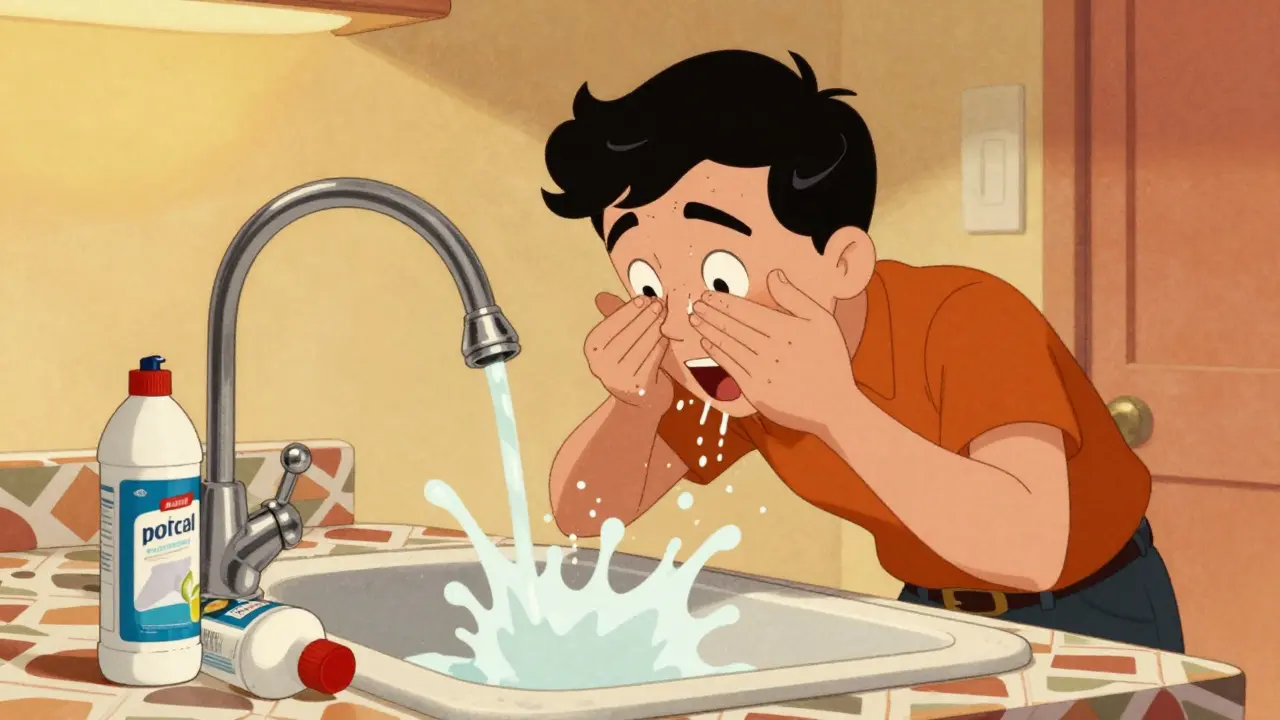
When a chemical splash hits your eye, every second counts. It’s not like a paper cut or a bruise-you don’t have time to panic, call someone, or check your phone. The damage starts in seconds. Alkalis like drain cleaner or ammonia can eat through your cornea before you even finish blinking. Acids like battery fluid burn, too, but they’re often easier to flush out. The difference between keeping your vision and losing it comes down to one thing: immediate irrigation.
Why Speed Is Everything
A 2017 study in the British Journal of Ophthalmology found that if you start flushing your eye within 10 seconds of a chemical splash, you cut your risk of permanent vision loss by 76%. That’s not a guess. That’s data from real cases. The longer you wait, the deeper the chemical goes. Alkalis, especially, keep moving inward like a slow-burning fuse. Sodium hydroxide (found in oven cleaners) can destroy the eye’s surface in under a minute. By the time you get to the ER, it might already be too late to save your sight.Most people don’t realize how fast this happens. A 2022 study of 1,247 workplace eye injuries showed that nearly 60% of victims waited more than a minute before doing anything. The average delay? Two minutes and 17 seconds. That’s enough time for irreversible damage. And it’s not just workers-kids spill cleaning products, cooks get vinegar in their eyes, gardeners get fertilizer splashed. This isn’t rare. It’s common. And it’s preventable.
What to Do Right Now
Here’s exactly what to do, step by step, whether you’re at home, at work, or in the garage:- Don’t rub. Rubbing pushes the chemical deeper and scrapes the surface. It’s instinctive, but it makes things worse.
- Turn your head sideways. Tilt your head so the injured eye is lower than the other one. This stops the chemical from running into your good eye.
- Hold your eyelids open. Use your fingers to gently pull your top and bottom eyelids apart. If you can’t do it yourself, have someone else help. The goal is to get water under your lids, not just on the surface.
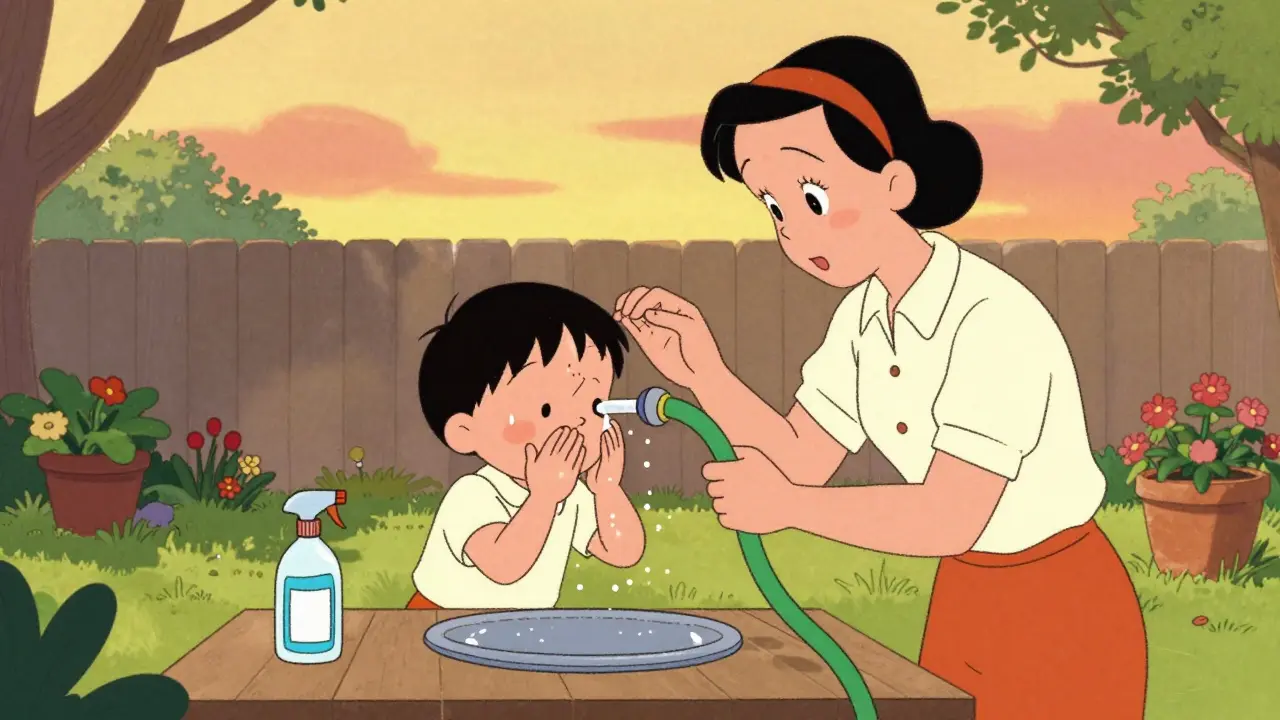
- Flush with cool water. Use the nearest source: a sink, shower, hose, or even a water bottle. Let it run continuously for at least 20 minutes. Don’t stop early. Don’t check if it’s better. Keep going.
- Remove contact lenses only if you can. If the lens is loose and you can slide it out without hurting your eye, do it. If it’s stuck or your eye is too swollen, leave it. Water will get under it anyway. The priority is flushing, not lens removal.
Some sources say 15 minutes. Others say 10. The American Red Cross says “until EMS arrives.” But the most reliable guidelines-like Healthdirect Australia and the updated ANSI Z358.1 standard-say 20 minutes. Why? Because chemicals don’t wash off like dirt. They bond. They react. They keep working. A 2023 study in Investigative Ophthalmology & Visual Science showed that 15 minutes of flushing left harmful residue in 37% of alkali cases. Twenty minutes dropped that to 9%.
What Not to Do
There are a lot of myths out there. Don’t fall for them.- Don’t use eye drops or saline unless you have no other option. Tap water works just as well as sterile saline. In fact, a 2020 study in JAMA Ophthalmology found no benefit to saline over plain water for initial flushing. Saline is nice to have, but it’s not magic. Water is everywhere.
- Don’t apply pressure. No squeezing, no bandages, no cotton swabs. You’re not cleaning a wound-you’re rinsing poison.
- Don’t wait to see if it hurts less. Pain doesn’t tell you how bad the damage is. Some chemicals numb the eye. That doesn’t mean it’s safe.
- Don’t use vinegar, baking soda, or other “neutralizers.” You don’t know what chemical you’re dealing with. Adding another substance could cause a reaction that makes it worse.
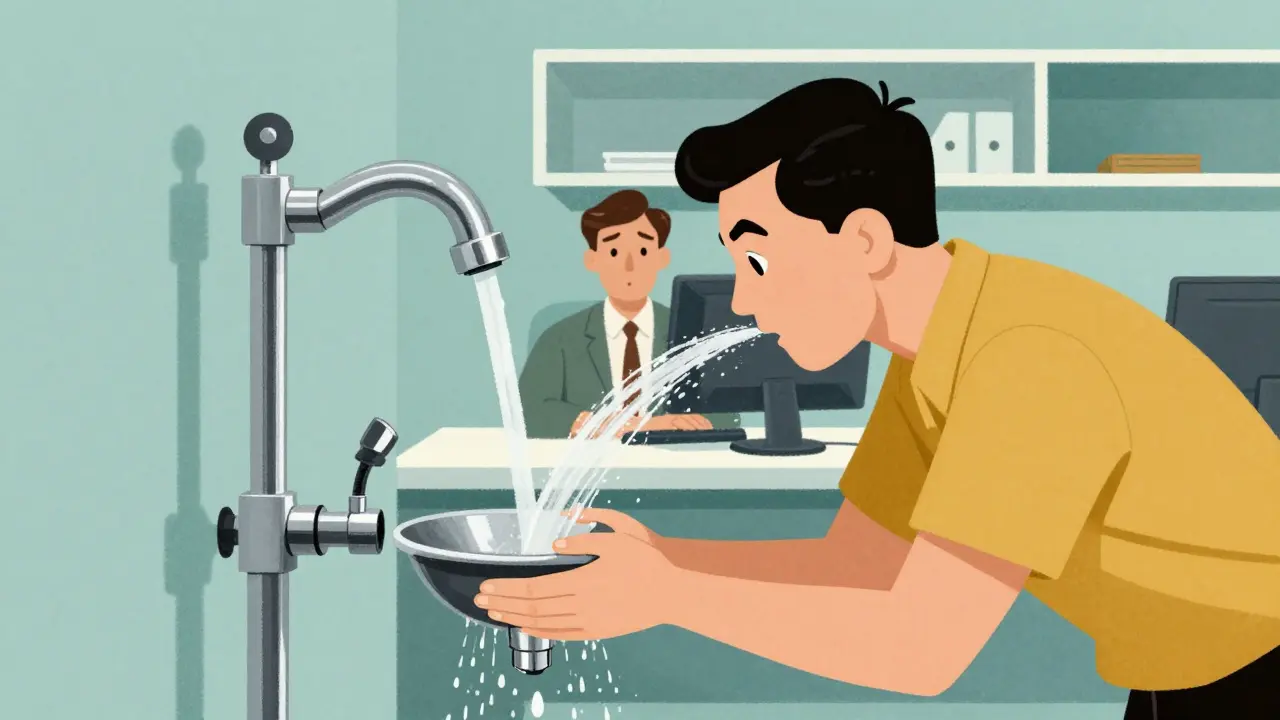
Workplace vs. Home: What’s Different?
If you work around chemicals, your workplace should have an ANSI Z358.1-compliant eyewash station. That means:- Water temperature between 60°F and 100°F (16°C-38°C)-not ice cold, not hot.
- Flow rate of at least 0.4 gallons per minute.
- Accessible within 10 seconds of the hazard.
- Activated with one hand, even if you’re wearing gloves.
But here’s the problem: a 2023 OSHA audit found that nearly 23% of facilities with chemical hazards didn’t have these stations where they were supposed to be. And even when they did, many employees had never used one. Training matters. People who’ve practiced flushing their eyes in a drill are 3.2 times more likely to do it right in a real emergency.
At home, you don’t need fancy equipment. A kitchen sink works. A shower works. A garden hose works. The key is volume and time. Don’t use a cup. Don’t dribble. Flood it.
What Happens After Flushing?
Even if your eye feels better after 20 minutes, you still need medical care. That’s non-negotiable. You might think the pain is gone, so it’s fine. But the damage could be under the surface. Corneal ulcers, scarring, glaucoma-they can develop hours or days later.Doctors will check your eye’s pH with litmus paper. If it’s not between 7.0 and 7.4 (neutral), they’ll keep flushing. They’ll look for corneal burns, measure pressure, and check for tissue death. In severe cases, you might need a corneal transplant. In 2023, Medicare data showed the average cost of one was $27,700. Prevention isn’t just about vision-it’s about money, too.
Workplace injuries cost U.S. employers $327 million a year. That’s not just medical bills. It’s lost workdays, lawsuits, training replacements. That’s why companies are spending more on safety gear, training, and eyewash stations. The global market for these devices is now $285 million and growing.
What’s New in Treatment?
There’s a new solution called Diphoterine, approved by the FDA in 2022. It’s not water-it’s a powder you mix with water that actively binds to chemicals instead of just washing them away. It can cut irrigation time by 40%. But it’s not for home use yet. It’s mostly in industrial settings and hospitals.Researchers are also testing citrate buffer solutions that neutralize alkalis faster than plain water. Smart goggles with built-in pH sensors are in testing by 3M. These could beep or flash when a chemical hits your eye, telling you to flush immediately.
But here’s the truth: none of that matters if you don’t flush right away. No gadget replaces the simple, brutal act of running water over your eye for 20 minutes.
How to Prepare
You can’t predict when a splash will happen. But you can prepare:- Know where your nearest water source is in every room you work in.
- Keep a bottle of water or a spray bottle in your toolbox, garage, or kitchen.
- Teach your kids what to do if they get cleaner in their eyes.
- Take a basic first aid course. The American Red Cross offers them in person and online.
- Check your workplace. Are the eyewash stations clean? Accessible? Functional?
Most people don’t think about eye safety until it’s too late. But this isn’t something you wait for a warning sign. It’s something you practice. Like fire drills. Like CPR. Your eyes are irreplaceable. Don’t gamble with them.
What if I only have a few seconds before I can start flushing?
Even if you’re delayed, start flushing as soon as you can. Every second still helps. A 2019 study showed that flushing after 30 seconds still reduced vision loss by 45% compared to waiting over 2 minutes. Don’t give up because you were slow-just act now.
Can I use bottled water or must it be tap water?
Bottled water is fine if it’s clean and you have no other option. But tap water is better because it’s flowing. A static bottle won’t flush effectively. You need continuous, high-volume flow. Use a sink, shower, or hose if possible.
Should I cover my eye after flushing?
No. Covering the eye traps heat and pressure, which can increase damage. Keep it open and exposed until you get to a doctor. A loose, clean cloth over the eye is okay only if you’re moving to a vehicle or ambulance-but don’t press on it.
Is it safe to flush both eyes at once?
Only if both eyes were exposed. If only one eye was splashed, flush just that one. Flushing the good eye risks transferring chemical residue or causing unnecessary discomfort. Keep the uninjured eye closed and protected while you flush the injured one.
How do I know if I need to go to the ER?
Go to the ER if you have any of these: blurred vision, intense pain that doesn’t improve, redness that spreads, sensitivity to light, or the feeling that something is still in your eye-even after flushing. You don’t need to wait for symptoms to get worse. If you’re unsure, go. It’s better to be checked than to risk permanent damage.



Roshan Joy
12 January 2026 - 08:33 AM
Just saved this for my toolbox. I work with batteries and cleaners - this is the kind of info you hope you never need, but will be so glad you read when you do. 🙏💧
Adewumi Gbotemi
12 January 2026 - 19:10 PM
Man, this is serious stuff. In my village, people use milk or urine to wash eyes after spill. No good. Water is the only thing. Thank you for this.
Michael Patterson
14 January 2026 - 12:24 PM
Okay so first off, I’m a retired industrial hygienist and let me tell you - this is basically gospel. But I gotta say, the part about not using vinegar? DUH. I’ve seen people pour apple cider on their eyes thinking it ‘neutralizes’ alkali. Bro. You’re not making a salad. Also, the 20-minute flush? Yeah, it’s brutal, but I’ve seen guys who only did 10 minutes end up with corneal grafts. Don’t be that guy. And don’t even get me started on people using eye drops like they’re putting lotion on their face. Water is free, it’s everywhere, and it doesn’t come with a label that says ‘may cause blindness if misused.’
Madhav Malhotra
15 January 2026 - 07:01 AM
Love how this breaks it down like a checklist. In India, we teach kids to run to the tap if something gets in their eyes - but nobody ever says ‘for 20 minutes.’ My uncle used to say ‘rinse till the burning stops’ - which is dangerous advice. This is exactly what we need in schools and workshops. Maybe we can translate this into Hindi and Tamil? Would help so many.
Jennifer Littler
16 January 2026 - 09:33 AM
Per ANSI Z358.1, the flow rate requirement is non-negotiable - 0.4 gpm is the minimum for effective decontamination. Anything less creates a false sense of security. Also, the pH neutralization window post-flush is critical; delayed medical intervention increases the risk of secondary inflammation cascades. The 20-minute protocol is evidence-based, not anecdotal. Please don’t confuse ‘feeling better’ with ‘healed.’
Jason Shriner
17 January 2026 - 02:07 AM
So let me get this straight… I’m supposed to sit there like a sad robot for 20 minutes while water pours into my eye… just because some guy in a lab said so? What if I’m at a party? What if I spilled wine? Is this what adulthood is now? Just… waiting? For water? Like a plant? 😔
Alfred Schmidt
18 January 2026 - 21:05 PM
THIS IS WHY PEOPLE DIE!! I’ve seen it!! My cousin lost his eye because he used a water bottle and thought 5 minutes was enough!! YOU DON’T KNOW WHAT’S IN THAT CHEMICAL!! YOU DON’T GET A SECOND CHANCE!! STOP BEING LAZY AND FLUSH FOR 20 MINUTES OR YOU’RE GOING TO BE BLIND AND THEN WHERE WILL YOU BE??!!
Vincent Clarizio
19 January 2026 - 17:19 PM
Think about it - your eyes are the only organ you can’t replace. You can get a new kidney, a new heart, even a new face - but your vision? That’s it. Once it’s gone, it’s gone. And yet we treat eye safety like it’s a suggestion. We put on gloves, we wear helmets, we use respirators - but we’ll squint through a chemical splash because ‘it’s just a little splash.’ That’s not bravery. That’s ignorance dressed up as toughness. The 20-minute flush isn’t a chore - it’s a ritual of self-preservation. Do it like you mean it.
Sam Davies
21 January 2026 - 06:13 AM
Oh, so now we’re supposed to believe that tap water is just as good as sterile saline? How quaint. I mean, I suppose if you’re living in a trailer park with no access to proper medical infrastructure, sure. But for anyone with actual standards - you’re basically asking for corneal erosion. And don’t even get me started on the ‘garden hose’ advice. That’s not irrigation, that’s assault.
Christian Basel
22 January 2026 - 04:19 AM
TL;DR - flush with water for 20 min. Everything else is noise. The rest of this is just citations dressed up as a TED Talk.
Alex Smith
24 January 2026 - 00:52 AM
Look, I know this feels like overkill - but here’s the thing: if you’re the kind of person who reads this and thinks ‘I’ll just wing it,’ then you’re the person who’s gonna need this advice the most. I’ve taught this to my kids, my coworkers, even my neighbor’s dog walker. Because you never know who’s gonna be the one holding the bottle of bleach when it tips over. And if you’re that person? You better know what to do. So go ahead - print this out. Tape it to your sink. Teach someone. Don’t just ‘hope for the best.’ Be the reason someone sees tomorrow.