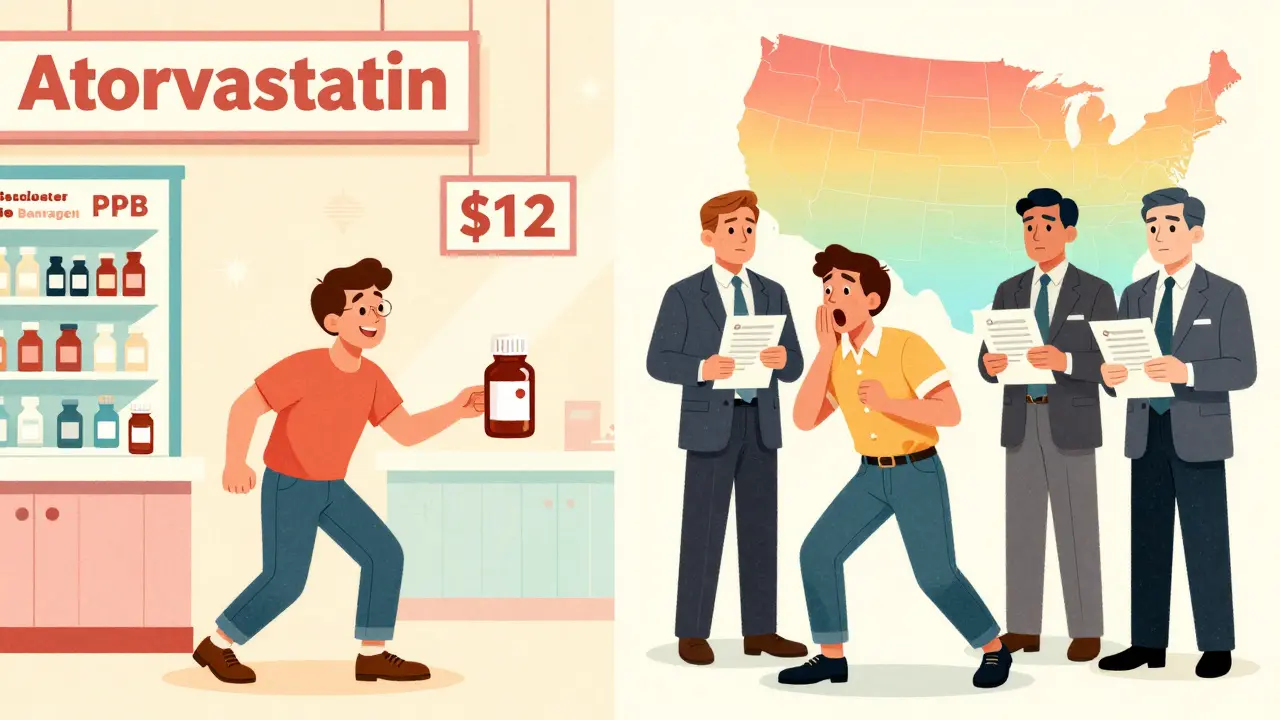
Ever bought a generic pill and been shocked by the price-only to find out your neighbor paid half as much for the exact same medicine? It’s not a mistake. It’s not a glitch. It’s the system. Generic drugs, which make up 90% of all prescriptions filled in the U.S., cost wildly different amounts depending on which state you live in. A 90-day supply of generic atorvastatin (the cholesterol drug) can run $12 in Texas and $45 in California-even with the same insurance. In rural areas, it might hit $80. Why? Because the rules, middlemen, and market forces that control drug prices aren’t national. They’re state-by-state. And that’s making some people pay way more than they should.
How the Same Pill Can Cost 300% More Just Across the Border
Look at GoodRx data from 2022: for the same generic drug, prices jumped up to 300% between neighboring states. That’s not inflation. That’s not supply chain issues. That’s pricing chaos. One state might require pharmacies to disclose what they pay for drugs. Another might let pharmacy benefit managers (PBMs) hide those numbers behind contracts no one can see. PBMs are the middlemen between insurers, pharmacies, and drugmakers. They negotiate prices, but they don’t always pass savings to you. In fact, research from the USC Schaeffer Center found that U.S. consumers overpay for generics by 13% to 20% because of how PBMs structure their deals. And those deals vary by state.Take Medicaid, the government program that covers low-income patients. Some states use the National Average Drug Acquisition Cost (NADAC) to set reimbursement rates for pharmacies. That’s a transparent, monthly average based on what pharmacies actually pay. Other states use older, less accurate benchmarks. The result? A pharmacy in Minnesota might get reimbursed $3.50 for a pill, while one in Florida gets $2.10 for the same thing. That difference doesn’t just affect the pharmacy-it affects what you pay out of pocket.
Why Cash Often Beats Insurance for Generics
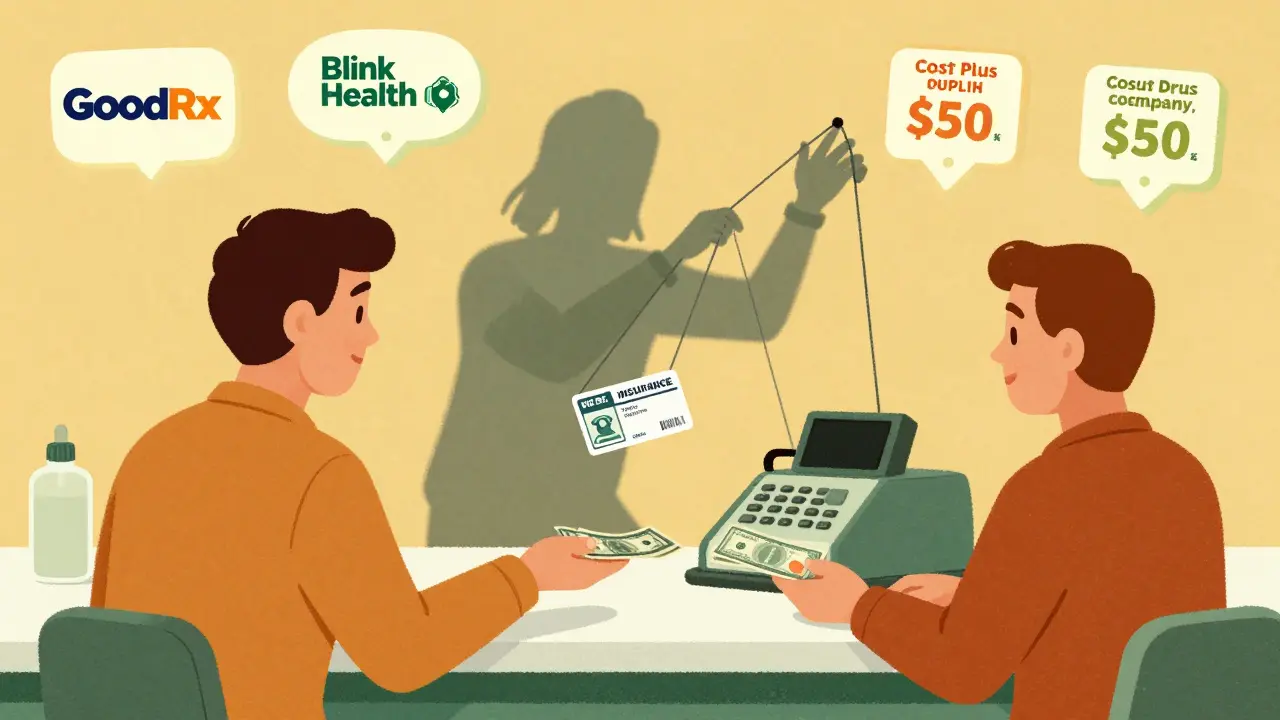
Here’s the twist: if you’re paying for a generic drug, your insurance might be making it more expensive. A 2021 study found that 4% of all U.S. prescriptions were paid in cash-and 97% of those were for generics. Why? Because for many people, paying cash through services like GoodRx, Blink Health, or Mark Cuban’s Cost Plus Drug Company saves 30% to 70% compared to using insurance.Here’s how it works: when you use insurance, the PBM sets a “copay” based on their own internal pricing, not what the drug actually costs. That copay can be $20, $40, even $60. But if you go to the pharmacy and pay cash, they might charge you just $10. That’s because the pharmacy is buying the drug at a wholesale price-often under $5-and marking it up just enough to cover overhead. Insurance doesn’t let you see that real price. Cash does.
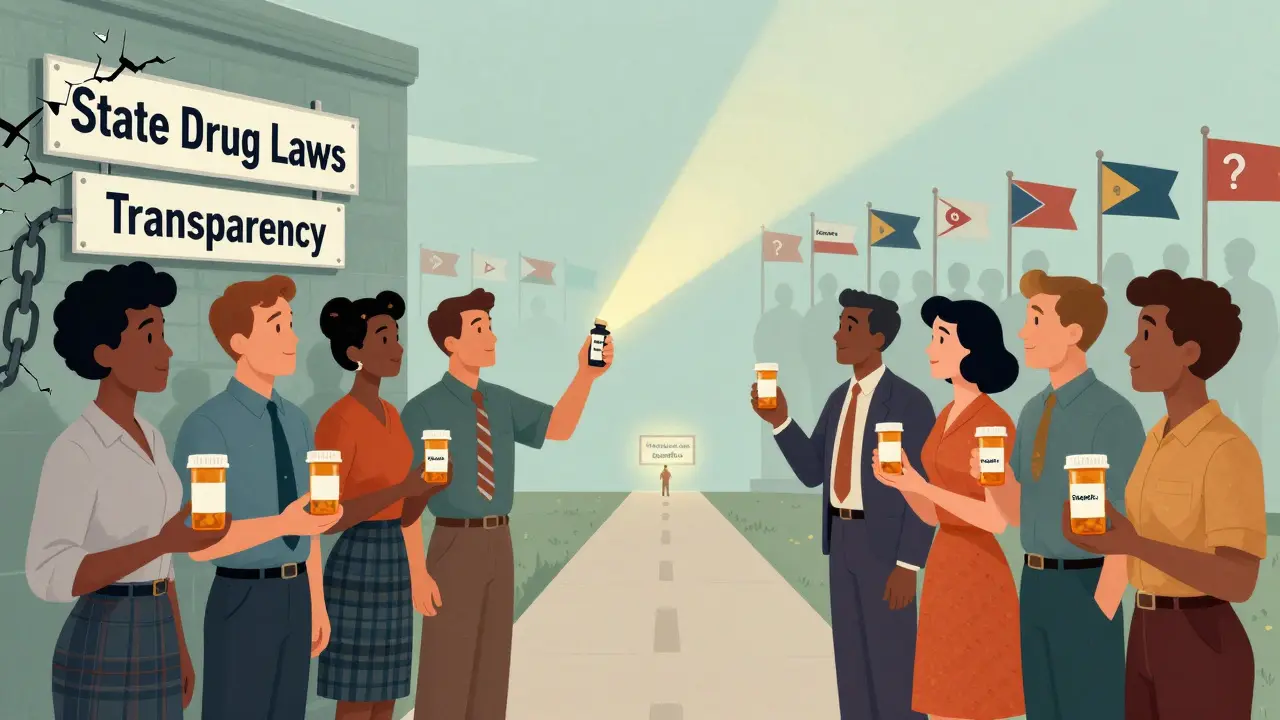
States with stronger transparency laws-like California, Vermont, and Maryland (before its law was struck down)-have seen patients pay 8% to 12% less for generics. But even in states without those laws, cash payment is often the smartest move. It’s not about being uninsured. It’s about bypassing a broken system.
The Legal Maze: Why States Can’t Just Cap Prices
You’d think a state could just pass a law to stop drug companies from charging too much. But the courts have blocked that idea. In 2018, a federal appeals court ruled Maryland’s law targeting generic drug price-gouging unconstitutional. Why? Because it interfered with interstate commerce. The Constitution gives the federal government control over trade between states. So even if a state wants to cap the price of a pill, it can’t legally force drugmakers or PBMs to comply if those companies operate across state lines.Other states tried similar moves. Nevada passed a law focused on diabetes drugs. But the lawsuit was dropped-not because it was weak, but because manufacturers and PBMs threatened to sue under the Defend Trade Secrets Act. That law lets companies protect their pricing formulas as trade secrets. So now, states are stuck. They can’t set price caps. They can’t force transparency. They can only nudge, study, and wait.
What’s Actually Changing-And What’s Not
The Inflation Reduction Act of 2022 brought some big changes-for Medicare patients. Starting in 2025, insulin will cost no more than $35 a month. There’s also a $2,000 annual cap on out-of-pocket drug costs for Medicare Part D enrollees. That’s huge. But here’s the catch: Medicare only covers 32% of total U.S. drug spending. That means 68% of people-working adults, younger folks, those without Medicare-are left out.And even for Medicare patients, the savings aren’t automatic. They depend on your state’s pharmacy network, which PBM you’re with, and whether your drug is on the formulary. Plus, the law only stops manufacturers from raising prices faster than inflation. It doesn’t touch the middlemen-the PBMs-who are the real drivers of price variation.
Meanwhile, 18 states have set up drug affordability boards as of 2023. These panels can review drug prices and recommend action. But they can’t force anyone to lower prices. Think of them as advisory committees with no teeth. They’re a step forward-but not a solution.
What You Can Do Right Now
You don’t have to wait for laws to change. You can take control today.- Always check GoodRx or SingleCare before paying. Enter your drug, your zip code, and compare cash prices across nearby pharmacies.
- If you’re paying cash, ask the pharmacist: “What’s your lowest price for this without insurance?” Sometimes they’ll drop it further.
- Switch to a mail-order pharmacy if your state allows it. They often have lower overhead and better pricing.
- If you’re on insurance and your copay is high, ask your doctor for a 90-day supply. Many insurers charge the same copay whether you get 30 or 90 pills-so you save money per pill.
- Look into patient assistance programs. Some drugmakers offer free or discounted generics to people who qualify based on income.
And here’s a pro tip: don’t assume your insurance is helping. Run the numbers. Pay cash once. Compare. You might be shocked.
The Bigger Picture: Why This Matters
Generic drugs are supposed to be the solution to high drug costs. They’re chemically identical to brand-name pills, but cost a fraction. In theory, competition should drive prices down. But in practice, the system is rigged. PBMs profit from opacity. Pharmacies are caught in the middle. Patients pay the price.The fact that generics make up 90% of prescriptions but only 18% of total drug spending tells you everything. Billions are being wasted on pricing games that have nothing to do with production, research, or quality. It’s all about who controls the data-and who gets to decide what you pay.
Some states are trying to fix it. Others are blocked. But until there’s federal action-or until enough people start paying cash and demanding transparency-the gap will stay wide. And you’ll keep paying more than you should.

RONALD Randolph
15 December 2025 - 21:37 PM
Let me get this straight-Americans pay more for generic pills because PBMs are crooked middlemen, and states can’t even cap prices? Of course not. The Constitution protects corporate greed. Shocking. Next you’ll tell me water is wet.
Benjamin Glover
15 December 2025 - 23:13 PM
Typical US chaos. In the UK, we have the NHS-prices are fixed, transparent, and fair. No GoodRx needed. You people invented capitalism, then forgot how to use it.
Raj Kumar
17 December 2025 - 01:49 AM
Yo, I’m from India and we get generics for like $0.10 a pill-same chem, same factory sometimes. But here? You’re getting roasted by middlemen who don’t even make the drug. It’s wild. Cash pays. Always check GoodRx. I learned this the hard way when my dad’s blood pressure med was $40 with insurance, $8 cash. Mind blown.
John Brown
17 December 2025 - 17:38 PM
This is such an important post. I never realized how broken the system is until I paid cash for my thyroid med-saved $50 a month. I told my whole family. We all use GoodRx now. It’s not about being uninsured-it’s about being smart. The system is rigged, but we can still win small battles.
Christina Bischof
18 December 2025 - 19:00 PM
I just checked my last prescription-$32 with insurance, $9 cash. I cried a little. Not because I’m upset-because I realized I’ve been letting them take advantage of me for years. Time to change.
Jocelyn Lachapelle
19 December 2025 - 02:32 AM
There’s hope. More people are waking up. I used to think insurance was my friend. Now I know it’s just a middleman with a fancy logo. Cash is power. And GoodRx? My new favorite app. 💪
John Samuel
19 December 2025 - 23:02 PM
While the structural inequities in pharmaceutical distribution are indeed lamentable, one must not overlook the role of regulatory arbitrage and the unintended consequences of state-level interventions. The federal preemption doctrine, as elucidated in the Maryland case, underscores the necessity for a unified, federally mandated pricing transparency framework-ideally codified under the Sherman Antitrust Act’s purview. Until such a framework is enacted, consumer empowerment via price comparison tools remains the most viable, albeit imperfect, bulwark against predatory PBM practices.
Sai Nguyen
21 December 2025 - 10:56 AM
Why do you think Americans are so dumb? You pay $45 for a pill? You’re not a victim-you’re lazy. Check prices. Use cash. Stop blaming the system. You chose this.
Michelle M
22 December 2025 - 19:56 PM
It’s not just about money-it’s about dignity. When you’re forced to choose between your meds and your rent, the system isn’t broken. It’s designed that way. But the fact that people are waking up? That’s the real revolution.
Nupur Vimal
24 December 2025 - 14:39 PM
Everyone says cash is better but nobody talks about how pharmacies are pressured by PBMs to not give cash discounts. I asked my local pharmacist and he looked scared. They’re caught between a rock and a hard place. This isn’t just about consumers-it’s about survival for small pharmacies too
Cassie Henriques
25 December 2025 - 19:31 PM
Wait-so if PBMs are the real villains, why hasn’t the FTC gone after them? They have the power. Is this just another case of regulatory capture? Also, has anyone looked into the PBM ownership chains? I read one study that said 3 companies control 78% of the market. That’s not competition. That’s a cartel. 🤔