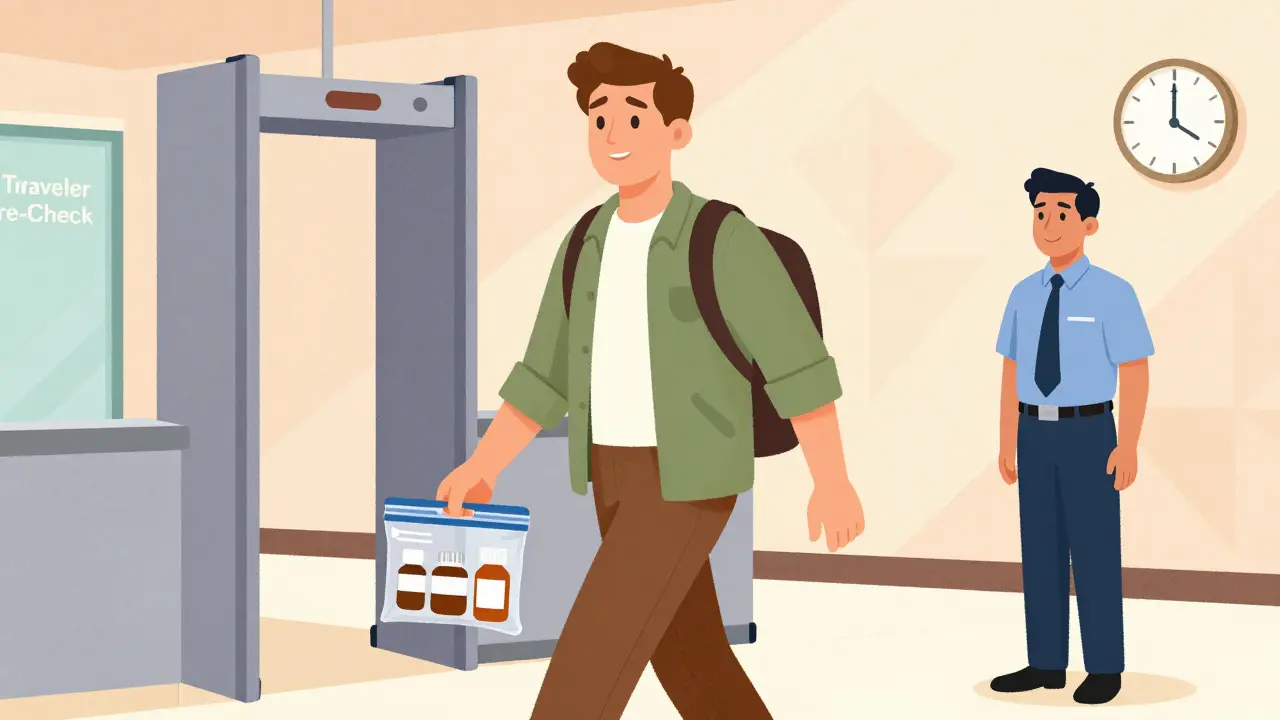
Traveling with liquid medications doesn’t have to be a nightmare. If you’re carrying insulin, chemotherapy drugs, EpiPens, or other essential liquids, you’re not alone. Millions of people fly every year with medically necessary liquids-and most of them breeze through security without issues. But if you don’t know the rules, you could end up stuck at the checkpoint for 20 minutes while an officer stares at your vials like they’re mystery boxes. The good news? The TSA has clear rules. The trick is knowing them-and how to use them.
What’s Allowed? Everything You Need, No Limits
Here’s the biggest myth busted right away: liquid medications are not subject to the 3.4-ounce (100 mL) rule. That rule? It’s only for your shampoo, toothpaste, and lotion. Medications? They’re in a whole different category. Prescription liquids-whether it’s a 10-ounce bottle of insulin or a 16-ounce bag of IV fluids-can go through security without being poured out. No bag. No size limit. Just declare them.
This exemption covers:
- Prescription liquids (insulin, liquid antibiotics, seizure meds)
- Injectables in pre-filled pens (EpiPens, glucagon kits)
- Prescription creams and gels (for eczema, psoriasis, etc.)
- Refrigerated liquids (even if they’re frozen solid)
And yes-even if you’re carrying more than you’d ever use on a weekend trip, it’s still allowed. TSA doesn’t care if you have enough medicine for a month. They care if it’s prescribed to you.
How to Pack It Right
Packing matters more than you think. One study found that 63% of delays in 2024 happened because someone put their meds in a random container. Here’s how to avoid that:
- Keep everything in its original pharmacy-labeled bottle. The label should show your name, the drug name, and the prescriber’s info.
- Don’t transfer pills or liquids into unlabeled containers. Even if it’s more convenient, TSA officers can’t verify it’s real medicine.
- Pack all medications in one clear, zip-top bag. Keep it separate from your 3-1-1 liquids bag. Put it in an outer pocket of your carry-on so you can grab it fast.
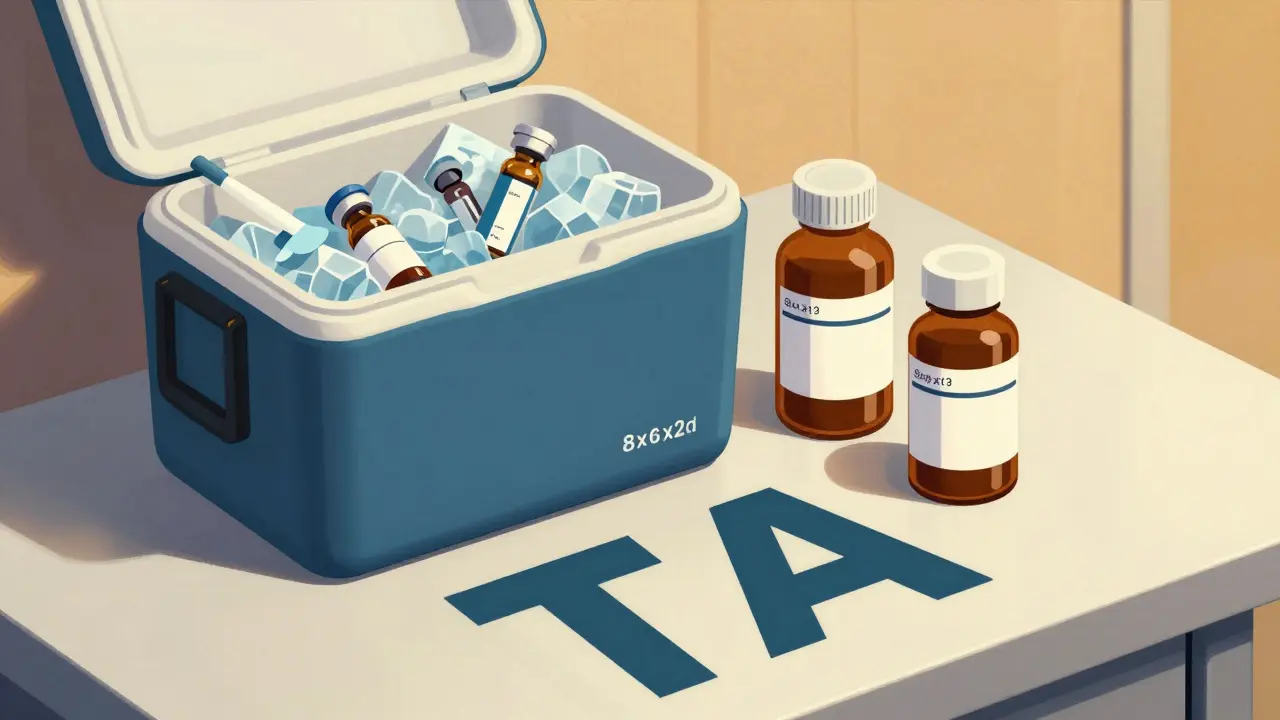
- If you’re carrying ice packs for refrigerated meds, make sure they’re not completely melted. Partially frozen is fine. Fully liquid? That’s a problem-declare it separately.
Pro tip: Use a small insulated cooler for insulin or other temperature-sensitive meds. The TSA allows coolers up to 8x6x2 inches. No dry ice. No liquid nitrogen. Just plain ice packs.
What to Say at the Checkpoint
Don’t wait for them to ask. As soon as you walk up to the security lane, say: “I have liquid medications that need to be screened.” Say it clearly. Say it early. This alone cuts your screening time in half.
Officers are trained to handle this-but not every officer sees it daily. If they look confused, calmly explain: “TSA allows medically necessary liquids without size limits. They just need to be declared.” You can even show them the TSA website on your phone if needed.
Request a visual inspection if you’re worried about X-rays. You can ask: “Can you inspect this visually instead of putting it through the machine?” They’re required to honor that request. It’s faster, and it protects sensitive meds from radiation.
What About Controlled Substances?
If you’re carrying opioids, benzodiazepines, or other controlled substances, bring documentation. Not just a prescription bottle-bring a printed copy of your prescription or a letter from your doctor. It’s not always required, but it prevents delays. In 2024, 41% of delays involving controlled substances were due to missing paperwork.
And yes-this includes medical cannabis. Even if it’s legal in your state, federal law still bans it on planes. TSA doesn’t actively search for it, but if they see it during screening, they’ll refer you to law enforcement. Don’t risk it. Leave it at home.
Real-World Scenarios: What Actually Happens
Travelers report wildly different experiences. One person in Chicago had their 100mL insulin vials screened in under two minutes. Another in Atlanta got held up for 22 minutes because the officer didn’t recognize a glucagon kit. Why? Training varies.
Here’s what works:
- 98% of TSA officers say original labels make screening easier.
- Travelers who declare meds upfront go through 92% faster, according to Johns Hopkins research.
- 89% of people who kept meds in labeled bottles had zero issues.
- Only 43% of those who used pill organizers or unmarked containers made it through without a hassle.
It’s not about how much you have. It’s about how clearly you show what it is.
What’s Changing in 2025 and Beyond
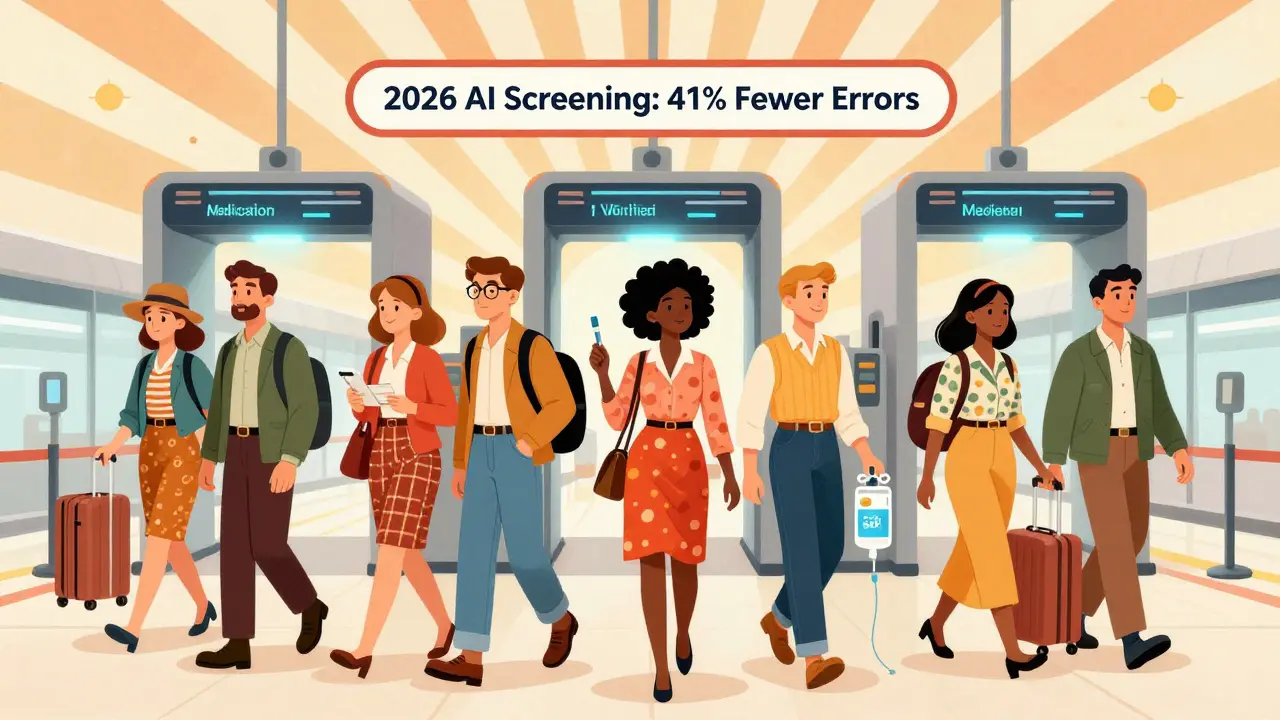
The TSA is making this easier. In September 2025, they’re launching a pilot program called Medical Traveler Pre-Check. If you fly often with meds, you can sign up ahead of time. Registered travelers will get a special lane with faster screening-target time: 1.1 minutes, down from the current average of 3.2 minutes.
By late 2026, 50 major airports will use AI tools to automatically identify liquid medications. Early tests in Dallas cut screening errors by 41%. That means fewer confused officers and fewer delays.
And the demand is growing. In April 2025, TSA processed nearly 3 million liquid medication declarations. That’s up 17% from last year. More people are using injectable meds-insulin, GLP-1 drugs, biologics-and the system is adapting.
What to Bring: The Checklist
Before you leave, make sure you have:
- All medications in original labeled containers
- A printed list: drug names, dosages, prescribing doctor, prescription numbers
- A digital copy of your prescriptions (saved on your phone)
- A separate clear bag for meds (not mixed with toiletries)
- Ice packs (if needed) - not fully melted
- Doctor’s letter (for controlled substances)
That’s it. No need for a notarized letter. No need for a medical ID card. Just clear labeling and clear communication.
What Not to Do
- Don’t hide your meds. If you try to sneak them through, you’ll get flagged.
- Don’t put them in checked luggage. If your bag gets lost, you’re stranded.
- Don’t rely on airport pharmacies. They don’t sell insulin or EpiPens on the spot.
- Don’t wait until you’re at the checkpoint to organize your stuff. Do it at home.
Most delays happen because people are unprepared-not because the rules are unfair.
Can I carry more than 3.4 ounces of liquid medication?
Yes. Liquid medications for medical use are exempt from the 3.4-ounce (100 mL) limit. You can carry as much as you need, as long as it’s prescribed to you and declared at security. This includes insulin, chemotherapy fluids, and other essential liquids.
Do my medications need to be in original bottles?
Yes, strongly recommended. Over 63% of 2024 delays were caused by unlabeled containers. TSA officers need to verify the medication matches your prescription. Original pharmacy labels with your name and doctor’s info make this quick and easy.
Can I bring ice packs for my insulin?
Yes. Frozen or partially frozen ice packs are allowed. If they’ve melted completely, you must declare them as liquid medication. Keep them in a sealed cooler under 8x6x2 inches. No dry ice or liquid nitrogen.
What if a TSA officer doesn’t know the rules?
Stay calm. Politely say, “TSA allows medically necessary liquids without size limits. They just need to be declared.” You can show them the TSA.gov website on your phone. Most officers will call a supervisor if unsure-this is a common situation.
Can I bring medical cannabis on a plane?
No. Even if legal in your state, cannabis is still federally prohibited. TSA agents are not required to report it, but if they see it during screening, they must refer you to law enforcement. Leave it at home.
Do I need a doctor’s note for my medications?
Not always, but it’s smart. For controlled substances like opioids or sedatives, bring a printed prescription or doctor’s letter. It prevents delays and questions. For insulin or antibiotics, the original label is usually enough.




Paul Cuccurullo
21 March 2026 - 14:32 PM
Just wanted to say thank you for this incredibly thorough breakdown. As someone who travels monthly for work and manages chronic illness, I’ve had my share of awkward TSA moments. This guide should be mandatory reading for anyone carrying meds-no joke. I’ve seen people get turned away for having insulin in a Ziploc, and it breaks my heart. You’ve turned panic into peace.
Thank you for the clarity. You didn’t just write an article-you wrote a lifeline.
Allison Priole
22 March 2026 - 20:24 PM
lol i just put my insulin in my purse and walked right through at lax last week and the officer didnt even blink. like, maybe the rules arent that hard? maybe we just overthink it? i mean, i didnt even use the bag. just the bottle. and i said 'meds' and they waved me on. chill out people lol
Casey Tenney
24 March 2026 - 19:30 PM
Anyone who doesn’t follow the original bottle rule is asking for trouble. This isn’t a suggestion-it’s a rule for a reason. If you’re too lazy to keep your meds labeled, don’t be surprised when you get held up. Stop being entitled and start being responsible.
Sandy Wells
25 March 2026 - 10:12 AM
Interesting. But honestly I think the whole system is overcomplicated. Why do we need to declare anything? Why not just let people carry what they need? The government shouldn’t be involved in medical logistics. I’ve never had an issue with unmarked bottles. Maybe the real problem is TSA overreach?
Thomas Jensen
26 March 2026 - 22:57 PM
Wait wait WAIT. So you’re telling me the TSA is using AI to identify meds now? And they’re gonna have a special lane? That’s not a pilot program-that’s a surveillance rollout. Who’s training the AI? What data is it using? Are they building a database of diabetic patients? Are they cross-referencing with insurance records? Did you know they’ve been scanning prescription labels since 2022 under ‘Project MedTrack’? I’ve got sources. This isn’t convenience-it’s control. And they’re coming for your insulin next. You think you’re safe? Think again.
Bring a Faraday bag. And a backup EpiPen. And a lawyer.
trudale hampton
28 March 2026 - 05:36 AM
I’ve been flying with my GLP-1s for two years now. Original bottle? Check. Separate bag? Check. Declared upfront? Always. And yeah-it’s been smooth every time. Honestly, the biggest thing is just being calm and prepared. TSA agents are people too. They don’t want to hassle you. If you’re cool, they’re cool. This guide nails it. I’m saving this for my next trip.
Natali Shevchenko
28 March 2026 - 15:33 PM
There’s something deeply human about the way we treat medical necessity as a loophole to be navigated. We don’t ask for permission to breathe, yet we’re expected to justify our survival in line at security. The fact that we need a checklist for basic dignity says more about our society than it does about TSA policy.
I carry my medications not because I’m afraid of being stopped, but because I’ve learned how fragile systems are. The label isn’t just proof-it’s armor. And the officer who says ‘thank you for declaring it’? That’s the moment you realize: we’re all just trying to get home safely.
Nicole James
29 March 2026 - 06:46 AM
Wait… so… if the TSA is using AI to identify meds… and they’re collecting data… and they’re tracking who has insulin… and they’re building a database… and they’re linked to federal databases… and they’re using facial recognition… and they’re cross-referencing with pharmacy records… and they’re sharing with ICE… and they’re using this to flag ‘non-compliant’ patients… and they’re using predictive analytics to determine ‘medication risk profiles’… then… then… this isn’t about security… this is about control… this is about… this is… oh my god… I think I’m going to cry…
Nishan Basnet
30 March 2026 - 21:53 PM
As someone from India who travels to the US often with my dad’s insulin, I want to say this guide saved us. Last year, we got held up in Houston because the officer didn’t understand our Indian pharmacy label. This time, I printed the TSA guidelines in English, laminated them, and put them in the bag. We breezed through. The system works-if you speak its language. Thank you for making the invisible rules visible.
Bryan Woody
31 March 2026 - 08:17 AM
Let me guess-you’re the kind of person who brings a 10-page printout of your prescriptions and a notarized letter from your great-aunt who’s a nurse? Nah. Just bring the bottle. Say ‘meds.’ Walk through. Done. Stop making this a performance. You’re not a TSA auditionee. And for god’s sake, if you’re carrying a 16oz bag of IV fluids, don’t act like you’re smuggling nuclear waste. It’s medicine. Not contraband.
Also-AI? Please. It’s just a fancy scanner. Stop letting conspiracy podcasts make you paranoid. You’re not being tracked. You’re just being helped.
Chris Dwyer
31 March 2026 - 20:17 PM
Hey-this is gold. Seriously. I’ve got a cousin with type 1 diabetes and she used to dread flying. After I shared this with her, she flew to Florida last month and had zero stress. She even took a photo of herself at security with her insulin and wrote: ‘I didn’t have to explain myself.’ That’s the win. This isn’t just info-it’s empowerment. Share this with everyone you know who needs it. We’ve got each other’s backs.
Timothy Olcott
2 April 2026 - 05:11 AM
USA! USA! USA! 🇺🇸 If you’re a real American, you follow the rules. Original bottle? Check. Declare? Check. No drama? Check. If you can’t handle that, maybe you shouldn’t fly. We don’t need drama on planes. We need discipline. And if you’re bringing medical cannabis? That’s not medicine-that’s treason. 🚫🌿