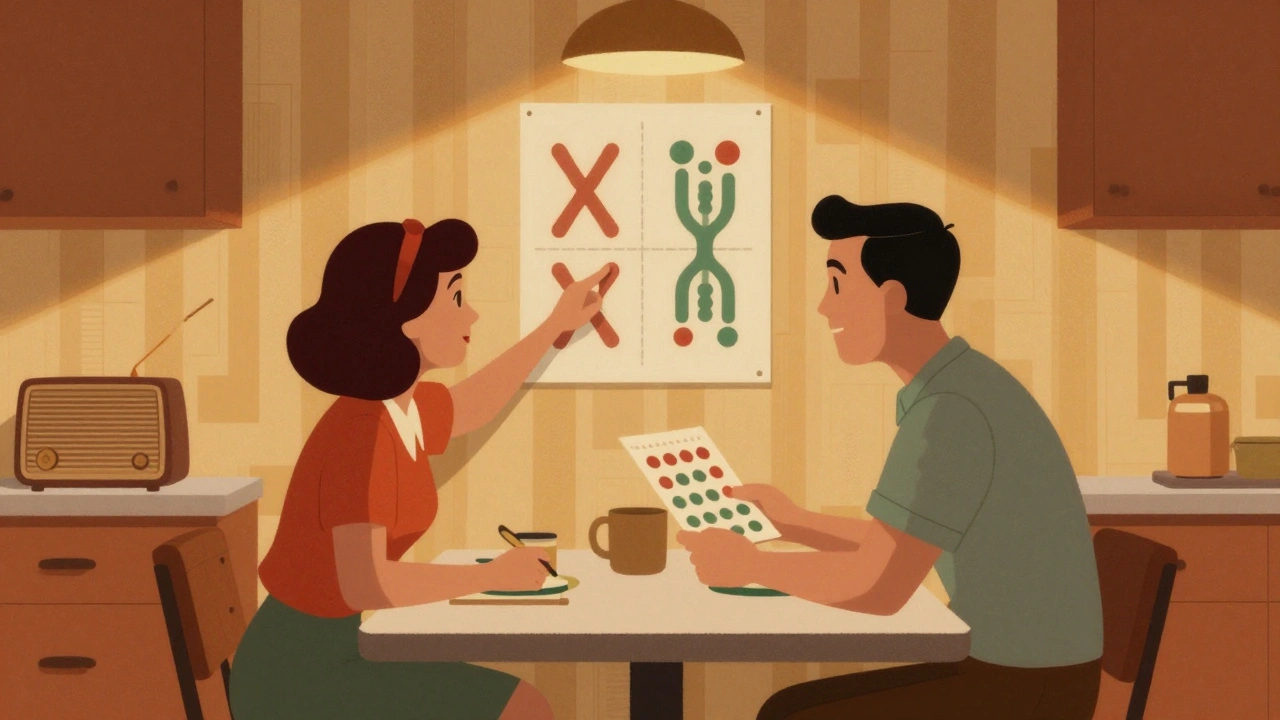
Most people think color blindness means seeing the world in black and white. That’s not true. For the vast majority of people with color vision problems, it’s about red-green color blindness-a condition where distinguishing between reds, greens, browns, and oranges becomes tricky. It’s not blindness. It’s a mismatch in how your eyes process certain wavelengths of light. And it’s not random. It’s passed down through genes, mostly from mom to son.
Why Men Are More Likely to Be Color Blind
If you’re male, you have about a 1 in 12 chance of being red-green color blind. If you’re female, that drops to about 1 in 200. Why such a big gap? It’s all about chromosomes.
Men have one X and one Y chromosome. Women have two X chromosomes. The genes that control red and green color vision sit on the X chromosome. If a man inherits a faulty version of one of these genes, he has no backup. His Y chromosome doesn’t carry a replacement. So he’s affected.
Women, on the other hand, have two X chromosomes. Even if one carries the faulty gene, the other one might still work fine. That means they usually don’t show symptoms. Only if both X chromosomes carry the defect-something that’s rare-will a woman have noticeable red-green color blindness.
This is why you see more men with this condition. It’s not about strength, health, or environment. It’s pure genetics.
The Science Behind the Colors
Your eyes have three types of cone cells that detect color: one for red, one for green, and one for blue. Red-green color blindness happens when the red or green cone pigments don’t work right-or are missing entirely.
The gene for the red pigment is called OPN1LW. The gene for green is OPN1MW. Both sit on the X chromosome, right next to each other. Because they’re so close, they sometimes get mixed up during sperm or egg formation. That’s when a gene copy gets deleted, duplicated, or swapped. The result? A messed-up pigment that can’t tell red from green properly.
There are two main types of full color blindness here:
- Protanopia: No functional red pigment. Reds look dark or brownish. Greens and yellows can look similar.
- Deuteranopia: No functional green pigment. Reds and greens look muddy. This is the most common form.
But most people don’t have full color blindness. They have anomalous trichromacy-meaning they still have three pigments, but one is slightly off. Deuteranomaly, a mild version of green pigment trouble, affects about 5% of men. That’s one in every 20 men you know.
How It’s Passed From Parent to Child
Let’s say a man has red-green color blindness. He passes his faulty X chromosome to all his daughters-but none of his sons. Why? Because sons get his Y chromosome, not his X.
So his daughters become carriers. They usually see color normally, but they can pass the gene to their kids. If a carrier woman has a son, there’s a 50% chance he’ll be color blind. If she has a daughter, there’s a 50% chance she’ll be a carrier.
Here’s how it breaks down:
- Color blind father + normal mother: All sons see color normally. All daughters are carriers.
- Carrier mother + normal father: 50% of sons are color blind. 50% of daughters are carriers.
- Color blind father + carrier mother: 50% of sons are color blind. 50% of daughters are carriers. 50% of daughters are color blind.
This is why you often see color blindness skip a generation. A grandfather passes it to his daughter (who doesn’t show it), and she passes it to her son.
What It Actually Feels Like
People with red-green color blindness don’t see the world in grayscale. They see colors-but the boundaries between reds and greens blur. A ripe tomato might look like a green pepper. A red fire truck might blend into a green bush. Green grass can look brownish in low light.
One engineer on Reddit said he once wired a circuit board wrong because he mixed up red and green wires. He now labels every wire with numbers.
Another person, a pilot applicant, was turned down because he couldn’t pass the color vision test-even though his vision was 20/20. He could see fine, just not the colors.
For many, it’s not a crisis. It’s a quirk. But it shows up in unexpected places:
- Reading color-coded graphs in school
- Telling ripe from unripe fruit
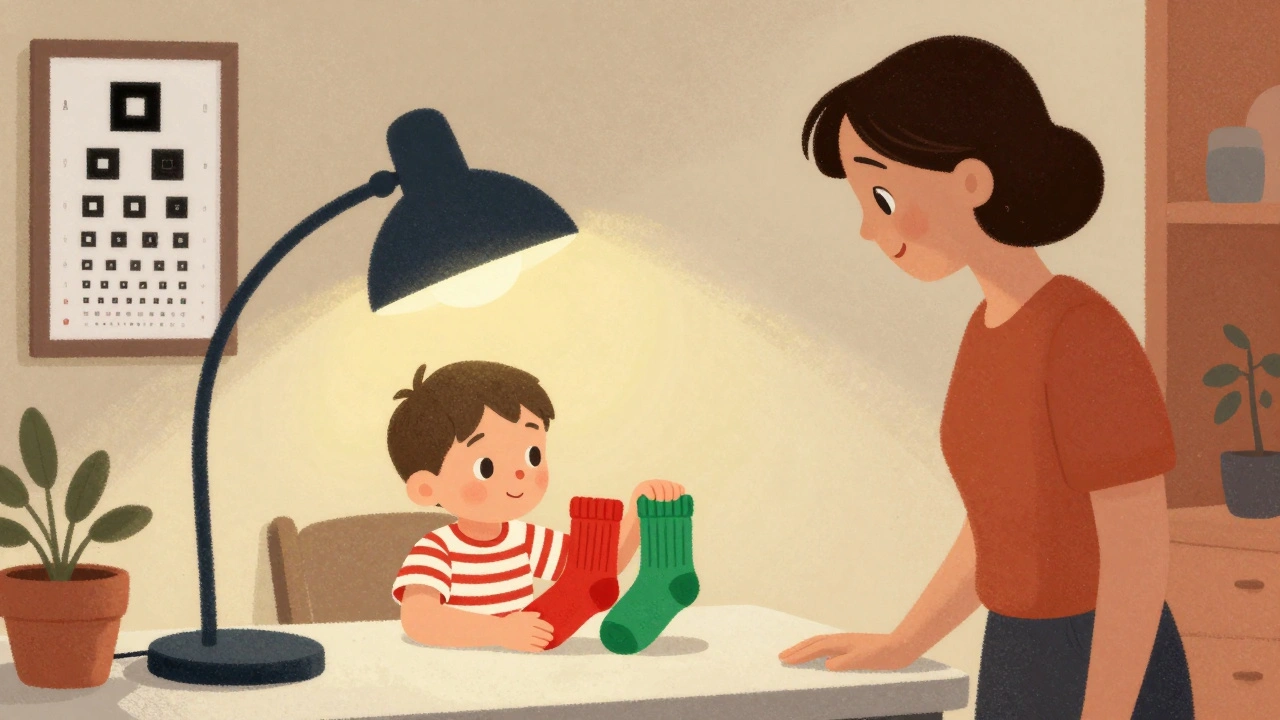
- Matching socks or clothes
- Understanding traffic lights when they’re foggy or dim
A 2022 survey found that 78% of people with red-green color blindness struggled with color-coded learning materials. That’s not just inconvenient-it’s unfair if schools don’t adapt.
Testing and Diagnosis
The most common test is the Ishihara test. It’s those plates with colored dots forming numbers. People with normal color vision see a 5. Someone with deuteranopia might see a 2-or nothing at all.
But Ishihara isn’t perfect. It only catches the most obvious cases. More advanced tests, like the Farnsworth-Munsell 100 Hue Test, can detect subtle differences. These are used in jobs where color accuracy matters-like electricians, pilots, or graphic designers.
There’s no blood test or DNA scan routinely done for this. It’s usually caught in childhood during school screenings or when someone makes a consistent mistake with colors.
Tools and Adaptations
You can’t fix the genes. But you can work around them.
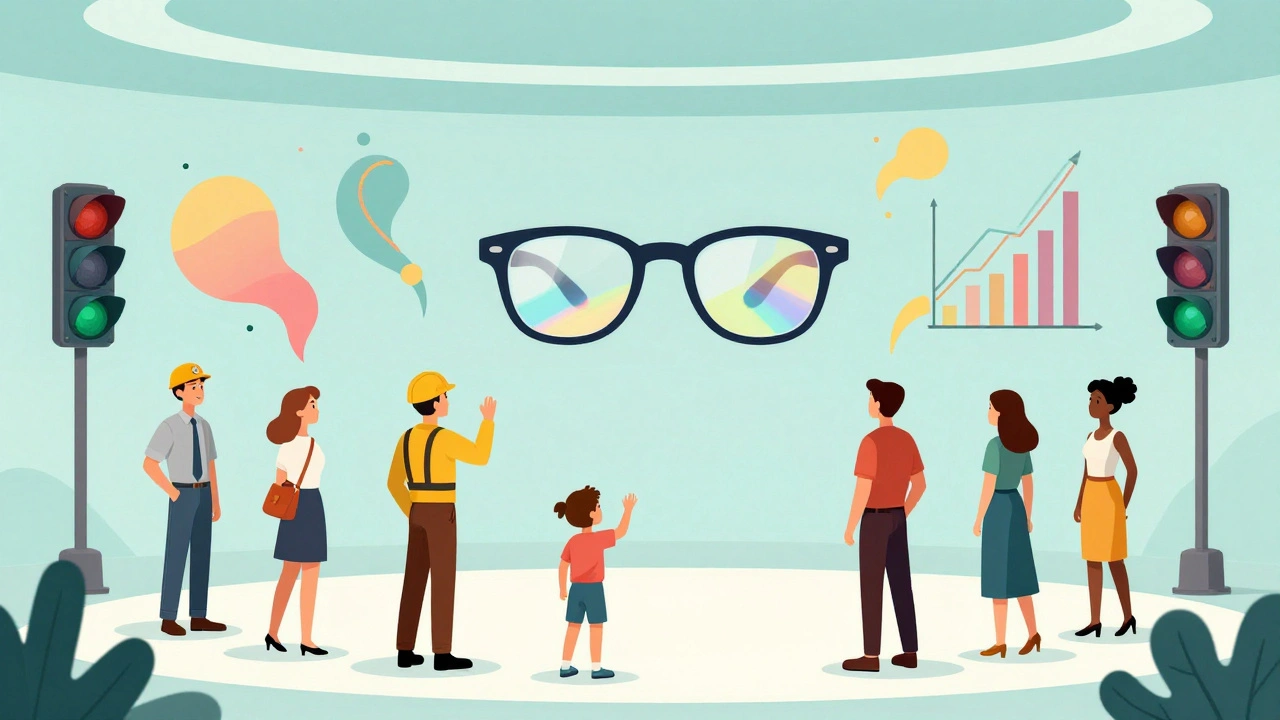
EnChroma glasses cost around $350-$500. They don’t cure color blindness. But they filter out certain wavelengths to make reds and greens pop more. About 80% of users report improved color distinction-especially in outdoor settings. They work best for deuteranomaly.
Digital tools help too. Apple and Windows have built-in color filters that shift hues so reds and greens stand out. The free Color Oracle app lets designers simulate how their websites look to colorblind users. Adobe Photoshop has a plugin called Colorblindifier-downloaded over 45,000 times-that lets you preview designs through the eyes of someone with protanopia or deuteranopia.
And there’s ColorADD, a universal symbol system developed in Portugal. It uses simple shapes-like triangles or circles-to label colors. Now used in 17 countries, it’s on public transit maps, school supplies, and even packaging.
What Doesn’t Work
There’s no cure. No eye drops. No supplements. No magic pill.
Some companies sell “color vision supplements” claiming to restore color. These are scams. No study has ever shown vitamins or herbs can fix a genetic defect in cone cells.
And while gene therapy has worked in monkeys-restoring full color vision for over two years-it’s still experimental in humans. The National Eye Institute is funding research, but don’t expect a treatment anytime soon.
Living With It
Most people with red-green color blindness lead full, normal lives. They adapt. They learn. They use labels, patterns, brightness, and technology.
One graphic designer said learning to rely on contrast instead of hue made her work better. She now designs websites that are easier for everyone to read-not just colorblind people.
And here’s the thing: color blindness isn’t a disability unless society makes it one. If your job requires color discrimination and no accommodations are made, that’s the problem-not you.
Legally, in places like the UK and EU, employers must make reasonable adjustments. That means labeling wires, using patterns on graphs, or letting you use color filters on your screen.
It’s not about fixing the person. It’s about fixing the environment.
What’s Next?
Researchers are working on better filters, smarter apps, and even wearable tech that can identify colors through sound. One prototype vibrates differently depending on whether you’re looking at red or green.
And as more apps, websites, and products follow accessibility guidelines like WCAG 2.1, colorblind people will face fewer barriers. The goal isn’t to make everyone see the same way. It’s to make sure no one gets left out because of how their eyes are wired.
Red-green color blindness isn’t rare. It’s common. And it’s not a flaw. It’s just a different way of seeing the world.



Elizabeth Crutchfield
3 December 2025 - 10:32 AM
i always thought colorblindness meant seeing in black and white lol. never knew it was just red/green being blurry. my brother can't tell if a banana is ripe or not, he just smells it now. 🤷♀️
Gillian Watson
4 December 2025 - 01:44 AM
fascinating how genetics works like this. in the uk we have a lot of people with this and no one talks about it. just assume everyone sees the same as you until someone says they can't see the green on a traffic light
Shofner Lehto
4 December 2025 - 14:15 PM
this is actually really well explained. i'm a software dev and we use color-coded alerts all the time. learned to use shapes and labels after a coworker pointed out i was making things impossible for him. simple fixes, huge difference.
Karl Barrett
4 December 2025 - 23:02 PM
the science here is elegant. it's not a defect, it's a variation in sensory perception-like having a different accent. the real issue is when systems are built assuming universal chromatic perception. we design for the median, not the margins, and that's where exclusion happens.
zac grant
5 December 2025 - 02:22 AM
i've had deuteranomaly my whole life. enchroma glasses? they work, but not like magic. they make greens pop a bit, but i still rely on brightness and context. also, labeling wires is the best life hack ever. why didn't i think of that sooner?
Rudy Van den Boogaert
6 December 2025 - 20:41 PM
my dad's colorblind. he used to get mad at my mom for buying "brown" socks that were actually dark red. turns out he saw them as gray. now we just buy all black or white. problem solved. no glasses needed.
jagdish kumar
8 December 2025 - 10:41 AM
they say it's genetic. but what if it's not? what if the system wants men to be blind to certain truths? the reds and greens… they're not just colors. they're power. control. distraction.
Ashley Elliott
9 December 2025 - 01:19 AM
i love how this post doesn't frame it as a disability but as a difference. schools should really start using patterns instead of color codes. my niece got so frustrated in math class because her graph was all red and green. now she uses dotted lines. small change, big relief.
Augusta Barlow
9 December 2025 - 12:45 PM
you know who benefits from people thinking this is just a genetic quirk? the corporations selling those $500 glasses. and the government avoiding accessibility laws. they want you to think it's your problem to fix, not theirs. it's not biology-it's capitalism. the real colorblindness is in the system.
Jenny Rogers
11 December 2025 - 09:07 AM
It is imperative to underscore that the biological underpinnings of this condition are not merely a matter of chromosomal inheritance, but a profound illustration of X-linked recessive transmission-a cornerstone of Mendelian genetics. The societal failure to accommodate such physiological variations reflects a disturbing epistemological deficit in public infrastructure design.
Pavan Kankala
11 December 2025 - 14:00 PM
they're hiding something. why do they only test for red-green? what about blue-yellow? why aren't we talking about the military using this to screen recruits? it's not coincidence. it's control.
Jordan Wall
12 December 2025 - 21:58 PM
lol i just got my enchroma glasses. they're like a filter for reality. now my coffee looks orange and the grass is neon. also, i think i just saw a rainbow in my toaster. 🤖🌈 #colorblindbutblessed
Jessica Baydowicz
14 December 2025 - 11:40 AM
this is the kind of post that makes me believe in humanity again. you didn’t just explain science-you gave people permission to say, ‘yeah, i see differently, and that’s okay.’ and honestly? the world needs more of that. keep sharing. 🌈