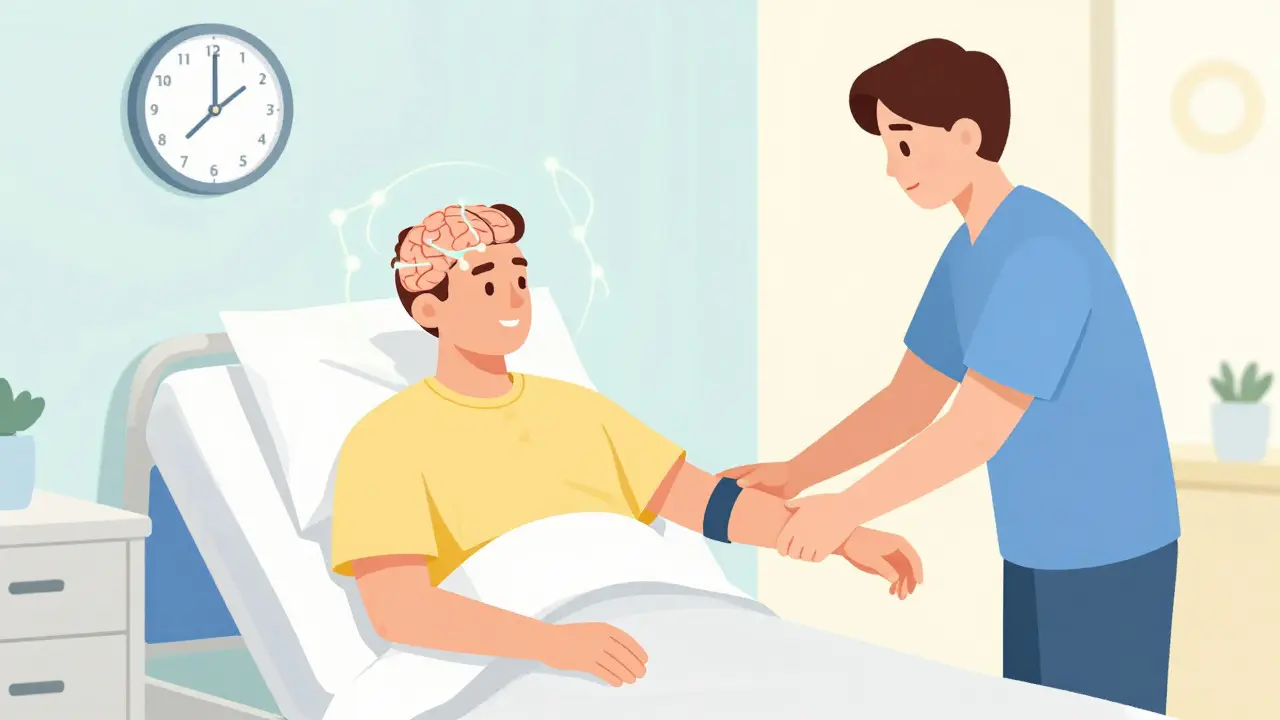
After a stroke, the road back isn’t about waiting for things to get better on their own-it’s about rehabilitation. The brain doesn’t just heal like a broken bone. It rewires. And when you start rehab early, with the right intensity and support, you can regain far more than most expect. Many people think recovery ends when they leave the hospital. That’s not true. The real work begins after discharge, and it’s built on science-not luck.
How the Brain Heals After Stroke
Your brain isn’t broken beyond repair. Even when part of it is damaged by a stroke, the rest can learn to take over. This is called neuroplasticity. It’s not a buzzword. It’s measurable. Studies using brain scans show that within just 2 to 4 weeks of starting therapy, areas of the brain not affected by the stroke begin to activate in new ways. They form fresh connections, like rerouting traffic around a collapsed bridge.
Think of it like learning to ride a bike again-but this time, your brain has to relearn how to move your arm, speak, or even stand up. The more you practice a movement, the stronger that neural pathway becomes. That’s why repetition matters. One study found that patients who did high-intensity therapy within 24 hours of their stroke improved mobility by 35% more than those who waited. Time isn’t just a factor-it’s a tool.
The Three Stages of Recovery
Recovery doesn’t happen all at once. It follows a pattern most people don’t know about. Understanding these stages helps you set realistic expectations and stay motivated.
- Recovery/Natural Healing (Days to Weeks): Right after a stroke, your brain is swollen and tired. Some movement may return naturally as swelling goes down. This is when therapists focus on preventing complications-like muscle tightness, bed sores, or blood clots. Positioning your limbs correctly, moving them gently, and getting you up to sit or stand as soon as it’s safe makes a huge difference.
- Retraining (Weeks to Months): This is where real progress happens. You start practicing tasks over and over: reaching for a cup, standing from a chair, saying words clearly. Therapists use cues-like pointing to a wheelchair brake or counting steps aloud-to help your brain remember how to do things. Small goals matter. Moving your fingers 5 degrees more each week? That’s progress. That’s hope.
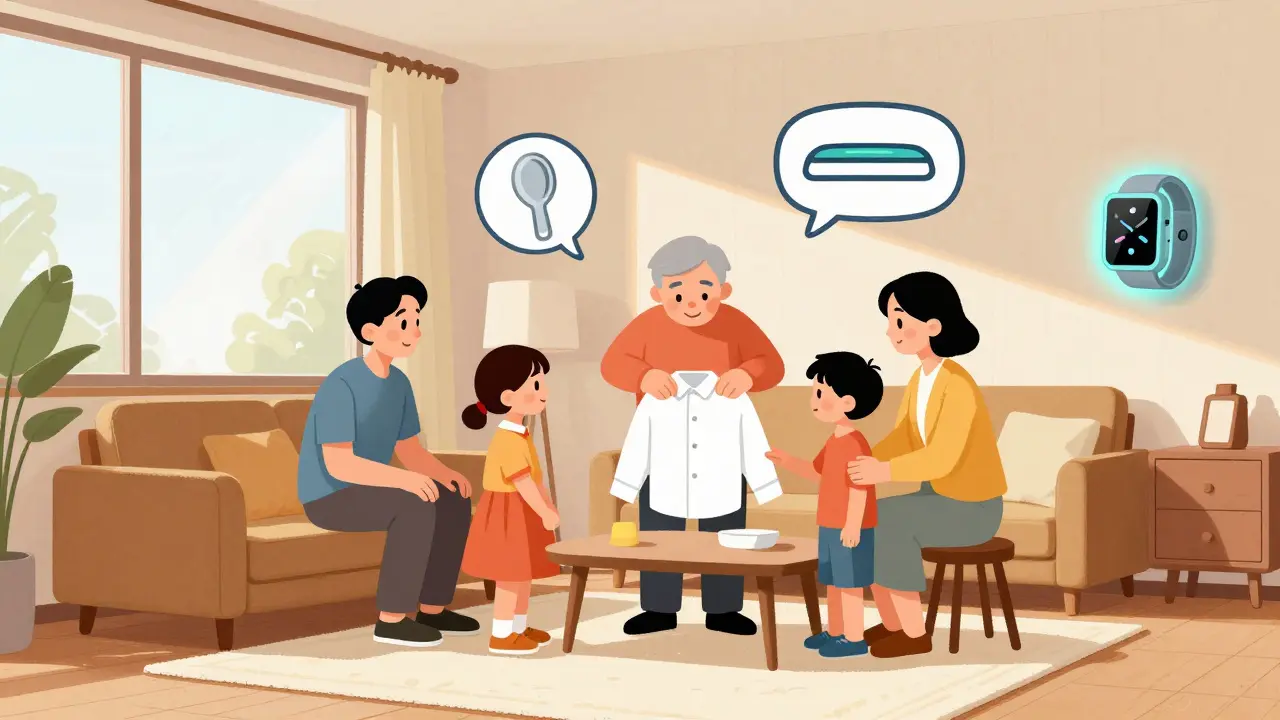
- Adaptation (Months to Years): Not everyone regains full function. But that doesn’t mean life is over. This stage is about adjusting. Maybe you’ll use a special grip on your spoon. Maybe your kitchen gets reorganized so you can reach things without help. Maybe you learn to use voice commands to control your lights. This is where families become partners. Studies show that when loved ones are involved, patients stick with therapy 37% longer.
The Team Behind Your Recovery
No single person can do this alone. Stroke recovery needs a team. And that team isn’t just doctors and therapists-it includes you, your family, and your daily routines.
A successful rehab team includes:
- Physiatrists (rehab doctors) who oversee your whole plan
- Physical therapists who work on walking, balance, and strength
- Occupational therapists who help you dress, cook, and brush your teeth again
- Speech-language pathologists who fix swallowing and communication issues
- Pyschologists who help with depression, anxiety, or frustration
- Social workers who connect you to home care, transportation, or financial aid
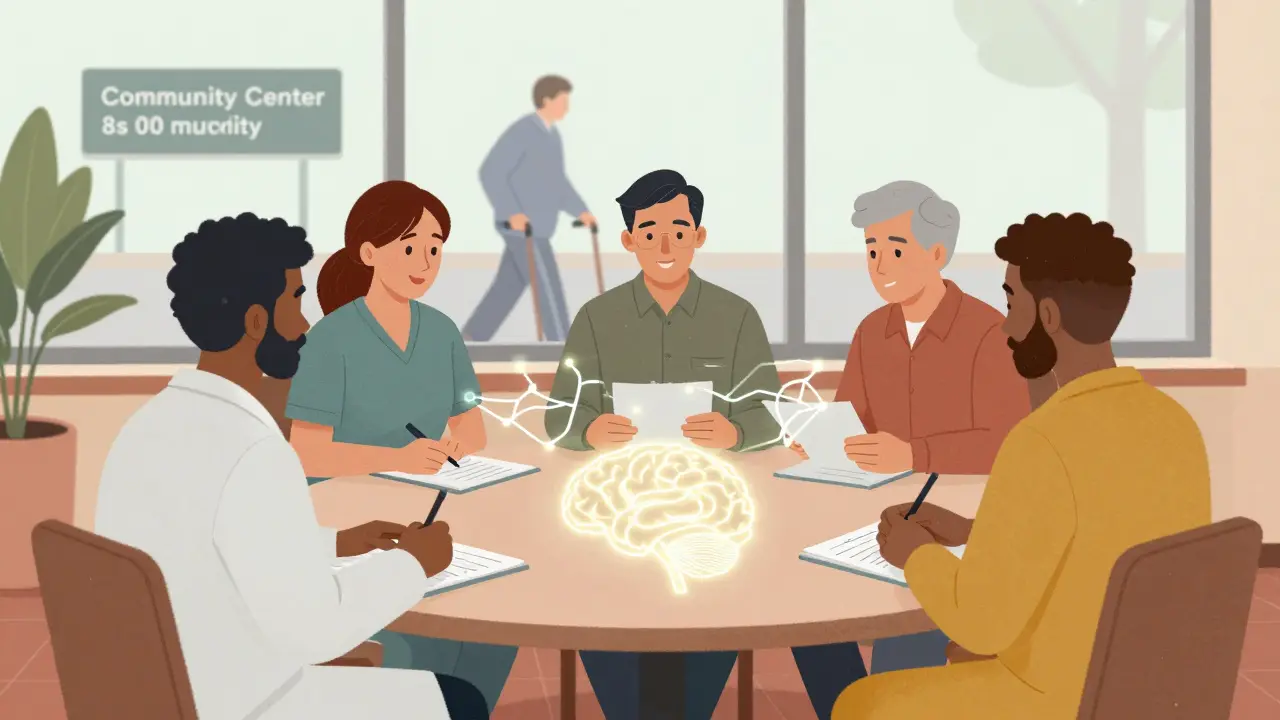
Research shows that facilities with regular team meetings-where everyone talks about your progress-see 22% better outcomes. If your rehab center doesn’t have this, ask why. Coordination isn’t optional. It’s essential.
Therapies That Actually Work
Not every therapy is created equal. Some are backed by strong evidence. Others? Not so much.
Physical therapy isn’t just stretching. It includes:
- Constraint-induced therapy: Wearing a mitt on your good hand for 90% of the day to force your weaker side to move. Studies show 30% more improvement than regular therapy.
- Robotic gait training: Machines that guide your legs through walking motions. Patients using these improve walking speed by 50% more than those doing traditional therapy.
- Functional electrical stimulation: Small electric pulses that make weak muscles contract. Can improve wrist and hand strength by 25-45%.
- Balance training: 60% of stroke survivors have balance problems. A structured program reduces fall risk by more than half.
Occupational therapy focuses on daily life:
- Practicing buttoning shirts, pouring coffee, or using a phone
- Modifying your home-adding grab bars, lowering countertops, installing lever handles
- Teaching you to use one hand if the other doesn’t work
Speech therapy doesn’t just help you talk. It helps you swallow. Nearly 50% of stroke survivors have trouble swallowing safely. That can lead to pneumonia. Speech therapists use exercises, posture changes, and even modified food textures to keep you safe.
Technology Is Changing the Game
Rehab isn’t stuck in the 1990s. Today’s tools are smarter, more engaging, and more effective.
- Virtual reality: Patients play games that simulate reaching for objects, cooking, or walking through a virtual store. This boosts upper limb function by 28% compared to standard therapy.
- Wireless activity monitors: These track how many steps you take each day. Just seeing your progress increases daily movement by 32%.
- Transcranial magnetic stimulation (TMS): A non-invasive device that uses magnetic pulses to stimulate brain areas. When combined with therapy, it improves motor recovery by 15-20%.
- Telerehabilitation: Therapy done at home via video calls. Recent studies show it’s 85% as effective as in-person visits for many tasks. This is huge for people who live far from clinics or have trouble getting around.
What Really Makes Recovery Work
It’s not just the therapy. It’s the person doing it. Research points to nine key factors that determine how well someone recovers:
- Your overall health before the stroke
- Your muscle strength and joint movement
- Your ability to control bladder and bowels
- Your pre-stroke level of independence
- Your home and social support system
- Your ability to learn and remember instructions
- Your motivation
- Your coping skills
- Your mood
Among all these, motivation stands out. Studies say it accounts for up to 40% of recovery success. If you’re not ready to try, no machine or therapist can force progress. That’s why setting small wins matters. Celebrate moving your thumb. Celebrate standing for 10 seconds. Celebrate asking for help.
Rest is just as important as effort. Too much therapy without breaks leads to fatigue-and fatigue kills progress. Experts recommend balancing your day: 40-50% therapy, 30-40% rest, and 20-30% social time. Talking to a friend, watching a show, or just sitting outside counts. It’s not a distraction. It’s part of healing.
What Happens After Rehab?
Most stroke survivors leave rehab still needing help. About 70% need ongoing therapy after discharge. That’s why community-based programs are so important. You don’t have to go back to the hospital to keep improving.
Look for:
- Local community centers with stroke support groups
- Home-based therapy services
- Online programs that offer guided exercises
- Yoga or tai chi classes designed for stroke survivors
Staying active, even at a low level, keeps your brain engaged. Walking around the block. Doing chair exercises. Playing cards with friends. These aren’t just pastimes-they’re part of your long-term recovery.
Common Myths About Stroke Recovery
- Myth: Recovery only happens in the first 3 months. Truth: The brain can keep improving for years. Some people regain function even after 5 or 6 years.
- Myth: If you can’t walk right away, you never will. Truth: Many people who start in a wheelchair learn to walk again with the right therapy.
- Myth: Depression is normal after stroke-you just have to live with it. Truth: Depression is common, but it’s treatable. Therapy and sometimes medication can make a big difference.
- Myth: Older people don’t recover well. Truth: Age doesn’t predict recovery. Motivation, support, and therapy intensity do.
How soon after a stroke should rehabilitation begin?
Rehabilitation should begin as soon as the patient is medically stable-often within 24 to 48 hours after the stroke. Early movement, even passive range-of-motion exercises, helps prevent complications like muscle stiffness and blood clots. Studies show that starting therapy within the first day improves functional outcomes by 35% compared to waiting.
Is it possible to recover fully after a severe stroke?
Full recovery is possible for some, but not guaranteed. It depends on the stroke’s location, how much brain tissue was affected, and how quickly rehab started. Many people with severe strokes regain enough function to live independently, even if they don’t return to their pre-stroke state. Neuroplasticity allows the brain to rewire over time, and continued therapy-even years later-can lead to meaningful improvements.
What role does family play in stroke recovery?
Family involvement is one of the strongest predictors of success. They help reinforce therapy at home, encourage daily practice, and provide emotional support. Studies show patients with active family support stick to their rehab routines 37% longer. Families also help identify changes in mood or behavior-like signs of depression-that the patient might not notice themselves.
Can technology like virtual reality really help stroke recovery?
Yes. Virtual reality systems simulate real-life tasks-like reaching for a cup or walking through a grocery store-in a safe, engaging way. Patients using VR show 28% greater improvement in upper limb function than those doing standard therapy. It’s not a gimmick-it’s evidence-based. The interactive nature keeps patients motivated, and the data collected helps therapists adjust programs in real time.
How long does stroke rehabilitation last?
There’s no fixed end date. Most patients receive intensive rehab for 3-6 months, often in an inpatient or outpatient facility. But improvement can continue for years. Many people transition to community-based programs, home exercises, or telerehabilitation. The goal isn’t to "finish" rehab-it’s to keep building skills and independence for life.
What if I can’t afford ongoing therapy?
Many resources exist. Medicare and private insurance often cover outpatient therapy. Community health centers, nonprofit organizations, and local stroke associations may offer free or low-cost programs. Telerehabilitation can reduce costs by eliminating travel. Ask your social worker or rehab team-they know what’s available in your area. You don’t have to pay full price to keep making progress.
Does depression affect recovery?
Yes, significantly. Depression affects 30-35% of stroke survivors and can slow recovery by reducing motivation, energy, and participation in therapy. It’s not just a "bad mood." It’s a medical condition that needs treatment-therapy, medication, or both. Addressing depression isn’t optional; it’s part of physical recovery.
Final Thought
Recovery after a stroke isn’t a race. It’s a long walk-sometimes slow, sometimes rocky, sometimes full of setbacks. But every step counts. Every practice, every conversation, every moment of effort adds up. You’re not just healing your body. You’re rebuilding your life. And with the right support, the right science, and the right mindset, you can get farther than anyone expected.



Noluthando Devour Mamabolo
13 March 2026 - 10:25 AM
Neuroplasticity isn’t just a buzzword-it’s biology on turbo mode. 🚀 After my mom’s stroke, we started passive ROM within 36 hours. By week 2, she was gripping my hand. Not perfect, but *there*. Repetition + consistency = rewiring. No magic, just science. And yeah, the 35% mobility jump? Real. 💪
Leah Dobbin
13 March 2026 - 13:48 PM
I find it rather amusing how this post casually dismisses the role of socioeconomic privilege in access to robotic gait training and TMS. The assumption that everyone has access to telerehab or community centers is… quaint. Let’s not pretend neuroplasticity is democratized.
Ali Hughey
14 March 2026 - 09:07 AM
Wait-so you’re telling me the government isn’t funding this?!!?? This is a cover-up. The real reason they don’t want you to know about VR rehab is because Big Pharma makes billions off long-term institutional care. And don’t get me started on the FDA approving TMS without double-blind studies… I’ve seen the documents. They’re redacted. 🔍👁️🗨️
Alex MC
15 March 2026 - 02:10 AM
This is one of the clearest summaries of stroke rehab I’ve read. The breakdown of stages-natural healing, retraining, adaptation-is spot on. And the part about rest being part of healing? Crucial. Too many push too hard too soon. Balance matters. Slow progress is still progress. 🙏
rakesh sabharwal
17 March 2026 - 01:54 AM
All this talk of neuroplasticity ignores the fundamental truth: the brain is a biological organ, not a Lego set. You can’t just ‘reroute traffic’ like it’s a traffic app. And who funded this study? Pharma? The tone here feels like a marketing brochure disguised as science.
Aaron Leib
18 March 2026 - 10:12 AM
Motivation is the engine, but support is the fuel. I’ve seen people with zero prior fitness rebound because their partner showed up every day to do 10 minutes of wrist curls. Not because it was easy. Because it mattered. Small wins. Daily. That’s the secret.
Dylan Patrick
20 March 2026 - 06:29 AM
I’m not a therapist. But I watched my uncle go from zero finger movement to holding his granddaughter’s hand. Took 18 months. No miracles. Just daily drills. The science? Real. The hope? Real. The grind? Also real. Don’t quit.
Kathy Leslie
21 March 2026 - 00:01 AM
My aunt did telerehab from her kitchen. Used her phone, a resistance band, and a YouTube video. She said it felt less intimidating than the clinic. And she stuck with it because she could do it in her socks. Sometimes, the best therapy is the one you don’t dread.
Amisha Patel
22 March 2026 - 02:23 AM
I’m curious-how do you define 'medically stable' for early rehab? Is it BP under 140/90? No new infarcts on CT? Or is it more subjective? I’m asking because my dad was cleared after 12 hours, but his oxygen saturation dipped during PT.
Elsa Rodriguez
22 March 2026 - 04:29 AM
I can’t believe people still believe this. My sister had a stroke at 42. They told her she’d never walk again. Then they sent her home with a pamphlet. No VR. No robotic gait. Just ‘wait and see.’ And now? She’s in a wheelchair. And no one cared enough to fight for her. This post is just sugar-coated denial.
Serena Petrie
22 March 2026 - 23:52 PM
The 35% mobility gain? Sounds made up.
Buddy Nataatmadja
23 March 2026 - 14:45 PM
In Indonesia, we call this 'kerja keras, sabar, dan doa'-hard work, patience, and prayer. The science here aligns with our tradition: consistent effort, family presence, and quiet persistence. No machines needed. Just humanity.
mir yasir
24 March 2026 - 12:56 PM
The assertion that neuroplasticity is 'measurable' is a gross oversimplification. fMRI data is noisy, confounded by vascular artifacts, and rarely replicated in longitudinal studies. This post reads like a grant proposal masquerading as clinical guidance.
Jinesh Jain
25 March 2026 - 21:07 PM
My brother started rehab 72 hours after his stroke. He’s walking now. Not fast. Not perfectly. But he walks. And he laughs. That’s the win. No fancy tech. Just repetition. And someone who didn’t give up on him.
douglas martinez
27 March 2026 - 05:16 AM
The team-based approach is non-negotiable. I’ve worked in rehab for 18 years. The facilities with weekly interdisciplinary meetings? Their patients leave with 2.3x more functional gains. Coordination isn’t bureaucratic-it’s therapeutic. If your center doesn’t do this, find a better one.