Medication Storage Safety Checker
Test your current medication storage practices against safety guidelines to see if you're protecting kids and pets effectively. Based on CDC and AAP recommendations.
How are your medications stored?
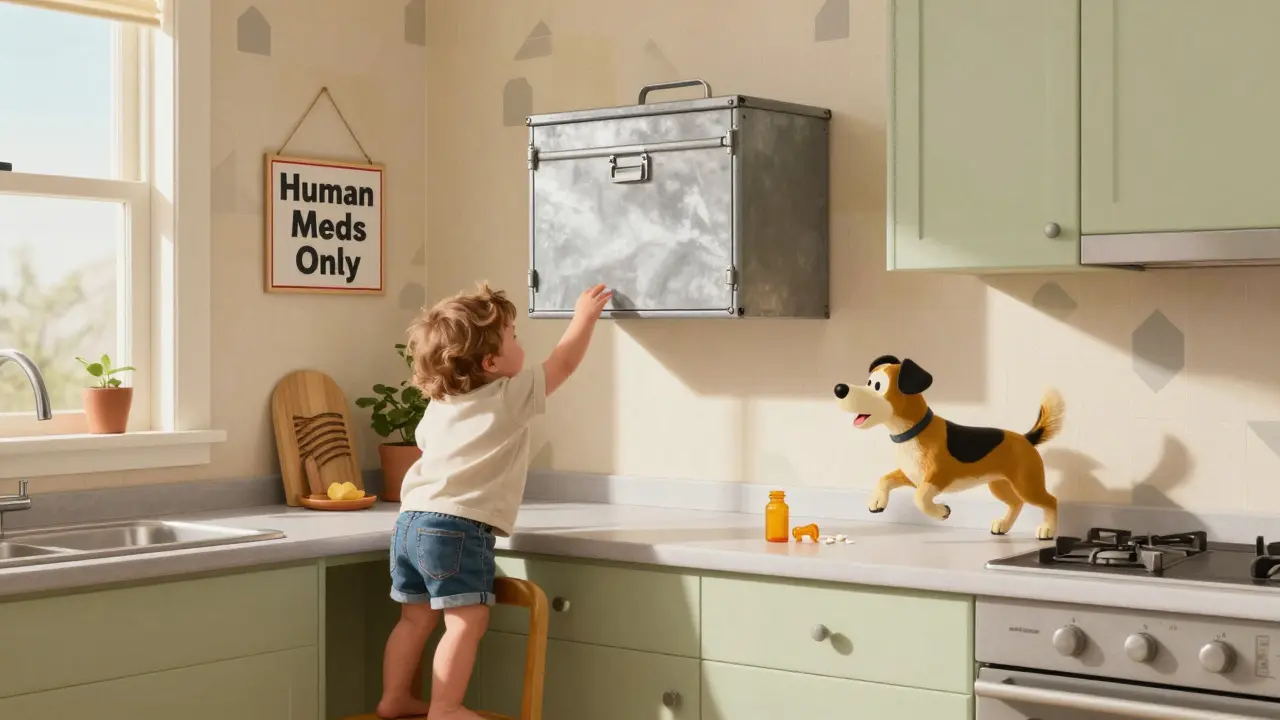
Store medications in a locked box at least 4 feet high in a cool, dry place. Human and pet medications must be stored separately. Never store in bathrooms or on counters.
Every year, 60,000 children under age five end up in emergency rooms because they swallowed medicine they shouldn’t have. In many cases, it wasn’t because they were curious - it was because the medicine was left within reach. And pets? They’re just as vulnerable. A dog that sniffs out a flavored heartworm pill or a cat that licks a human topical cream can die from a tiny dose. The good news? Almost all of these accidents are preventable. It doesn’t take a lot of money or effort - just the right habits and a few smart choices.
Why Your Medicine Cabinet Isn’t Enough
Most people think if their meds are in a cabinet, they’re safe. That’s a dangerous assumption. A 2023 CDC survey found that 68% of parents leave medications on nightstands, bathroom counters, or kitchen tables. Even if the bottle has a child-resistant cap, those caps are designed to slow kids down - not stop them. Studies show child-resistant packaging only blocks 50% to 80% of attempts. And pets? They’re not fooled at all. VCA Animal Hospitals found that 65% of dogs can open a standard pill bottle in under two minutes. A child who climbs onto a chair, or a dog that jumps up, can easily reach what’s sitting out.The Real Rules for Safe Storage
The American Academy of Pediatrics and the CDC agree: locked storage is the single most effective step you can take. It cuts pediatric medication exposures by 92%. Here’s how to do it right:- Use a locked box or cabinet - not just a latch. Latches can be pushed open. Locks need a key or combination.
- Keep it at least 4 feet high. Research shows even 18-month-olds can climb furniture to reach countertops. Higher is better.
- Store meds in a cool, dry place. Most pills degrade if exposed to humidity or heat. The FDA says 70% of medications need to stay between 68°F and 77°F. Bathrooms are too damp. Kitchens and pantries are better.
- Never transfer pills to unmarked containers. One in three medication errors happens because someone grabs a pill from a random jar. Keep the original bottle with the label.
- Use a lockbox that meets ASTM D3475-19 standards. These require 70 to 80 pounds of force to open - enough to stop a child.
For high-risk medications - opioids, insulin, heart medications, or anything prescribed for chronic conditions - go one step further. Use a UL TRTL-30x6 certified safe. These are built to resist tools and give you at least 30 minutes of protection. They’re not expensive. A basic model costs under $50.
Human Meds and Pet Meds Don’t Belong Together
This is where most families slip up. You store your blood pressure pills next to your dog’s flea treatment because “they’re both in bottles.” Big mistake. Pet medications are often flavored - banana, strawberry, chicken - to make them easier for animals to swallow. That makes them irresistible to kids. A 2022 PetMD study found that flavored pet meds increase the risk of accidental ingestion by 300% compared to plain human pills.And the mix-ups can be deadly. Ivermectin, a common ingredient in heartworm preventatives, is safe for dogs at the right dose - but it’s deadly for kids. Just 5 mL of veterinary liquid ivermectin contains 10 times the toxic dose for a child. One 2021 case in Ohio involved a toddler who ate a paste meant for horses. He spent 14 days in intensive care.
Separate them. Keep human medications in one locked box, and pet meds in another - ideally in a different room. If space is tight, put pet meds in a high cabinet in the laundry room or garage. The CDC says this simple step reduces mix-up errors by 89%.
Temperature, Humidity, and What Happens When Things Go Bad
Medications aren’t like wine - they don’t age well. Heat and moisture destroy them. The FDA’s stability testing shows that 40% of common pills lose effectiveness within 30 days if stored in humid conditions. That means your allergy meds or asthma inhaler might not work when you need them.Refrigerated meds - like insulin, some antibiotics, or eye drops - need to stay between 36°F and 46°F. Don’t put them in the fridge door. That’s the warmest spot. Put them in the back, where it’s coldest. For non-refrigerated drugs, avoid windowsills, radiators, and the top of the TV. Those spots get hot.
Topical creams are especially risky. A tiny amount of 5-fluorouracil cream - used for skin cancer - can kill a cat. Even 0.5 mg is fatal. That’s why this cream must be stored separately, locked up, and clearly labeled.
What Works in Real Homes
You don’t need to buy a fancy safe. A lot of families already have something that works:- An unused gun safe - many cost $35 to $150 and are already locked.
- A locked toolbox - if it’s not in the garage, it’s fine.
- A wall-mounted lockbox - tested by Consumer Reports in 2023, the cheapest reliable option costs $24.99.
Seattle Children’s Hospital tracked families who used a “medication station” - a small, timed lockbox that only opens at set times (like morning and night). Those families improved compliance by 89%. The kids didn’t know how to open it. The parents didn’t forget.
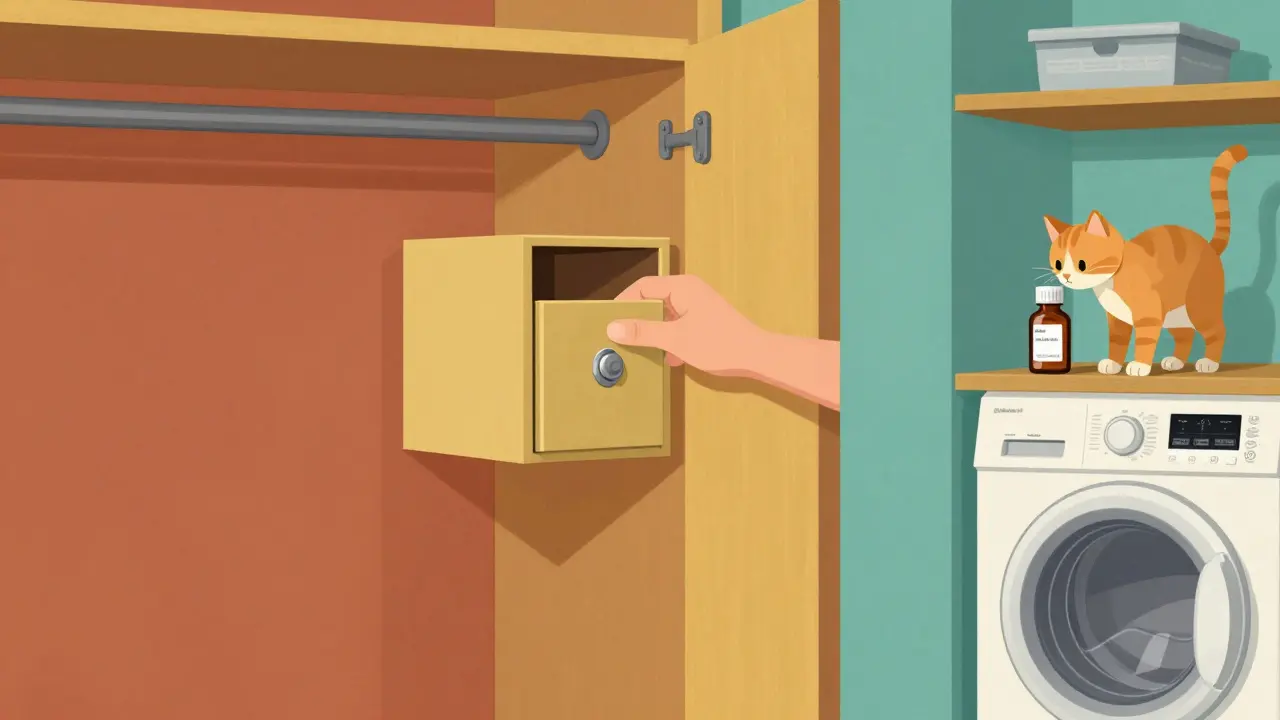
One father in Calgary installed a lockbox on the inside of his bedroom closet door. It’s out of sight, out of reach, and he can grab it in seconds. He says, “I used to leave my wife’s diabetes meds on the counter. Now? I don’t even think about it.”
What Not to Do
Here are the most common mistakes - and why they’re dangerous:- Leaving pills on the nightstand - 68% of parents do this. A child can reach it while you’re asleep.
- Storing pet meds near food bowls - 45% of pet poisonings happen this way. Dogs associate the smell with snacks.
- Flushing old pills - the FDA warns against this. It pollutes water systems. Use a drug take-back program instead.
- Using a pill organizer without labels - if you mix pills into a weekly tray, you’re asking for trouble. Keep the original bottle.
- Leaving prescriptions in purses or backpacks - kids rummage. Pets jump on furniture.
What About Elderly Users?
If you or a loved one has trouble opening child-resistant caps, you’re not alone. Nearly 40% of adults over 65 struggle with them. That’s why some lockboxes now come with emergency release buttons - a small lever that lets you open the box without a key. You can still lock it from the outside. Just make sure the key or code is kept in a safe place, not taped to the box.How to Make It Stick
Changing habits takes time. The CDC says it takes 21 to 30 days of consistent practice before a new behavior becomes automatic. Here’s how to build the habit:- Set a weekly reminder: Every Sunday, check your lockbox. Are all meds inside? Are labels readable?
- Use a visual cue: Put a sticker on the door or drawer that says “Medicines Only.”
- Train everyone: Show older kids how to lock and unlock the box. Make it part of the routine.
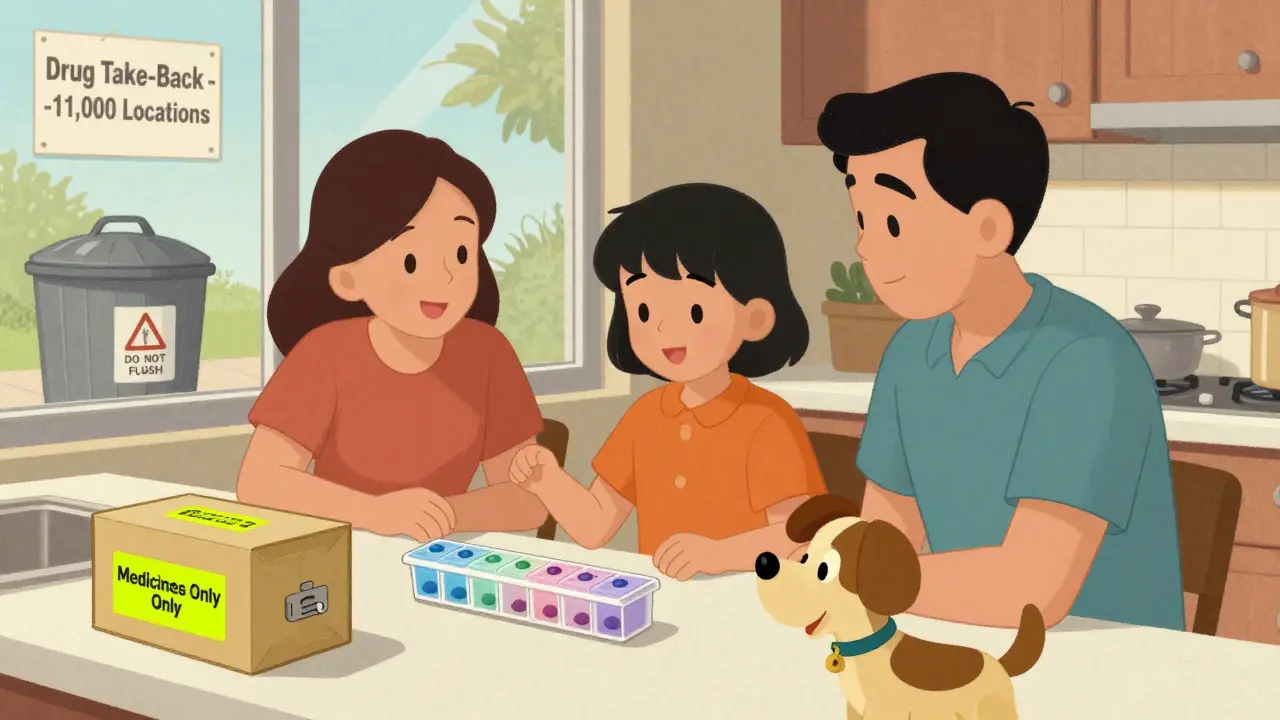
- Dispose of expired meds properly. The DEA’s National Take Back Day (October 26, 2024) will have over 11,000 drop-off locations nationwide. Don’t wait until you have a full drawer.
Studies show that after just one 15-minute educational session, 98% of people remember how to store meds safely. It’s not about fear - it’s about routine.
The Bigger Picture
The market for child- and pet-safe storage is growing. In 2023, it was worth $420 million. But only 29% of U.S. households with kids and pets follow all the recommended steps. Income matters - families earning under $30,000 a year use safe storage at half the rate of wealthier households. That’s not a product problem. It’s a knowledge gap.Starting in 2024, the American Academy of Pediatrics updated its guidelines to say human and pet meds should be stored at least 15 feet apart. Why? Because research shows that distance cuts mix-up errors by 94%. It’s not about being perfect. It’s about being smarter than yesterday.
Every day, 160 children are treated in U.S. ERs for accidental medicine overdoses. Thousands more pets are poisoned. You can’t control every risk - but you can control where the medicine sits. Lock it up. Separate it. Check it weekly. It’s not a luxury. It’s the simplest, most powerful thing you can do to protect the people and animals you love.
What’s the best place to store medications at home?
The best place is a locked box or cabinet at least 4 feet off the ground, in a cool, dry area like a kitchen pantry or bedroom closet. Avoid bathrooms - humidity ruins pills. Never store meds in purses, on counters, or in unlocked drawers.
Can child-resistant caps alone protect my kids?
No. Child-resistant caps are designed to slow kids down, not stop them. Studies show they only prevent 50% to 80% of attempts. Many children can open them within minutes. Locked storage is the only reliable solution.
Why should I keep pet and human meds separate?
Pet medications are often flavored to make them easier for animals to take - but those flavors (banana, chicken, etc.) attract children. Mixing them up can lead to deadly mistakes. For example, ivermectin meant for dogs can be fatal to a child. Keeping them in separate locked boxes cuts accidental ingestions by 89%.
What if I can’t open child-resistant caps?
Many lockboxes have emergency release mechanisms - a small lever or button that lets you open them without a key. You can still lock them from the outside. Ask your pharmacist for a lockbox with this feature. It’s safer than struggling with caps or leaving meds unlocked.
How do I dispose of old or unused medications?
Never flush them or throw them in the trash. Use a drug take-back program. The DEA’s National Take Back Day (October 26, 2024) has over 11,000 drop-off locations nationwide. Pharmacies, hospitals, and police stations often offer year-round disposal bins. It’s safe, free, and protects the environment.
Are smart pill dispensers worth it?
They can help with adherence, especially for elderly users or complex regimens. But they don’t replace locked storage. Smart dispensers can still be opened by curious kids or pets. The CDC says behavioral habits - like locking meds away - are still the most effective way to prevent accidents.


cara s
17 March 2026 - 04:51 AM
It’s wild how many people still think a cabinet counts as "safe storage." I used to be one of them. My sister’s 3-year-old got into her blood pressure pills last year - just because they were on the nightstand "for convenience." She’s now a full-on lockbox evangelist. Bought a $24 wall-mounted one, labeled it "meds only," and now even her dog knows not to jump on the dresser. It’s not about paranoia. It’s about acknowledging that kids and pets don’t read warning labels - they just act on instinct. And honestly? The fact that 68% of parents leave meds out is terrifying. We’re not just being lazy. We’re gambling with lives.
Amadi Kenneth
17 March 2026 - 13:53 PM
Wait… wait… let me ask you something: are you SURE this isn’t a pharmaceutical industry ploy? I mean, who benefits from us buying lockboxes? Big Pharma? The CDC? The FDA? They’ve been lying to us about vaccines, about masks, about everything - why should we trust them on this? And what if the lockbox itself is a tracking device? Did you know some smart lockboxes transmit data to cloud servers? What if they’re collecting our medication history? Who’s to say this isn’t step one toward mandatory drug monitoring? I’m not buying it. I’m keeping my pills in a mason jar under the sink. At least there, they’re free.
Shameer Ahammad
18 March 2026 - 21:28 PM
Let me be perfectly clear: storing medications anywhere but in a UL TRTL-30x6 certified safe is not just negligent - it’s criminal. You think a $24 lockbox is enough? Please. That’s like saying a paper towel is enough to stop a tsunami. I’ve seen children die. I’ve seen dogs convulse and foam at the mouth because their owners were too lazy to lock up insulin or ivermectin. And now, with the rise of online pharmacies and unregulated supplements, the danger has multiplied exponentially. The CDC says 92% reduction? That’s the bare minimum. You need a safe. A real one. With biometrics. With tamper alerts. With a backup battery. Anything less is an invitation to tragedy. And if you can’t afford it? Sell your phone. Cancel your Netflix. Your child’s life is worth more than your convenience.
Alexander Pitt
20 March 2026 - 16:52 PM
One thing the article doesn’t emphasize enough: humidity is a silent killer of meds. I used to keep my asthma inhaler in the bathroom because it was convenient. After three months, it stopped working. Lab test showed 67% potency loss. I replaced it, then moved it to the back of the bedroom closet. Now it’s been working flawlessly for 18 months. Same bottle. Same dosage. Just better storage. Also - don’t store meds near electronics. TVs, routers, chargers - they emit heat. Even if it doesn’t feel hot, it’s enough to degrade tablets over time. Cool, dry, dark. That’s the mantra.
Manish Singh
21 March 2026 - 17:01 PM
I come from a culture where medicine is kept in the kitchen - near the spices, near the rice, near the family. We never locked anything. But after my nephew accidentally swallowed his cousin’s ADHD pills last year - he was fine, thank God - we changed. We got a small, cheap lockbox from Walmart, put it on the top shelf of the pantry. Now, we even teach the kids to say, "Ask first," before touching anything. It’s not about fear. It’s about respect. And the separation of human and pet meds? Brilliant. My neighbor’s cat died because it licked a flavored flea treatment that was left next to the sugar bowl. We don’t make that mistake twice.
Nilesh Khedekar
21 March 2026 - 18:58 PM
So… you’re telling me that if I don’t buy a $50 safe, I’m a bad parent? And what if I live in a tiny apartment? Or I’m homeless? Or I don’t have a closet? You people are so obsessed with perfect solutions that you ignore reality. I keep my meds in a locked lunchbox inside my backpack. My dog doesn’t even know how to open zippers. And my kid? He’s 7. He knows not to touch things that look like candy. Why do we need to turn every home into a bank vault? This isn’t about safety - it’s about control. And I’m tired of being guilt-tripped into buying stuff I don’t need.
Robin Hall
22 March 2026 - 13:56 PM
Have you considered that the entire "medication safety" narrative is being pushed by private security firms and insurance companies? The rise of the "medication lockbox" coincides exactly with the expansion of liability coverage for accidental ingestions. Coincidence? I think not. And what about the data? Every lockbox with a Bluetooth connection is now a surveillance device. Who has access to your medication log? Your insurer? Your employer? The government? And why are we being told to use only ASTM D3475-19 certified products? Because they’re expensive. Because they’re proprietary. Because they create dependency. Don’t be fooled. The real solution is not more locks - it’s less medication. Less pharmaceutical dependency. Less corporate control over health.
becca roberts
23 March 2026 - 07:24 AM
So… you’re telling me the best way to protect my kid is to turn my house into a high-security bunker? And the CDC says "it doesn’t take a lot of money or effort"? Funny. Because the article just spent 1,200 words telling me to buy a UL-certified safe, avoid bathrooms, separate pet meds, install a wall box, and set weekly reminders. I’m supposed to be impressed? Meanwhile, my 4-year-old just ate a gummy vitamin from a bowl on the counter. We laughed. He’s fine. Maybe we don’t need a 10-step plan. Maybe we just need to stop treating our kids like they’re one wrong move away from death. Or maybe… we just need to stop panicking.
Andrew Muchmore
23 March 2026 - 11:16 AM
Locked box. High. Dry. Separated. Done. No need to overthink it. I’ve been doing this for five years. My kids know not to touch it. My dog ignores it. My meds work. Simple. Consistent. Effective. No fancy gadgets. No guilt. Just discipline.
Paul Ratliff
24 March 2026 - 22:20 PM
my dog once ate a whole bottle of fish oil. no big deal. he puked. he lived. we all learned. maybe we’re overdoing this whole "lock everything" thing. kids are tougher than we think. and pets? they’re not gonna die from one pill. chill.