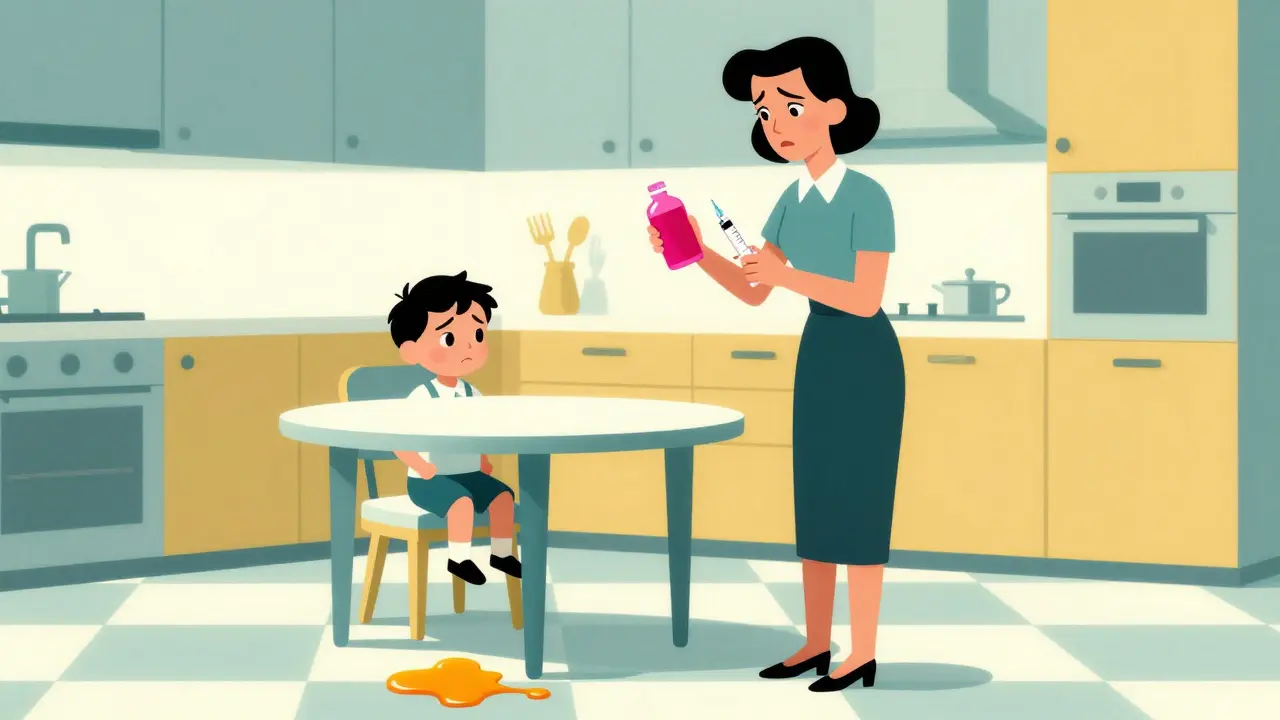
Most of us grew up believing that kids just can't swallow pills. For decades, the default move for any pediatrician was to prescribe a syrup or a suspension. It seemed like the only way to ensure a child actually took their medicine without a massive struggle. But here is a surprising fact: research shows that children as young as 3 to 5 years old can be trained to swallow pills, and in some cases, they actually prefer them over the chemical-tasting liquids we've all encountered.
Choosing between a liquid and a solid doesn't just come down to whether your child will fight you. It affects how accurately they get the dose, how long the medicine lasts in your fridge, and even how quickly it starts working. If you're tired of the "strawberry" flavored syrup that tastes like soap and results in a sticky mess on the kitchen floor, it might be time to look at the alternatives.
The Quick Breakdown: Liquid vs. Tablets
Before we get into the weeds, here is a snapshot of how these two formats stack up. While liquids feel "safer" for toddlers, they often come with more room for error and shorter expiration dates.
| Feature | Liquid Formulations | Solid Formulations (Tablets/Mini-tabs) |
|---|---|---|
| Dosing Flexibility | High (can be adjusted by 0.1mL) | Fixed (unless split or used as mini-tabs) |
| Shelf Life | Short (often 14-30 days after mixing) | Long (typically 24-36 months) |
| Taste Acceptance | Often poor due to strong artificial flavors | Higher (especially with film-coating) |
| Storage | Frequently requires refrigeration | Room temperature stable |
| Accuracy | Higher risk of measurement error | Highly precise per unit |
When Liquid is the Right Choice
There are times when a liquid is non-negotiable. For infants under 6 months, solids are a hard no due to choking risks. Beyond that, pediatric medications is a field where precision matters. When a dose needs to be calculated based on a child's exact weight or body surface area, liquids allow for titration down to 0.1mL increments using an oral syringe.
Liquids also generally hit the bloodstream faster. According to analysis from the US Pharmacist, liquid forms can be 15-30% faster in absorption than solids. This is great when you need a fever to drop quickly or a sudden allergic reaction to be managed. However, this convenience comes with a price: instability. Many liquids degrade rapidly, meaning if you don't finish the course of antibiotics in the allotted window, the medicine may lose its potency.
The Rise of Mini-Tablets and Solids
The biggest fear parents have with tablets is choking. But the data is reassuring. FDA adverse event reports show that actual choking incidents with appropriately sized pediatric tablets occur at a rate of less than 0.002%. The real game-changer here is the Mini-tablet is a small, solid dosage form, sometimes as small as 2mm in diameter, designed specifically for pediatric use .
Modern mini-tablets aren't just small; they are often film-coated. This means the bitter taste of the drug is locked away, unlike crushed tablets which release a pungent flavor the moment they hit the tongue. A study of 60 children aged 6 months to 6 years found that mini-tablets were actually accepted better than liquids, particularly in the 6-to-12-month age group. Why? Because children often find the texture of a tiny pill less offensive than a thick, syrupy liquid that doesn't actually taste like the fruit it claims to be.
The Danger of the "Crush and Mix" Method
When a doctor prescribes a tablet but your child can't swallow it, the temptation is to crush it into applesauce. Be very careful here. Pharmacokinetics is the branch of pharmacology concerned with the movement of drugs within the body , and crushing a pill can completely change how a drug is absorbed.
If you crush a "time-released" or "extended-release" tablet, you might dump the entire 24-hour dose into your child's system all at once. This can lead to toxicity or severe side effects. Furthermore, research suggests that 30-40% of home-prepared crushed medications result in dosing errors because some of the powder stays on the spoon or the bowl, meaning your child doesn't get the full amount needed to fight the infection.
How to Train Your Child to Swallow Pills
If you want to move away from liquids, you can't just drop a pill in their mouth and hope for the best. It requires a gradual approach. The American Academy of Pediatrics is the leading professional association of pediatricians in the United States, providing evidence-based guidelines for child health suggests that children as young as 2 to 4 can be trained with the right technique.
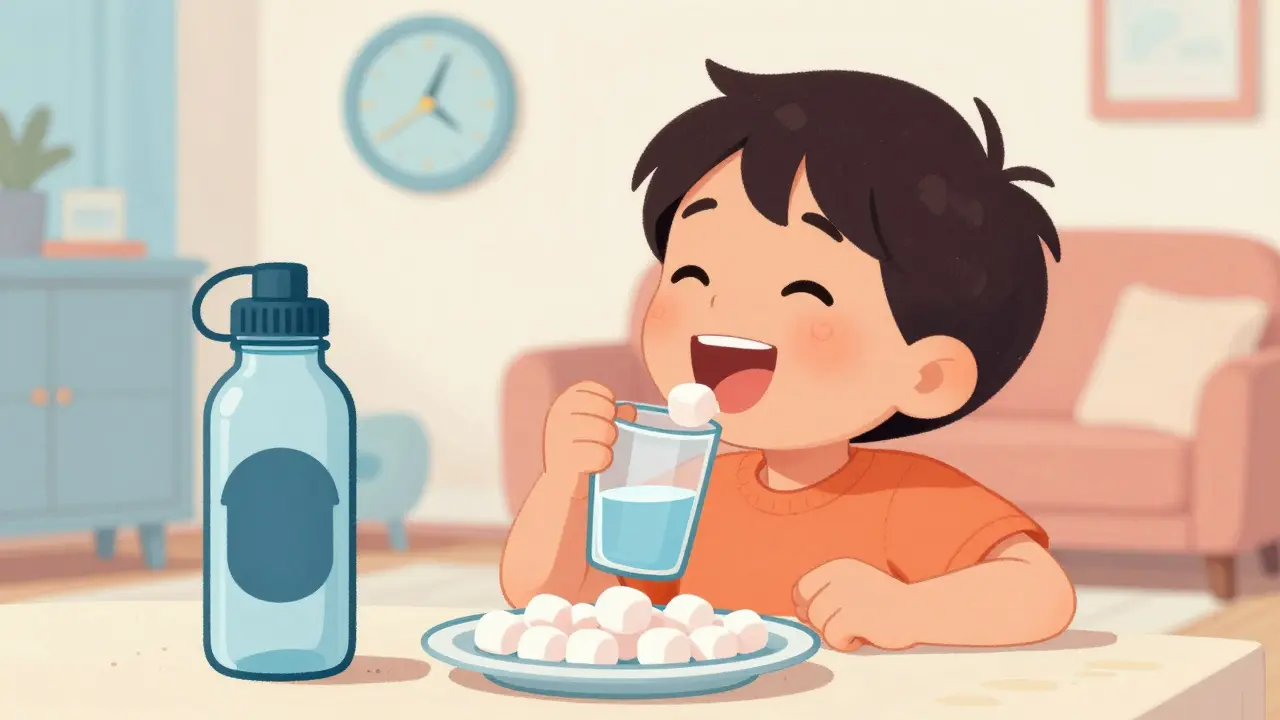
- The Practice Phase: Start with something edible and safe. Use mini-marshmallows or small balls of bread. Have them swallow these with water to get the "feeling" of a pill moving down their throat.
- The Pop-Bottle Method: This is a favorite at BC Children's Hospital. Place the tablet on the tongue, close the lips tightly around the opening of a water bottle, and take a sip. The suction helps pull the pill back and down the throat more naturally.
- Positive Reinforcement: Don't make it a battle. If they struggle, go back to the practice phase. Once they succeed with a mini-tablet, they'll feel a sense of accomplishment, which makes the next dose much easier.
Choosing Based on the Condition
Not all medications are created equal. If your child is dealing with a chronic condition that requires a precise, daily dose-like levothyroxine for thyroid issues-a liquid may still be the safest bet for absolute accuracy. However, for medications with a wider therapeutic window, such as many common antibiotics or vitamins, solids are often superior.
Solid forms show 22% higher adherence rates in chronic conditions. Why? Because they are easier to travel with, don't require a fridge, and don't trigger the "taste trauma" that leads to children fighting their parents every single morning. When the process becomes effortless, the child is more likely to stay consistent with their treatment.
At what age can a child safely swallow a tablet?
While every child is different, many can be trained as early as 3 years old. The key is starting with appropriately sized "mini-tablets" (around 2-4mm) rather than standard adult pills. By age 6 or 7, most children can handle standard 6-8mm tablets if they have been practiced.
Is it okay to crush a tablet if I don't have a liquid version?
Only if your pharmacist or doctor explicitly says it is safe. Many tablets are designed for slow release; crushing them destroys this mechanism and can lead to an overdose or make the medication ineffective. Additionally, crushing often leads to imprecise dosing as medication is lost during the process.
Why are liquid medications so often disliked by kids?
Most liquids use artificial flavorings to mask the naturally bitter taste of the drug. These often taste "chemical" rather than like real fruit. Because liquids coat the entire tongue and throat, the taste lingers much longer than a coated tablet, which passes through the mouth quickly.
Do liquid medicines expire faster than tablets?
Yes, significantly. Once a powder is reconstituted into a liquid, the shelf life often drops to just 14-30 days and may require refrigeration. Tablets are far more stable, typically lasting 24-36 months at room temperature.
What should I do if my child keeps spitting out liquid medicine?
First, check if a mini-tablet version is available. If you must use liquid, try using an oral syringe to place the medicine in the cheek pouch rather than the back of the throat to reduce the gag reflex. You can also ask your pharmacist about flavoring options that might be more palatable for your specific child.
What to do next
If you're currently struggling with a liquid medication, start by asking your pharmacist if a mini-tablet or an orodispersible (fast-melting) tablet exists for that specific drug. If the answer is yes, don't just switch overnight. Spend a weekend practicing with mini-marshmallows to build your child's confidence. This transition not only reduces the stress of dosing but often saves you money and reduces waste from expired syrups.


Mark Zhang
4 April 2026 - 08:58 AM
The pop-bottle method sounds like a total lifesaver for parents. I've seen so many families struggle with the liquid battles, and having a tangible way to practice with marshmallows really takes the pressure off both the kid and the parent.
Rob Newton
5 April 2026 - 16:39 PM
Liquid is just easier. Why overcomplicate it?
The Charlotte Moms Blog
6 April 2026 - 01:50 AM
The lack of mention regarding the additives in those "film-coatings" is absolutely appalling!!! Who even knows what's in those polymers... totally unacceptable!!!
Jenna Carpenter
7 April 2026 - 15:42 PM
I tried to tell my sister not to crush her kids meds but she didnt lissen... now the kid is all jittery and she wonders why. Read the label folks!
Aysha Hind
9 April 2026 - 11:12 AM
Obviously the push for "mini-tablets" is just a scheme by big pharma to get kids hooked on pills from age three. It's a slippery slope into a medicated childhood designed by some corporate boardroom in Basel. Wake up people, the "taste trauma" is a fabrication to make you buy these little chemical pellets that probably contain tracking markers anyway. I'll stick to the old ways or just use honey if I have to, because at least I can see the syrup. This whole transition is just a way to streamline the drugging of our youth under the guise of "convenience" and "adherence rates." Who cares if it's easier to travel with? Maybe we shouldn't be traveling with a pharmacy in our pockets for a toddler. The science is probably funded by the companies making the coatings. Absolutely ludicrous.
Hudson Nascimento Santos
10 April 2026 - 02:28 AM
It is interesting to consider the psychological shift from the struggle of liquid administration to the autonomy of swallowing a pill. We are essentially teaching a child to master a physical hurdle, which might translate into a broader sense of competence in their own healthcare.
Brian Shiroma
10 April 2026 - 08:36 AM
Oh sure, because nothing says "fun childhood" like practicing swallowing fake pills with marshmallows. Just a lovely way to spend a weekend.
sophia alex
10 April 2026 - 09:50 AM
Ugh, as if anyone in this thread actually knows how to properly parent in a high-society environment. We only use the best pharmaceutical grade options, and these "tips" are just so quaint. 🙄
HARSH GUSANI
10 April 2026 - 18:41 PM
Liquids are for babies! My kids were strong and took tablets from the start 🇮🇳💪. This article is just making things too complicated for no reason! 💊✨
simran kaur
11 April 2026 - 19:13 PM
The adherence statistics are likely skewed by urban populations who have access to these "mini-tabs" while the rest of the world is ignored. Very typical of the Western-centric data set.
Sakshi Mahant
13 April 2026 - 08:26 AM
It is quite helpful to have these options laid out so clearly. In many cultures, the transition to solids happens quite naturally, but having a structured method like the pop-bottle could really help a lot of parents find a peaceful middle ground. 😊
Hope Azzaratta-Rubyhawk
14 April 2026 - 13:54 PM
EVERY PARENT MUST IMPLEMENT THE PRACTICE PHASE IMMEDIATELY! It is the only way to ensure your child does not suffer from the inefficiency of liquid dosing! Do it now!
Rachelle Z
16 April 2026 - 11:19 AM
Right because the only thing missing from my Saturday was a marshmallow pill-swallowing party... so revolutionary!!! 🤣🌈