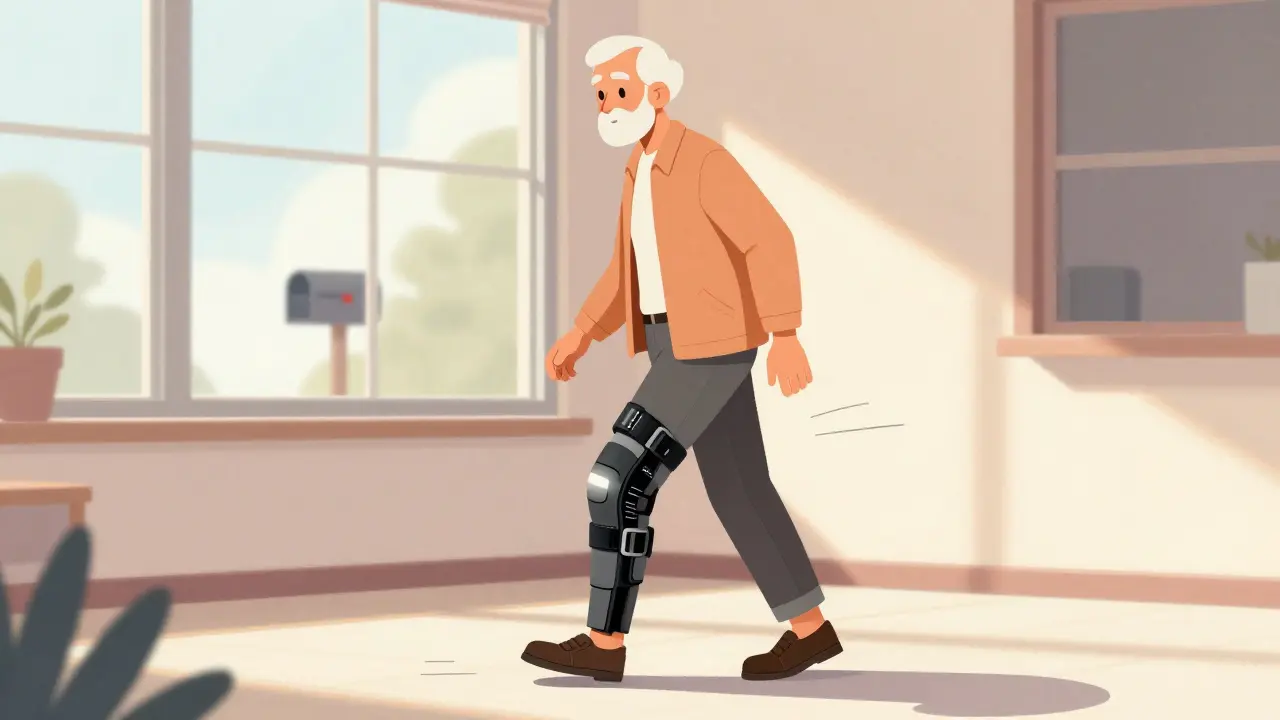
When your knee hurts just to stand up or walk to the mailbox, you’re not just dealing with pain-you’re losing your independence. Knee osteoarthritis (OA) affects over 250 million people worldwide, and if you’re over 50, your odds are higher than you think. The good news? You don’t need surgery right away. Three proven, non-surgical approaches-bracing, injections, and exercise-can give you real relief, and many people find the best results by combining them.
Bracing: The Hidden Hero for Knee Pain
Knee braces aren’t just for athletes. For osteoarthritis, especially when the pain is on the inner side of the knee (medial compartment OA), unloader braces are one of the most effective tools you can use. These braces work by shifting pressure away from the damaged part of your joint, like gently pulling your knee into a better alignment. Studies show they can reduce pain by 30-45% on the WOMAC scale, which measures pain, stiffness, and function. You won’t feel it instantly, but within a few days of wearing it during daily activities, many people report being able to walk farther and stand longer. One study found unloader braces cut the knee’s adduction moment-essentially how much weight presses down on the bad side-by 20-40%. That’s a huge change for a joint that’s been wearing down for years. But not all braces are created equal. Cheap off-the-shelf ones often don’t fit right and won’t help. You need a custom fit from a certified orthotist. The right brace costs between $300 and $1,200, and while insurance like Medicare may cover 80%, you’ll still pay the deductible. Most people need 2-3 weeks to get used to the feel, and skin irritation is the most common complaint. If you’re getting redness or sores, it’s not the brace-it’s the fit. Go back and get it adjusted.Injections: Fast Relief, But Not a Fix
If you need quick pain relief to get through a flare-up, injections are the fastest option. There are four main types, each with different pros and cons:- Corticosteroids: These are the most common. A single shot costs $50-$150 and can give you 4-12 weeks of relief. But repeated use-more than 3-4 times a year-can damage cartilage over time. The FDA recommends limiting them for this reason.
- Hyaluronic acid (viscosupplementation): This is like adding lubricant to a rusty hinge. You get a series of 3-5 weekly injections, costing $500-$1,200 total. A new version called Gel-Syn 3, approved in 2023, lasts up to 22 weeks. But not everyone responds. Studies show it reduces pain by about 35mm on the VAS scale at 4 weeks, better than placebo but not always better than exercise.
- PRP (Platelet-Rich Plasma): Your own blood is drawn, spun to concentrate healing factors, and injected back in. It costs $500-$2,000 and isn’t usually covered by insurance. Evidence is mixed, but some patients report longer-lasting relief than steroids.
- Botulinum toxin (Botox): Still experimental for OA, but early studies show it can block pain signals in the joint. Costs $400-$800 per injection.
Exercise: The Only Treatment That Gets Better Over Time
This is the one no one wants to hear first. But here’s the truth: exercise is the only intervention that improves your joint’s long-term health. It doesn’t just mask pain-it rebuilds the support system around your knee. Water-based exercise (like swimming or water aerobics) reduces pain by 28.7% on the VAS scale, compared to 22.3% for land-based workouts. Both work best when done 2-3 times a week for 45-60 minutes. You don’t need to run. Walking, cycling, and seated leg lifts are enough. A 2023 meta-analysis found consistent stretching improved total knee range of motion by an average of 8.2 degrees after just 6-8 weeks. And the benefits go beyond your knee. People who stick with exercise report less pain in their hips and back, better sleep, and improved mood. One Healthgrades analysis of nearly 4,000 patients showed 78% saw significant improvement after 12 weeks of exercise. But here’s the catch: only 48% still stick with it after a year. Why? It’s hard. It’s boring. It takes time. Start slow. Work with a physical therapist for the first 4-6 weeks to learn proper form. Use apps or videos from the Arthritis Foundation-they’re clear, free, and rated 4.7/5 for usability. Don’t push through sharp pain. Mild discomfort is normal. Sharp, stabbing pain is a stop sign.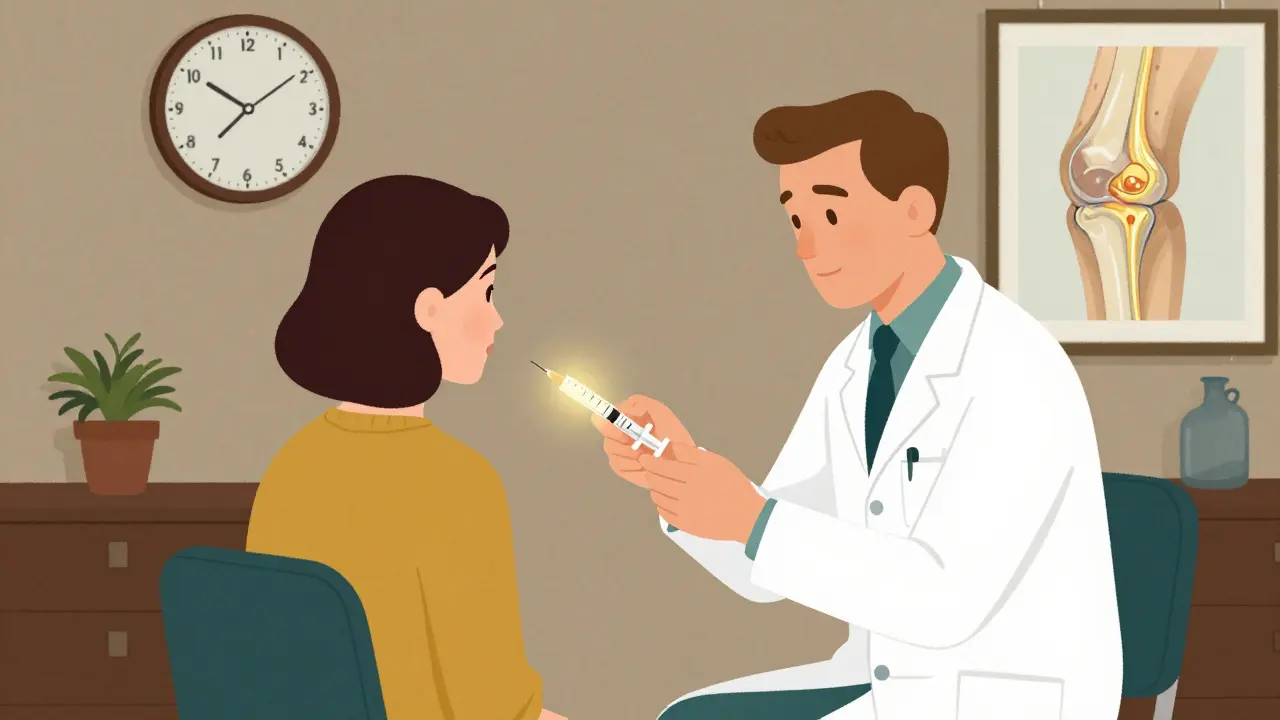
Which One Should You Choose? A Real-World Comparison
There’s no single best option. But there is a best combination.| Treatment | Pain Relief Speed | Duration of Relief | Cost (per course) | Long-Term Function | Adherence Rate (12 months) | Risks |
|---|---|---|---|---|---|---|
| Unloader Brace | Days to weeks | Long-term (with use) | $300-$1,200 | High | 89% | Skin irritation, bulkiness |
| Corticosteroid Injection | Days | 4-12 weeks | $50-$150 | Low | 92% | Cartilage damage with repeat use |
| Hyaluronic Acid Injection | Weeks | 12-22 weeks | $500-$1,200 | Low | 92% | Injection site pain, rare infection |
| Exercise Program | 4-12 weeks | Years (if continued) | $0-$100 (app or class) | Very High | 48% | None if done correctly |
How to Build Your Personal Plan
Here’s how to put it all together, step by step:- Start with exercise. Even 15 minutes a day, 3 times a week. Use a free app or join a local arthritis-friendly class. This is your foundation.
- Get fitted for a brace. If your pain is worse when walking or going up stairs, especially on one side, ask your doctor for a referral to an orthotist. Don’t buy online without a fitting.
- Use injections strategically. Save them for flare-ups. If you’re having a bad month, get a steroid shot to give you the window to get back to your exercise routine. Don’t use them as your main tool.
- Track your progress. Use a simple journal: rate your pain (0-10), note how far you walked, and how many days you exercised. You’ll see patterns.
- Reassess every 3 months. If your pain hasn’t improved after 12 weeks of consistent exercise and bracing, talk to your doctor about other options. Don’t wait until you’re stuck on the couch.

What to Avoid
- Don’t stop moving because you’re afraid of pain. Movement is medicine. - Don’t rely on injections alone. They don’t fix anything. They just buy time. - Don’t ignore your weight. Losing just 10 pounds cuts knee stress by 40 pounds with every step. - Don’t trust miracle cures. No supplement, cream, or gadget replaces proven therapy. - Don’t wait until you’re in agony. Early intervention keeps you active longer.What’s Next?
The future of knee OA care is personal. Smart braces with motion sensors (like Össur’s Unloader One Pulse) are already giving real-time feedback on how you walk. Researchers are using AI to match patients with the best treatment based on their joint shape, muscle strength, and even genetics. In five years, your doctor might hand you a custom exercise plan generated by your wearable brace. But right now, the tools you need are already here: a brace that fits, a shot when you need it, and a routine that keeps your muscles strong. You don’t need to be perfect. You just need to be consistent.Can knee braces make osteoarthritis worse?
No, when properly fitted, unloader braces reduce stress on the damaged part of the knee and can slow progression. But poorly fitted braces can cause skin breakdown or alter your gait in a way that strains other joints. Always get fitted by a certified orthotist.
How often can I get corticosteroid injections in my knee?
Most doctors limit corticosteroid injections to 3-4 times per year in the same knee. More frequent use can damage cartilage over time. The FDA recommends this limit, and studies show diminishing returns after the third injection.
Is walking good for knee osteoarthritis?
Yes, walking is one of the best exercises for knee OA. It improves circulation, strengthens muscles around the joint, and helps with weight control. Start with short, flat walks and gradually increase distance. Use a brace if needed, and avoid steep hills or uneven surfaces if your pain flares.
Do hyaluronic acid injections really work?
They work for some people-not all. Studies show an average 35mm reduction in pain on the VAS scale at 4 weeks, which is better than placebo but not always better than exercise. Newer formulations like Gel-Syn 3 last longer-up to 22 weeks. Insurance often requires trying exercise first before approving them.
Why do I keep dropping out of my exercise program?
You’re not alone. Over 50% of people stop exercising after 6 months because it’s hard to stay motivated. To stick with it, find a buddy, join a group class, use a tracking app, or reward yourself for consistency-not results. Small wins matter. Even 10 minutes a day counts.
If you’ve tried one of these treatments and it didn’t work, don’t give up. Try another. Or better yet, combine them. The goal isn’t to eliminate pain completely-it’s to keep you moving, independent, and in control of your life.




Alexandra Enns
24 January 2026 - 13:01 PM
This article is basically Big Pharma’s PR stunt dressed up as medical advice. Braces? Please. I’ve seen people wearing those things like they’re in a steampunk convention. And injections? You think they’re helping? Nah. They’re just buying time so you’ll keep paying for more shots while the real solution-avoiding processed carbs and sugar-is ignored. Your knee doesn’t need lubricant. It needs less inflammation. And guess what? That comes from your plate, not a doctor’s syringe.
Marie-Pier D.
25 January 2026 - 03:12 AM
OMG I’m so glad someone finally said this 😭 I’ve been using a brace for 6 months now and it’s been life-changing-like, I finally walked to the park with my grandkids without crying. But honestly? The exercise part? HARD. Like, ‘I-want-to-sleep-for-a-week’ hard. But I did it with a YouTube video from the Arthritis Foundation and now I can actually bend my knee again. You’re not broken-you’re just outta practice. 💪❤️
blackbelt security
27 January 2026 - 03:07 AM
Consistency beats magic bullets. I was skeptical about exercise too-until I started doing seated leg lifts while watching TV. 10 reps, 3x a day. No fancy gear. No cost. After 8 weeks, my pain dropped from an 8 to a 3. I didn’t feel ‘cured.’ I felt *capable*. That’s the win.
Karen Conlin
28 January 2026 - 22:20 PM
Let’s be real-most people don’t have access to orthotists or can’t afford a $1,200 brace. And let’s not pretend insurance covers everything. I’ve seen elderly folks skip meals to pay for steroid shots. This article reads like it was written for middle-class Americans with good benefits. What about the rest of us? The ones who walk 3 miles to the clinic because they can’t afford gas? We need solutions that don’t require a trust fund.
Sushrita Chakraborty
29 January 2026 - 16:49 PM
It is imperative to note that the efficacy of hyaluronic acid injections remains a subject of ongoing scientific debate. While some randomized controlled trials indicate statistically significant pain reduction, others-including a 2022 Cochrane review-conclude that the clinical significance is marginal. Moreover, the cost-benefit analysis must be weighed against non-pharmacological interventions, which demonstrate superior long-term outcomes with negligible risk. Therefore, exercise should remain the first-line recommendation, as endorsed by the European League Against Rheumatism.
Jamie Hooper
30 January 2026 - 02:22 AM
braces are just fancy knee corsets lmao. i got one off amazon for $80 and it’s basically a neoprene sleeve with a strap. i wear it to the pub and people think i’m in a wrestling match. still, i can walk to the shop now so… 🤷♂️
Husain Atther
30 January 2026 - 10:09 AM
Many of us in developing countries do not have access to these treatments at all. In my village, people use warm mustard oil massages and rest. It’s not fancy, but it’s what works with what we have. I hope the medical community remembers that not everyone can afford a $1,200 brace or a specialist visit. Sometimes, compassion matters more than technology.
Helen Leite
1 February 2026 - 06:08 AM
THEY’RE HIDING THE TRUTH!! 😱 The real cause of knee OA? 5G radiation from cell towers + chemtrails messing with your joint fluid!! I know a guy whose knee stopped hurting after he wrapped it in aluminum foil and stopped eating GMO corn. The FDA doesn’t want you to know this!! 🤫
Izzy Hadala
2 February 2026 - 14:05 PM
While the empirical data presented in this article is methodologically sound and aligns with current clinical guidelines, I would respectfully request access to the primary source studies referenced for the 89% adherence rate associated with unloader braces. Additionally, I am curious as to whether the longitudinal follow-up period for the exercise cohort extended beyond 12 months, as attrition bias may significantly influence reported outcomes. The statistical methodology underpinning these claims warrants further scrutiny.
Elizabeth Cannon
2 February 2026 - 22:49 PM
Y’all are overcomplicating this. I got a $25 knee sleeve from Walmart, started walking 20 mins a day, and cut out soda. No shots. No fancy brace. No therapist. I’m 68 and I can now play with my grandkids without limping. You don’t need a PhD to fix your knee. You just need to move. And stop lying to yourself that you’re too old.