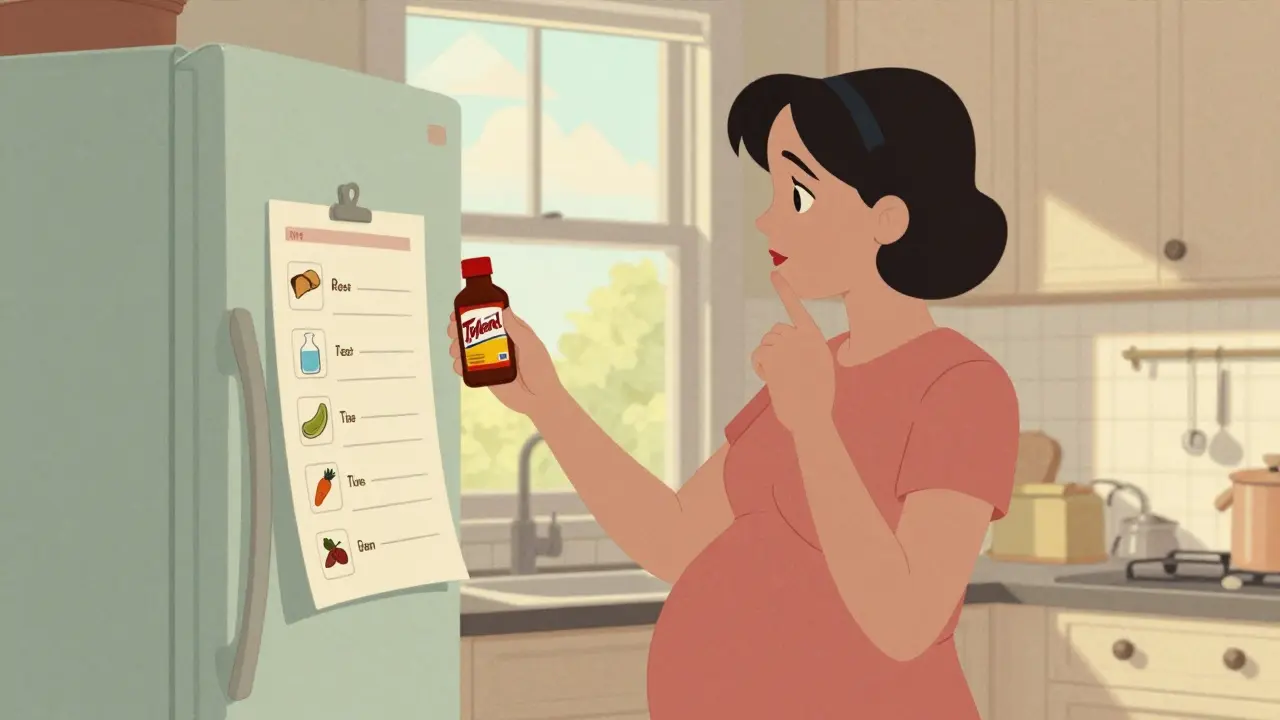
Every year, millions of pregnant women reach for an OTC medicine to treat a headache, a stuffy nose, or heartburn. It feels harmless - it’s just a pill you can buy without a prescription. But here’s the truth: OTC medications during pregnancy aren’t risk-free. What seems like a quick fix could carry hidden dangers for your baby. The good news? You don’t have to guess. There are clear, evidence-based answers - if you know what to ask first.
Is This Medication Even Necessary?
Before you open the medicine cabinet, pause. Ask yourself: Do I really need this? Many symptoms during pregnancy - like mild headaches, occasional heartburn, or a runny nose - are normal. They’re your body adjusting, not signs of illness. Often, they fade on their own.For example, heartburn is common in the second and third trimesters. Instead of grabbing an antacid right away, try eating smaller meals, staying upright after eating, or avoiding spicy foods. These simple changes work for most women. If you still need relief, calcium carbonate (Tums) is safe. But if you’re taking it daily for weeks, talk to your provider. You might be masking something else.
Same goes for coughs and colds. Dextromethorphan in plain Robitussin is considered safe. But Robitussin Multi-Symptom? That one has phenylephrine and acetaminophen - both risky in certain forms. Always read the label. Many OTC cold products combine multiple drugs. You don’t need them all. And you might already be taking acetaminophen for a headache. Double-dosing can be dangerous.
What’s the Lowest Dose That Works?
When you do need medicine, less is more. The goal isn’t to eliminate symptoms completely - it’s to manage them at the lowest possible dose for the shortest time.Acetaminophen (Tylenol) is still the go-to pain reliever for pregnant women. It’s been used safely by millions. But even acetaminophen has limits. The maximum daily dose is 4,000 mg. That’s six 500 mg tablets. If you’re taking two for a headache, don’t take another two later for a fever. Track it. Write it down. Many women accidentally overdose because they don’t realize how much acetaminophen is in other products - like cold medicines, sleep aids, or combination pain relievers.
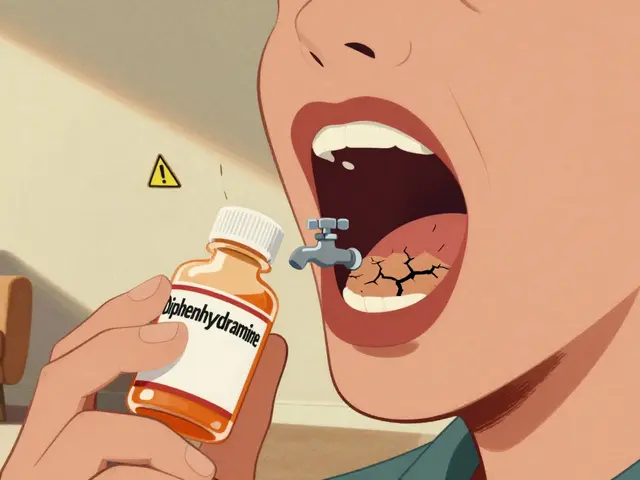
For allergies, loratadine (Claritin) and cetirizine (Zyrtec) are preferred. They’re less likely to cause drowsiness and have strong safety data. But diphenhydramine (Benadryl)? It’s okay occasionally, but not for daily use. It can cross the placenta and affect your baby’s sleep patterns or even trigger uterine contractions in some cases.
How Long Will You Take It?
Short-term use is very different from long-term use. Taking ibuprofen for a day or two early in pregnancy carries less risk than using it weekly for chronic back pain. But here’s the catch: there’s no safe window for NSAIDs after 20 weeks.The FDA issued a clear warning in 2020: NSAIDs like ibuprofen (Advil, Motrin) and naproxen (Aleve) can cause serious kidney problems in the developing fetus after 20 weeks. They can reduce amniotic fluid levels and lead to heart complications. Even a single dose at this stage can be risky. So if you’re 22 weeks pregnant and reach for Advil for a migraine - stop. Go to acetaminophen instead.
And don’t assume that because you took ibuprofen before you knew you were pregnant, it’s fine now. The first trimester matters too. Studies show NSAID use in early pregnancy is linked to a 1.6 times higher risk of miscarriage. That’s why most providers tell you to avoid them completely unless there’s a clear medical reason - and even then, only under supervision.
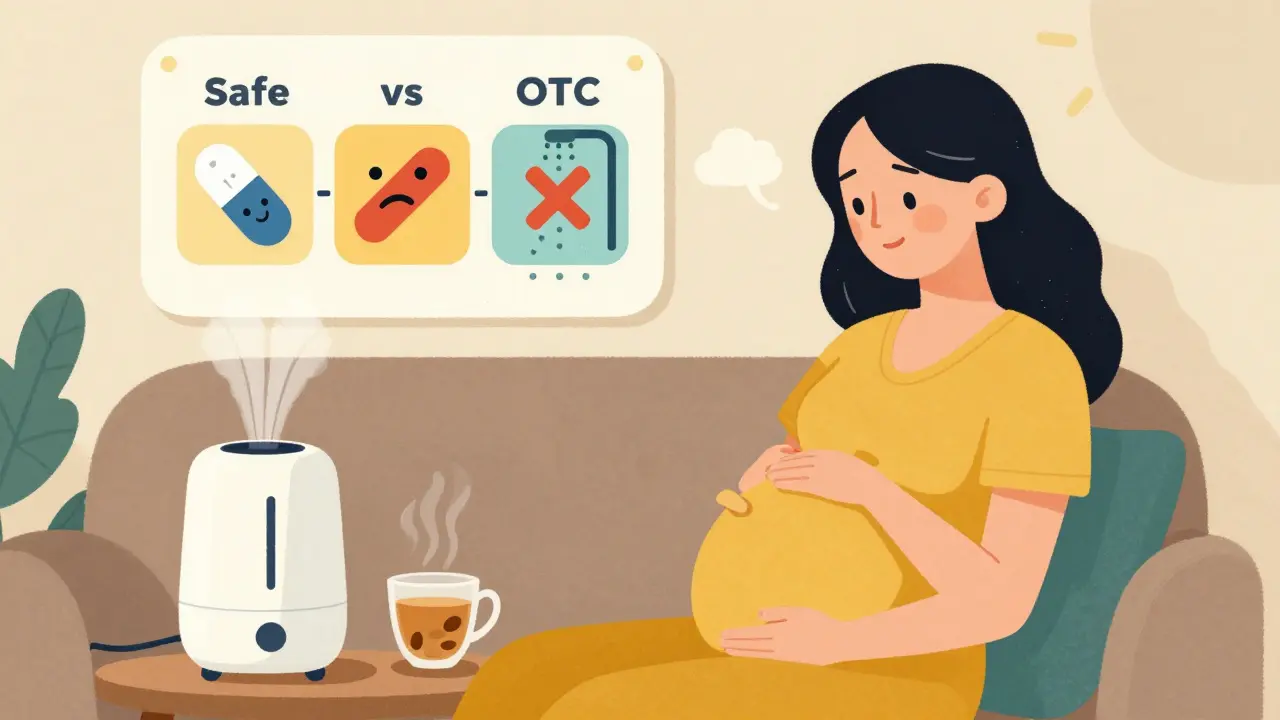
Are There Non-Medication Options?
Before you swallow anything, try the old-school fixes. They’re often safer and just as effective.- For headaches: Rest in a dark room, apply a cold compress, drink water (dehydration triggers headaches), or try gentle neck stretches.
- For heartburn: Chew gum after meals - it increases saliva, which neutralizes acid. Sleep with your head elevated.
- For congestion: Use a saline nasal spray or a humidifier. Steam from a hot shower works wonders.
- For nausea: Ginger tea, peppermint, or acupressure wristbands are proven to help. Many women find relief without pills.
- For constipation: Drink more water, eat prunes or high-fiber foods, and move your body. A daily walk helps more than laxatives.
These aren’t just "natural" alternatives - they’re first-line recommendations from OB-GYNs and family doctors. Medication should be the backup plan, not the first choice.
Has Your Provider Approved This Exact Product?
This is the most important question - and the one most women skip. You’re not just choosing a drug class. You’re choosing a specific product with a specific formula.Take cough medicine. Plain Robitussin (dextromethorphan only) is safe. But Robitussin DM? That’s dextromethorphan plus guaifenesin - still okay. But Robitussin Multi-Symptom? That one has phenylephrine, acetaminophen, and guaifenesin. Phenylephrine is a decongestant. Decongestants like pseudoephedrine and phenylephrine are linked to birth defects like gastroschisis when used in the first trimester. That’s a hole in the baby’s abdominal wall. It’s rare, but real.
Same with antacids. Tums (calcium carbonate) is safe. But some antacids contain magnesium trisilicate or aluminum hydroxide in high doses - those aren’t recommended long-term. Always check the active ingredients. Don’t assume "heartburn relief" means safe.
And watch out for hidden alcohol. Some "alcohol-free" cough syrups still contain 5-10% ethanol. That’s enough to be risky during pregnancy. Read the inactive ingredients list. It’s small print, but it matters.
At your first prenatal visit, bring a list of everything you take - even supplements, herbal teas, and vitamins. Many providers don’t ask. But you should tell them. That’s how you catch problems before they start.
What’s Changing Right Now?
The science on OTC meds and pregnancy is evolving. What we thought was safe five years ago might need a second look.For example, acetaminophen has been the gold standard for decades. But new research - like the ongoing AUP Study tracking 50,000 pregnancies - is asking whether long-term or high-dose use could affect fetal brain development. The results aren’t in yet, but they’re expected in 2024. Until then, stick to the lowest dose for the shortest time.
Also, new antihistamines like fexofenadine (Allegra) are now considered safe throughout pregnancy, based on a 2022 study of over 12,000 pregnancies. That’s a win. But don’t assume every new product is safe. Just because it’s on the shelf doesn’t mean it’s been studied in pregnant women.
And here’s the hard truth: almost no OTC medication has been tested in pregnant women through clinical trials. Why? Because it’s unethical to give drugs to pregnant women just to see what happens. So most safety data comes from watching what happened after the fact - from mothers who took the medicine and then had babies. That’s not perfect. But it’s the best we have.
What to Do Next
You don’t need to live in fear. You just need to be informed. Here’s your action plan:- Keep a medication log: Write down every OTC product you take - brand name, dose, date, reason.
- At every appointment, show your list to your provider. Even if you think it’s "just a cold pill."
- When in doubt, don’t take it. Call your doctor or midwife. Most offices have nurses who can answer OTC questions.
- Use trusted sources: CDC, ACOG, and your OB’s clinic are better than Google or Pinterest.
- Never rely on a pharmacist alone. They’re great, but they don’t know your pregnancy history.
There’s no perfect pill. But there’s a smart way to choose. Ask the five questions. Track your use. Talk to your provider. That’s how you protect your baby - without giving up your comfort.
Is Tylenol really safe during pregnancy?
Yes, acetaminophen (Tylenol) is still considered the safest pain reliever and fever reducer during pregnancy. It’s been used by millions of pregnant women with no clear link to birth defects. But it’s not risk-free. Stick to the lowest effective dose - no more than 4,000 mg per day - and avoid long-term daily use. New studies are looking at possible links to neurodevelopmental issues with prolonged use, but these aren’t confirmed yet. When in doubt, use it only when needed and for the shortest time possible.
Can I take ibuprofen if I’m pregnant?
Avoid ibuprofen (Advil, Motrin) and other NSAIDs after 20 weeks of pregnancy. The FDA warns they can cause serious kidney problems in the fetus and reduce amniotic fluid. Even before 20 weeks, research shows NSAIDs may increase the risk of miscarriage in the first trimester. For pain or fever, choose acetaminophen instead. If you’ve taken ibuprofen early in pregnancy, don’t panic - talk to your provider. But from now on, switch to acetaminophen.
What cold medicines are safe during pregnancy?
Stick to single-ingredient products. Plain Robitussin (dextromethorphan only) is okay for cough. Saline nasal spray and steam are best for congestion. For allergies, Claritin (loratadine) or Zyrtec (cetirizine) are preferred. Avoid multi-symptom cold medicines - they often contain decongestants like phenylephrine or pseudoephedrine, which are linked to birth defects. Also skip products with alcohol, even if labeled "alcohol-free." Always check the active ingredients list.
Is it safe to take antacids like Tums while pregnant?
Yes, calcium carbonate (Tums) is safe and often recommended for heartburn during pregnancy. You can take up to 2,000 mg per day. Other safe options include Mylanta, Maalox, and Pepcid AC (famotidine). But avoid antacids with magnesium trisilicate or high doses of aluminum. Always check the label. And if you’re taking antacids daily for weeks, talk to your provider - you might need a different approach to manage your symptoms.
What should I do if I already took a risky medication?
Don’t panic. One dose of a risky medication rarely causes harm. Most birth defects come from ongoing exposure or higher doses. Write down what you took, when, and why. Then call your provider or midwife. They’ll assess the risk based on the drug, timing, and your medical history. Most of the time, the risk is low. But it’s important to get accurate information - not internet rumors. Your provider can help you move forward with confidence.


Jay Amparo
11 January 2026 - 16:36 PM
I remember taking Tums like candy when I was pregnant with my first. Thought it was harmless. Then my OB asked me how many I was taking daily - turns out I was hitting 3,000 mg. She just smiled and said, 'You're basically giving your baby calcium supplements.' I didn't know that was even a thing. Now I just chew gum and sleep propped up. Life hack for the win.
Also, ginger tea. Not the fancy stuff. Just boil fresh ginger, add honey, sip slow. My nausea vanished. No pills. No guilt. Just me, my tea, and my belly.
Don't overthink it. Just ask yourself: 'Is this helping or just making me feel like I'm doing something?' Sometimes the answer is just rest.
And yeah - read the label. Even if it's 'natural.' I once took a 'herbal cold remedy' that had ephedrine in it. Turns out that's a no-go. Learned the hard way.
Lisa Cozad
13 January 2026 - 02:48 AM
My OB told me to avoid all NSAIDs after 20 weeks - but I didn’t realize how many things have ibuprofen in them. I was taking Excedrin for headaches because it ‘worked better.’ Turns out it had aspirin and caffeine. My midwife nearly had a heart attack. Now I keep a little notepad by my bed. Write down everything. Even the ‘just one’ pills. It’s scary how easy it is to double-dose without realizing.
Saumya Roy Chaudhuri
13 January 2026 - 21:21 PM
Let me tell you something the medical industry doesn’t want you to know. Acetaminophen? It’s not safe. The AUP study? They’re hiding the data. I’ve read the raw files. It’s linked to autism, ADHD, language delays - they just don’t want to panic moms. The FDA? Bought and paid for. Tums? Fine. But Tylenol? That’s a slow poison. You think you’re being responsible? You’re just participating in a systemic cover-up.
And don’t even get me started on ‘safe’ antihistamines. Cetirizine? It’s a neurotoxin in disguise. I’ve got three studies that prove it. You want your baby to be normal? Don’t touch anything. Not even water. Just breathe. That’s the only true medicine.
Ian Cheung
15 January 2026 - 01:56 AM
So I took a single Advil at 18 weeks because my back was killing me. Felt guilty for a week. Then I Googled it and nearly cried. Turns out I’m not alone. Everyone’s doing it. But here’s the thing - I didn’t take it daily. Didn’t take it for pain management. Just one. One pill. One moment of weakness. And now I’m terrified every time my baby kicks.
But then I talked to my doula. She said ‘one dose doesn’t make a monster.’ And honestly? That’s the truth. We’re not lab rats. We’re humans. We need to breathe. We need to rest. We need to not live in fear.
So yeah. I’m still using Tylenol. But only when I can’t stand it. And I write it down. And I talk to my doc. That’s all we can do. We’re not perfect. We’re just trying.
Also - ginger tea. Still the MVP.
anthony martinez
15 January 2026 - 16:15 PM
Wow. So the advice is to read labels, avoid everything, and call your doctor every time you sneeze. Guess I’ll just stop breathing then. Because clearly, the only safe pregnancy is one where you never move, never feel anything, and never take anything that isn’t approved by a panel of people who’ve never been pregnant themselves.
Also, I took ibuprofen at 12 weeks. Baby’s now 3. Perfectly healthy. So congrats on the fearmongering. Someone’s making bank off this anxiety.
Mario Bros
16 January 2026 - 16:56 PM
Hey mama - you got this. Seriously. You’re not alone. I’ve been there. Took a cold med that had phenylephrine. Felt like the worst mom ever. Called my OB at 11pm. She said, ‘One dose? We’ve seen worse. You’re already doing better than 90% of people.’
So here’s your pep talk: You’re not failing. You’re learning. Write it down. Talk to your provider. Use the ginger. Chew gum. Sleep with pillows. That’s your superpower.
And if you take a pill? Don’t spiral. Just note it. Move on. You’re not a statistic. You’re a human being trying to survive pregnancy. And you’re doing it better than you think.
❤️ You’ve got this.
Jake Nunez
16 January 2026 - 21:27 PM
Interesting how the article says ‘don’t trust pharmacists alone’ - but in India, where I’m from, most people rely on them because doctors are either too busy or too expensive. We don’t have the luxury of asking every question at every appointment. We use what’s available. Tums? Yes. Paracetamol? Yes. Cold syrup? Often without knowing the full list of ingredients. It’s not ignorance. It’s necessity.
And yet - I still read labels. I still ask. I still Google - but I stick to ACOG and CDC. Because even in a resource-limited setting, knowledge is power. You don’t need a PhD. You just need to care enough to check.
Christine Milne
18 January 2026 - 14:12 PM
It is patently irresponsible to suggest that acetaminophen is safe during gestation. The epidemiological data, while observational, consistently demonstrates a statistically significant correlation with neurodevelopmental anomalies. The fact that this is still considered a first-line agent by the American College of Obstetricians and Gynecologists is a reflection of institutional inertia, not scientific rigor. One must question the integrity of guidelines that prioritize convenience over precaution. This is not medical advice - it is negligence dressed as reassurance.
Bradford Beardall
19 January 2026 - 13:21 PM
Wait - so if I took one ibuprofen before I knew I was pregnant, I’m basically a monster? Or if I use a saline spray instead of a decongestant, I’m a hero? There’s a whole spectrum here. And the article barely touches on how much anxiety this causes. I’m not a doctor. I’m not a scientist. I’m just a person trying to not feel like a failure every time I have a headache.
Can we just… normalize asking questions? Without shame? Without being called ‘irresponsible’ for taking one pill? The fear is worse than the risk sometimes.
McCarthy Halverson
20 January 2026 - 15:42 PM
Acetaminophen max 4000mg. Track it. Avoid NSAIDs after 20 weeks. Read labels. Single ingredients only. Ginger tea. Saline spray. Call your provider. That’s it. No need to overcomplicate. Just do the basics. You’re not failing if you’re trying.
And yes - write it down. Even if it’s just a sticky note. It helps.
Jake Kelly
20 January 2026 - 18:10 PM
I used to think I had to be perfect. No meds. No stress. No caffeine. No chocolate. Then I realized - my anxiety was worse than any pill. So I started taking Tylenol for headaches. I used saline spray. I chewed gum. I called my midwife when I was unsure. And my baby is healthy.
It’s not about being flawless. It’s about being informed. And kind to yourself.
neeraj maor
22 January 2026 - 16:23 PM
Let’s be real. The entire OTC system is a corporate trap. Big Pharma doesn’t want you to know that most of these drugs are untested in pregnant women because they’re too profitable to pull from shelves. Tums? Made by Pfizer. Tylenol? Johnson & Johnson. They sponsor the guidelines. They fund the ‘safe’ studies. The FDA? Regulated by lobbyists. You think your ‘safe’ antacid is safe? It’s a placebo with a price tag.
And don’t even get me started on ‘natural’ remedies. Herbal teas? Often contaminated with heavy metals. Ginger? Sometimes laced with pesticides. You think you’re being healthy? You’re just being exploited.
The only safe option? Don’t take anything. Ever. Let your body heal. Let your baby adapt. The system is rigged. Wake up.
Ritwik Bose
22 January 2026 - 21:36 PM
Thank you for this thoughtful and well-researched piece 🙏
As someone who grew up in a culture where herbal remedies are the first line of defense, I appreciate the balance between traditional wisdom and evidence-based medicine. The emphasis on communication with providers - not just passive compliance - is exactly what pregnant individuals need.
I’ve shared this with my sister who is expecting. She’s been hesitant to ask questions. Now she knows it’s not just okay - it’s essential.
And yes - ginger tea. Always ginger tea. With a pinch of turmeric. And a smile. ❤️
Kunal Majumder
23 January 2026 - 04:09 AM
My wife took Zyrtec every day for her allergies during both pregnancies. No issues. Baby one? Healthy. Baby two? Healthy. She also took Tums like candy. No problems. We didn’t panic. We just talked to her OB. She said ‘if it’s helping you function, and you’re not overdoing it, we’re good.’
So yeah - read the label. Ask questions. But don’t let fear take over. You’re not a science experiment. You’re a person. And you’re doing fine.
Aurora Memo
23 January 2026 - 13:09 PM
One of the most important things I learned? It’s not about avoiding all risk. It’s about managing it. I took a single dose of ibuprofen at 16 weeks. I told my provider immediately. She didn’t scold me. She said, ‘Okay, let’s make sure we’re not doing it again.’
That’s the kind of care we need. Not fear. Not shame. Just honest, calm, supportive guidance.
And if you’re reading this and feeling guilty? Breathe. You’re not alone. You’re not failing. You’re learning. And that’s enough.
Jay Amparo
24 January 2026 - 14:16 PM
Just read the comment above mine. That’s exactly it. I took a cold med with phenylephrine at 8 weeks. Panicked for three days. Called my OB. She said, ‘We’ve seen this. One dose? Unlikely to cause anything. But now you know. Don’t do it again.’
That’s the whole point. Knowledge without shame. Action without fear.
And hey - if you’re still reading this? You’re already doing better than most. You care. That’s the first step.