
Why Too Many Pills a Day Makes You Miss Doses
Imagine waking up, swallowing six pills. Then again at noon, another four. Evening brings three more, and before bed, two. That’s 15 pills in one day. Now imagine doing that every single day for months-or years. It’s not just inconvenient. It’s exhausting. And it’s why so many people stop taking their meds, even when they know it matters.
Medication adherence isn’t about willpower. It’s about design. When your routine is cluttered with too many pills, too many times a day, your brain starts to tune out. You forget. You skip. You get overwhelmed. And the science is clear: the more times you have to take a pill each day, the less likely you are to take it at all. Studies show that people taking four or more doses daily are twice as likely to miss doses compared to those on once-daily regimens.
What Counts as a Simplified Regimen?
A simplified regimen doesn’t mean fewer drugs. It means fewer times you have to take them. The goal isn’t to cut your meds-it’s to group them smartly so your day doesn’t revolve around pill bottles.
Most people don’t realize that many medications can be safely combined or shifted to once-daily timing. For example, some blood pressure pills, cholesterol meds, and even diabetes drugs now come in extended-release forms that last 24 hours. That means a drug you used to take twice a day can now be taken just once. No loss in effectiveness. Just less hassle.
The Universal Medication Schedule gives patients a simple framework: take your meds at four standard times-morning, noon, evening, bedtime. That’s it. No 7 a.m., 11 a.m., 3 p.m., 6 p.m., 9 p.m. chaos. Just four slots. And when you align your pills to those slots, dosing errors drop by 35%.
Four Proven Ways to Cut Down Daily Doses
There are four main tools used by pharmacists and doctors to simplify regimens. Not all work for everyone-but most people can use at least one.
- Fixed-dose combinations (FDCs): This is when two or more drugs are merged into a single pill. For example, a common heart failure combo includes an ACE inhibitor and a diuretic in one tablet. HIV patients often take three antivirals in one pill. About one-third of all simplification efforts use this method. It cuts pill count fast-sometimes from 10 pills to 3.
- Once-daily dosing: Some medications were originally designed for multiple doses, but newer versions release the drug slowly over 24 hours. A statin you took at night and again in the morning? Now it’s just one at night. Not every drug can do this, but many can. Blood pressure meds, antidepressants, and antivirals are prime candidates.
- Medication synchronization: Instead of picking up prescriptions on different days each month, your pharmacist aligns all your refills to one date. No more juggling three pharmacy trips a month. You get everything on the same day. This reduces missed doses by preventing gaps in supply. Studies show it cuts pharmacy visits by 60%.
- Multi-dose compliance packaging: Think of those little plastic boxes with compartments labeled AM, PM, Night. Your pharmacist fills them weekly. You open one box, and everything you need for that time is right there. No counting. No confusion. For older adults or those with memory issues, this is a game-changer. Adherence jumps by 22% or more.

What Doesn’t Work-and Why
Not every simplification plan succeeds. And sometimes, the attempt itself causes harm.
Some patients try to combine meds on their own-say, tossing all their pills into one cup because they look similar. Big mistake. Some drugs shouldn’t be taken together. Others need to be spaced apart. A pharmacist survey found that 42% of patients who simplified on their own ended up taking incompatible meds together.
Insurance is another roadblock. Even if your doctor prescribes a once-daily combo pill, your plan might not cover it. One study showed 45% of Medicare Advantage patients were denied access to preferred simplified formulations because they cost more. That’s not a clinical issue-it’s a financial one.
And here’s the quiet truth: simplification doesn’t always mean better health outcomes. You might take your pills more often, but if your blood pressure or A1C doesn’t improve, something else is going on. Maybe diet, maybe stress, maybe another undiagnosed condition. Adherence is necessary-but not always sufficient.
How to Start the Process
You don’t need to wait for your doctor to bring it up. You can start today.
- Write down every pill you take, including over-the-counter drugs and supplements. Note the time, dose, and reason. Don’t guess-check the bottles.
- Bring it to your pharmacist. They’re trained to spot simplification opportunities. Ask: “Can any of these be combined? Can any be switched to once-daily?”
- Ask your doctor: “Is there a fixed-dose version of these meds?” or “Could any of these be safely moved to once daily?”
- Request synchronization: Call your pharmacy and ask if they offer refill alignment. Most do.
- Try compliance packaging: If you’re juggling more than five meds, ask for a blister pack. It’s often covered by insurance for seniors.
Don’t be afraid to push back. If your doctor says, “We’ve always done it this way,” ask, “Is there a newer option?” The goal isn’t to change your treatment-it’s to make it easier to stick with.
Real Stories, Real Results
In Calgary, a 72-year-old woman named Eleanor took 14 pills a day-six for high blood pressure, four for arthritis, two for cholesterol, one for thyroid, and one for sleep. She missed doses constantly. Her doctor switched her to three fixed-dose combos, moved two to once-daily, and put the rest into a weekly blister pack. She went from 14 doses to four. Her adherence jumped from 58% to 92%. She started walking again. Said she felt like she had her life back.
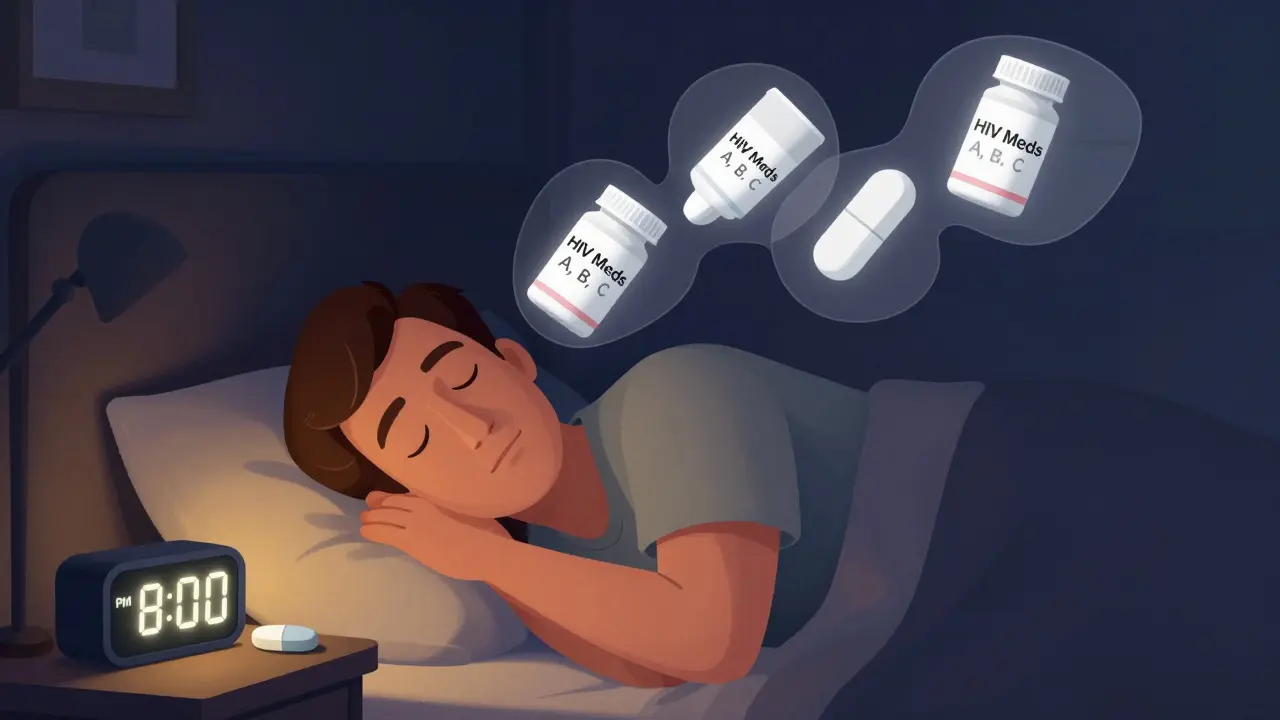
A man in his 50s with HIV switched from a three-pill, twice-daily regimen to a single pill once a day. His missed dose rate dropped from 12% to 4%. He stopped checking the clock every four hours. He started sleeping through the night.
These aren’t miracles. They’re outcomes of smart, simple changes.
What to Watch Out For
Simplification isn’t magic. It needs oversight.
First, never stop or change a med without talking to your provider. Even if two pills look alike, they might not be interchangeable.
Second, if you’re using a blister pack, check it weekly. Pharmacies sometimes make errors-especially when filling dozens of packs a day. Open one and compare it to your original prescription.
Third, if your regimen changes, ask for a written summary. Keep it in your wallet or phone. That way, if you’re in an emergency room or see a new doctor, they know exactly what you’re taking and when.
The Bigger Picture
This isn’t just about pills. It’s about dignity. About reclaiming your time. About not living in fear of forgetting something that keeps you alive.
With aging populations and rising rates of chronic disease, medication complexity is only getting worse. But so are the tools to fix it. AI-powered systems now analyze drug interactions and half-lives to suggest optimal combinations. Smart pill dispensers alert you when you miss a dose-and send alerts to your care team.
And here’s the good news: Medicare now covers medication reviews as part of the Annual Wellness Visit. Pharmacists can bill for time spent simplifying regimens. That means more people are getting help.
You don’t have to suffer through a confusing, overwhelming routine. There’s a better way. It just takes a conversation.






Shawn Peck
30 January 2026 - 20:43 PM
This is literally the most common thing I see in my dad's medicine cabinet. Fifteen pills a day? That's not a regimen, that's a full-time job. And nobody tells you how hard it is to keep track of which one does what. I swear, if I had to do that, I'd just throw them all in a cup and hope for the best.
Niamh Trihy
1 February 2026 - 02:32 AM
I work as a community pharmacist and this is exactly what we push daily. Fixed-dose combos and blister packs are game-changers. One elderly patient went from 18 pills to 4 in a weekly pack. Her daughter cried when she saw her take her meds without help for the first time in years. It's not rocket science - just basic human design.
Diana Dougan
2 February 2026 - 15:00 PM
Wow. Another feel-good article about pills. Did you forget to mention that 70% of these 'simplified' combos cost 3x more and insurance denies them? Also, 'once-daily' doesn't mean 'safe'. I had a friend take a combo pill and ended up in the ER because the diuretic and beta-blocker clashed. This isn't empowerment. It's corporate cost-cutting dressed up as healthcare.
Natasha Plebani
2 February 2026 - 20:21 PM
The ontological burden of pharmaceutical compliance is a structural failure of biomedical capitalism. We reduce human temporality to discrete, quantifiable intervals - morning, noon, evening, bedtime - as if the body operates on a clock rather than a dynamic, embodied rhythm. The pillbox is not a tool of liberation; it is a technocratic enclosure of autonomy. The very act of scheduling ingestion reinforces the alienation of the patient from their own physiological agency.
Kelly Weinhold
3 February 2026 - 01:40 AM
I just want to say - if you're reading this and feeling overwhelmed by your meds, you're not alone. Seriously. I used to be the person who skipped pills because I was tired of the chaos. Then my pharmacist sat me down with a pill organizer and we did it together. Now I take my meds like a ritual - not a chore. I feel lighter. I sleep better. You deserve to feel this easy. Don't be shy to ask for help. It's not weak to need a system. It's smart.
Kimberly Reker
4 February 2026 - 17:20 PM
I’ve been using a weekly blister pack for my diabetes and blood pressure meds for 2 years. Best decision ever. No more guessing. No more panic when I can’t find a bottle. My pharmacist fills it every Friday and I pick it up on my way to yoga. It’s that simple. And yes, it’s covered by my insurance. Just ask.
Eliana Botelho
5 February 2026 - 19:44 PM
Okay but what if you’re on 12 different meds and your doctor refuses to combine them because they’re ‘too old school’? I asked my cardiologist about FDCs and he said ‘We’ve always done it this way.’ So I went to a different doctor and got a referral to a med sync pharmacist. Took three months. Got my pills down to 3 pills a day. But now my insurance says the combo pill isn’t on formulary. So I pay $200 a month out of pocket. This system is broken. And you’re all just talking about organizing pills like it’s a Pinterest board.
Rob Webber
6 February 2026 - 05:50 AM
This article is a joke. You think people don’t know this stuff? We’ve been screaming about pill overload for a decade. But the system doesn’t care. Doctors are paid per visit, not per outcome. Pharmacies don’t get reimbursed for counseling. Insurance blocks the good stuff. And now you’re giving us a checklist like we’re toddlers who forgot to brush our teeth. I’m not lazy. I’m exhausted. And you’re not helping.
calanha nevin
7 February 2026 - 21:54 PM
Medication adherence is a systemic issue not a personal failing. Patients are not failing because they forget. The system is failing to accommodate human limitations. Pharmacists are the unsung heroes here. They are the ones who spend hours coordinating refills, checking interactions, and educating patients. We must expand their scope of practice and fund their time. This is not optional. It is essential.
Lisa McCluskey
9 February 2026 - 09:10 AM
My mom started using a blister pack after her stroke. She couldn’t read the labels anymore. The pharmacy filled it for free through Medicare. She hasn’t missed a dose in 18 months. Simple. No drama. Just good care. If you’re struggling, ask your pharmacist. They want you to succeed.
owori patrick
10 February 2026 - 06:10 AM
I come from Nigeria where many people can’t afford even one pill a day. But when I moved to the US and saw how complicated the system is here, I was shocked. You have all the tools, all the science, all the money - and you still make it hard to stay alive. This post is good. But it’s only for those who can navigate the system. What about the rest?
Claire Wiltshire
11 February 2026 - 03:59 AM
Thank you for outlining actionable steps that are both practical and compassionate. I’ve shared this with my elderly patients and they’ve expressed profound relief. The key is not just simplification - it’s dignity. When a person can take their medications without anxiety, they reclaim not just their health, but their sense of self. This is healthcare done right.
Darren Gormley
12 February 2026 - 03:23 AM
LMAO 🤡 this is the kind of content that makes me want to throw my pill organizer out the window. 'Ask your pharmacist' - yeah, right. They’re overworked and underpaid and they don’t have time to play detective with your 17 meds. And 'fixed-dose combos'? Try getting one that’s not $400 a month. Also, 'medication synchronization'? My pharmacy still sends me 3 separate texts on 3 different days. This article is a fantasy written by someone who’s never had to take more than 2 pills a day.
Shawn Peck
12 February 2026 - 09:48 AM
^^^ this. I told my dad to ask his pharmacist. He did. They said 'We don’t do that here.' So he called 5 others. One finally did it. Took 3 weeks. He’s still paying $150 extra a month for the combo pill. But at least he’s not mixing his blood pressure meds with his anxiety pills anymore.