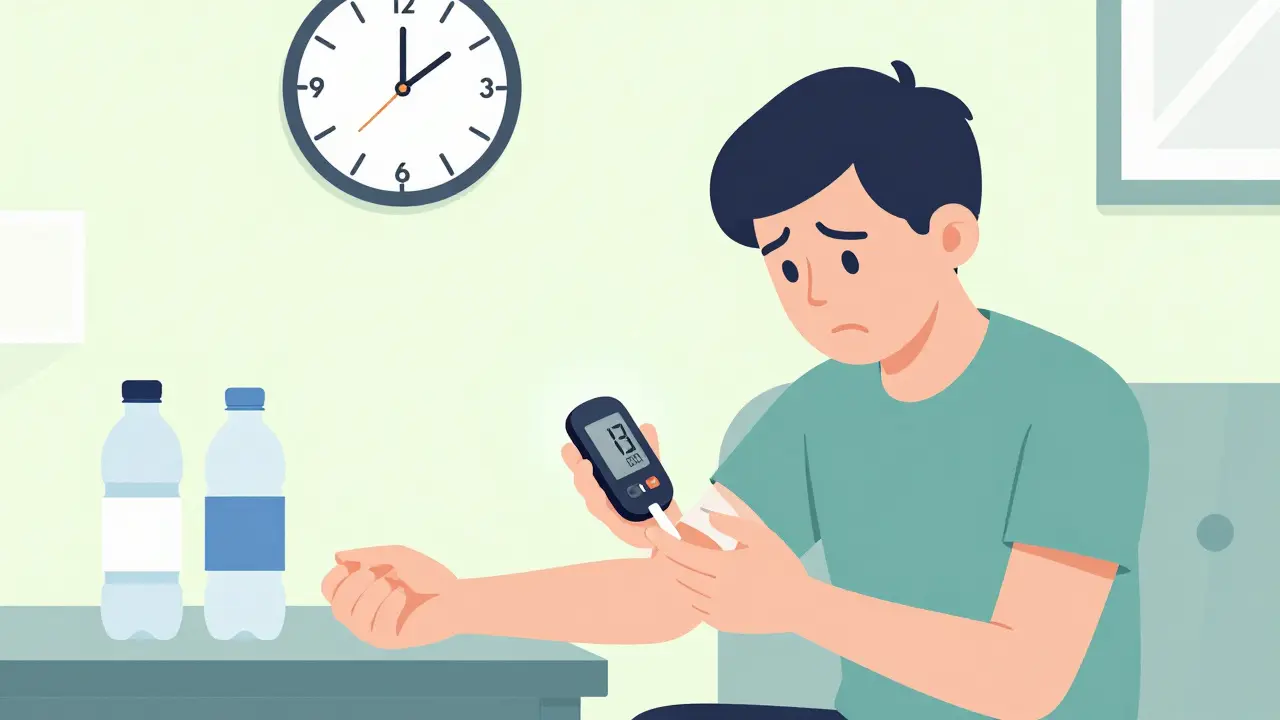
Diabetic ketoacidosis, or DKA, isn’t something you can wait out. It doesn’t fade away with rest or home remedies. If you or someone you care about has diabetes and starts showing signs like extreme thirst, frequent urination, nausea, or fruity-smelling breath, DKA could be kicking in-and time is critical.
What Happens When Your Body Runs Out of Insulin
Insulin is the key that lets your cells use glucose for energy. Without enough insulin-whether because you missed a dose, got sick, or your body stopped producing it altogether-your body panics. It starts breaking down fat for fuel. That process creates ketones, acids that build up in your blood. Too many ketones make your blood too acidic. That’s DKA.
This isn’t just a high blood sugar problem. It’s a full-body crisis. Blood glucose levels usually shoot above 250 mg/dL, but sometimes they’re normal or even low-what doctors call "euglycemic DKA." This happens more often with SGLT2 inhibitors, a type of diabetes medication, or in people who haven’t been diagnosed yet. That’s why you can’t rely on blood sugar alone. Ketones are the real red flag.
Early Warning Signs You Can’t Ignore
DKA doesn’t hit all at once. It creeps up over hours. The earliest signs are easy to brush off:
- Drinking way more than usual-four to six liters a day
- Peeing constantly, even at night
- Dry mouth that won’t go away, no matter how much you drink
- Feeling unusually tired, even after sleeping
If you have type 1 diabetes, and you notice two or more of these, check your blood sugar. If it’s over 240 mg/dL, test for ketones using a urine strip or a blood ketone meter. Don’t wait. If ketones are moderate or large, call your doctor or head to the ER. Don’t try to "tough it out."
Many people delay care because they think, "My sugar isn’t that high," or "I just have the stomach flu." But in 18% of cases, DKA is mistaken for gastroenteritis in emergency rooms. That delay can be deadly.
When It Gets Serious-Symptoms That Mean Emergency
If early signs aren’t acted on, things get dangerous fast-within 12 to 24 hours:
- Nausea and vomiting, sometimes repeatedly
- Sharp abdominal pain, often mistaken for appendicitis
- Weakness so severe you can’t stand or hold a cup
- Deep, fast breathing-called Kussmaul respirations-like you’re gasping for air
- Breath that smells like nail polish remover or rotten apples (that’s acetone)
- Confusion, dizziness, or trouble staying focused
- Loss of consciousness
These aren’t "maybe" symptoms. They’re clear signals your body is in metabolic collapse. A blood pH below 7.3 and bicarbonate under 18 mmol/L confirm DKA. If you’re seeing these signs, don’t call your doctor. Don’t wait for an appointment. Go to the hospital now.

What Happens in the Hospital
Once you arrive, treatment starts immediately. There’s no waiting for test results to be "reviewed." The clock starts ticking the moment you walk in.
First: fluids. You’re given 1 to 1.5 liters of saline over the first hour-enough to start rehydrating your cells and flushing out ketones. After that, fluids continue at a slower rate, but you’ll get several liters total over the next 24 hours.
Second: insulin. You get a small IV dose right away, then a continuous drip. The goal isn’t to drop your blood sugar fast-it’s to bring it down slowly, 50 to 75 mg/dL per hour. Dropping it too quickly can cause brain swelling, especially in kids. That’s the leading cause of death in pediatric DKA cases.
Third: potassium. Even if your blood test shows normal potassium, your body is actually starving for it. Insulin pushes potassium into cells, and you’ve lost a lot through urine. So doctors start replacing it within the first few hours-usually 20 to 30 mEq per hour. Without this, your heart can go into dangerous rhythms.
Fourth: monitoring. Every hour, your blood sugar is checked. Every 2 to 4 hours, ketones are measured. Electrolytes are checked every 2 to 6 hours. This isn’t just routine-it’s life-saving. Treatment doesn’t end when your sugar drops. It ends when your blood pH is above 7.3, ketones are below 0.6 mmol/L, and bicarbonate is back above 18 mmol/L-on two tests in a row.
Bicarbonate? Rarely used. Only if your pH drops below 6.9. Most hospitals used to give it freely. Now, evidence shows it does more harm than good. The American Diabetes Association says it’s unnecessary in 95% of cases.
Why DKA Keeps Happening-And How to Prevent It
Half of all DKA cases are triggered by infection-pneumonia, UTIs, flu. One in three is from missing insulin doses. One in five is the first sign someone has type 1 diabetes.
Cost is a huge factor. In the U.S., insulin averages $374 a month. People ration it. Some skip doses to make it last. That’s not laziness-it’s survival. And it’s why DKA cases are rising. Uninsured patients are over three times more likely to end up in the hospital with DKA than those with insurance.
Technology helps. People using continuous glucose monitors (CGMs) like Dexcom G7 reduce DKA risk by 76%. Why? Because they get alerts when glucose and ketones rise together-hours before symptoms show. One user in Calgary told me: "My CGM screamed at 3 a.m. I called 911 before I even got out of bed. That saved me."
Insulin pump users need to know: if you’re sick, switch to injections. About 35% of pump-related DKA cases happen because the tubing got blocked or the site failed. Pumps can’t handle insulin resistance during illness like injections can.
How Long Do You Stay in the Hospital?
Most people stay 2.5 to 4 days. But your length of stay depends on how sick you were when you arrived. If your blood pH was 7.0 to 7.2, you’ll likely be out in about 2 days. If it was below 7.0, expect 4 days or more.
And here’s the hard truth: 12% of people who leave the hospital too early-before ketones fully clear-end up back in the ER within 72 hours. That’s why doctors won’t discharge you until everything checks out. No shortcuts.

What Comes After the Hospital
Going home doesn’t mean you’re out of the woods. You need follow-up within 48 hours. Your doctor will check your insulin regimen, review your sick-day plan, and make sure you understand when to test ketones and when to go back.
If you’re newly diagnosed, you’ll need intensive education-how to inject insulin, how to read your monitor, how to adjust doses when you’re sick. Many hospitals now offer diabetes transition programs. Take them. They save lives.
And if you’re using an SGLT2 inhibitor (like Jardiance or Farxiga) and have type 1 diabetes, talk to your doctor. These drugs increase your risk of euglycemic DKA. You may need to stop them, especially if you’re ill or cutting calories.
Final Warning: Don’t Wait for the Worst
DKA is preventable. It’s treatable. But it’s not optional. If you have diabetes and feel off-especially with high blood sugar-test for ketones. Don’t wait for vomiting. Don’t wait for confusion. Don’t wait for someone else to tell you it’s serious.
The rule is simple: if your blood sugar is over 240 mg/dL and you have ketones, call your doctor or go to the ER. If you’re alone and feeling dizzy or confused, call 911. No one should die because they didn’t know what to look for.
Every year, over half a million hospital days in the U.S. are spent treating DKA. Most of them are preventable. Knowledge saves lives. Don’t let yours be another statistic.
Can you get DKA without having diabetes?
No, DKA only happens in people with diabetes, because it requires insulin deficiency. But it can be the first sign that someone has type 1 diabetes-especially in children and teens. About 30% of pediatric DKA cases are the first diagnosis of diabetes. If someone without a prior diagnosis shows symptoms like extreme thirst, vomiting, and fruity breath, they need immediate testing for diabetes and ketones.
Is DKA only for type 1 diabetes?
Mostly, yes-about 80% of cases occur in type 1 diabetes. But type 2 diabetes patients can develop DKA too, especially during severe illness, infection, or if they’re not taking insulin as prescribed. People on SGLT2 inhibitors (like Farxiga or Jardiance) are also at risk, even if their blood sugar isn’t extremely high. This is called euglycemic DKA and is becoming more common.
Can you treat DKA at home?
No. DKA is a medical emergency. Home treatment with extra insulin or fluids won’t fix the acidosis or electrolyte imbalances. You need IV fluids, precise insulin dosing, and constant monitoring in a hospital. Even if you feel better after giving insulin, ketones and acid levels can still be dangerously high. Delaying hospital care increases your risk of brain swelling, heart failure, or death.
How do you test for ketones at home?
You can test for ketones using either urine strips or a blood ketone meter. Blood ketone meters (like those made by Abbott or Roche) are more accurate and detect ketones earlier. Test when your blood sugar is above 240 mg/dL, during illness, or if you have symptoms like nausea or abdominal pain. A reading above 1.5 mmol/L is moderate risk. Above 3.0 mmol/L is high risk-you need medical help immediately.
Why do people with DKA breathe so fast?
The body tries to fix the acid buildup by blowing off carbon dioxide through deep, rapid breathing-called Kussmaul respirations. This is a natural attempt to raise blood pH. It’s not a sign of lung trouble; it’s a sign of metabolic crisis. If you or someone else is breathing deeply and rapidly with diabetes, treat it as an emergency until proven otherwise.
Can DKA come back after treatment?
Yes, in about 12% of cases, DKA returns within 72 hours after leaving the hospital. This usually happens when treatment is stopped too early-before ketones fully clear-or if the original trigger (like an infection or missed insulin) isn’t resolved. That’s why doctors don’t discharge patients until ketones are below 0.6 mmol/L and pH is stable on two consecutive tests.
What’s the biggest mistake people make with DKA?
Waiting. Too many people delay care because they think, "I’ll just take more insulin," or "It’s probably just the flu." But DKA isn’t a bug-it’s a metabolic fire. Every hour of delay increases mortality risk by 15%. The most common reason people wait? Not recognizing the symptoms as serious. If you have diabetes and feel worse than usual, test for ketones. Don’t guess. Don’t wait.
What to Do Next
If you have diabetes, make a DKA action plan now. Write down: when to test ketones, who to call, where the nearest ER is, and how to reach your endocrinologist after hours. Keep ketone strips or a meter in your bag. Tell family members what to look for.
If you’ve had DKA before, talk to your care team about whether a CGM or insulin pump with alerts would help. If cost is a barrier, ask about patient assistance programs-many drug companies offer free insulin to those who qualify.
DKA isn’t a failure. It’s a warning. And if you act fast, you can turn that warning into a second chance.





jefferson fernandes
13 January 2026 - 17:14 PM
Look, I’ve seen this too many times-people waiting because they think, "It’ll pass." It won’t. I’m a nurse in Chicago, and last month, a 19-year-old came in with a blood sugar of 842 and ketones off the chart. He thought he just had the flu. He almost didn’t make it. Test for ketones. Don’t wait. Period.
Milla Masliy
14 January 2026 - 04:48 AM
This is so important. I’m from a community where diabetes is often ignored until it’s too late. My cousin was diagnosed with type 1 after a DKA episode-she didn’t even know she had it. We need more outreach, especially in underserved areas. Maybe local clinics could hand out free ketone strips with insulin prescriptions? It’s not just medical-it’s social justice.
sam abas
15 January 2026 - 05:21 AM
Okay, so let me get this straight-you’re saying if your blood sugar is over 240 and you have ketones, you go to the ER? What about people who don’t have insurance? Or those who live in rural areas where the ER is 90 minutes away? And what if your CGM gives a false positive? Or if you’re on SGLT2 and your sugar is normal but you’re still in DKA? You don’t even mention the fact that most hospitals don’t have enough endocrinologists on staff to handle these cases properly. This is a band-aid solution to a systemic problem. Also, typo: "pH below 7.3" should be "pH below 7.35" for clinical significance. Just saying.
John Pope
15 January 2026 - 12:41 PM
DKA isn’t just a medical event-it’s a metaphysical rupture. When your body turns on itself, metabolizing fat like a starving monk in a desert, you’re not just sick-you’re being unmade. The acetone breath? That’s the scent of your soul burning through the veil of glucose dependence. And the Kussmaul respirations? That’s your lungs screaming into the void, trying to exhale the acid of modern life: insulin pricing, corporate greed, the alienation of chronic illness. This isn’t about IV fluids. It’s about the collapse of care in late capitalism. And yet-we still cling to the myth of individual responsibility. "Just test your ketones!" As if that’s enough when your insulin costs more than your rent.
vishnu priyanka
15 January 2026 - 22:07 PM
Man, I read this while sipping chai in Bangalore. My uncle had DKA back in ’08-he skipped insulin because he couldn’t afford it. Ended up in ICU for 10 days. We’re lucky here in India that insulin is cheaper now, but still, no one talks about this. People think diabetes = just take pill, no big deal. This post? Eye-opener. Gonna share with my cousin who just got diagnosed.
Angel Molano
16 January 2026 - 03:35 AM
Stop being lazy. Test your ketones. Go to the hospital. Don’t make the system pay for your ignorance.
Vinaypriy Wane
17 January 2026 - 11:34 AM
I’ve been there-my brother had DKA last winter. We didn’t know what was happening until he collapsed. I wish I’d known then what I know now. Please, if you’re reading this and you have diabetes, please don’t wait. I’m not just saying this because I care-I’m saying it because I’ve seen what happens when you wait. The hospital saved his life. But it shouldn’t have come to that.
Randall Little
18 January 2026 - 21:39 PM
So let me get this straight: you’re recommending people with type 2 diabetes on SGLT2 inhibitors stop their meds if they’re sick… but you don’t mention that these drugs are prescribed for heart and kidney protection? So now we’re supposed to trade one risk for another? And what about the 12% of DKA cases that happen in people who never missed a dose? You’re painting this as a personal failure, but the system’s failing people too. Also, "euglycemic DKA" is a term coined in 2015-why not cite the ADA guidelines directly? Just saying.
lucy cooke
20 January 2026 - 13:54 PM
Oh darling, this is so… *profound*. DKA as a metaphor for the collapse of the human spirit under the weight of pharmaceutical capitalism. The fruity breath-ah, the perfume of the modern soul, distilled through insulin scarcity. And the IV fluids? Just a temporary balm on a wound that runs deeper than glucose levels. I’ve been reading Baudrillard on metabolic collapse, and honestly, this post feels like a late-stage capitalist elegy written in medical jargon. I’m crying. I’m buying a CGM. I’m changing my life.
Trevor Whipple
21 January 2026 - 07:37 AM
Y’all act like DKA is some secret. Nah. I’ve been diabetic since I was 8. If your sugar’s up and you feel like crap, test for ketones. It’s not hard. Stop making it a drama. Also, pumps suck when you’re sick. Switch to shots. Duh.
Lethabo Phalafala
21 January 2026 - 20:57 PM
I almost died from DKA in Cape Town. I was 22. No insurance. No family. I walked into the ER with my eyes rolling back and said, "I think I’m dying." They didn’t ask for ID. They saved me. Now I carry ketone strips in my bra. Yes, my bra. Because when you’re poor, you improvise. This post? It’s the truth. Don’t wait. Don’t be proud. Just call 911.
Lance Nickie
22 January 2026 - 11:32 AM
DKA? Nah, I just drink water and take extra insulin. Works every time. Who needs a hospital?
Clay .Haeber
23 January 2026 - 07:12 AM
Let’s be real-DKA is the ultimate flex. You’re not just diabetic-you’re *metabolically elite*. Your body’s burning fat like a Tesla on Autopilot while the rest of you is screaming into the void. And the hospital? Just a glorified detox spa with IVs and judgmental nurses. But hey, if you’re gonna die, at least die with acetone breath and a pH of 6.8. That’s art, baby.
Adam Vella
23 January 2026 - 17:56 PM
It is imperative to underscore the clinical necessity of sequential, evidence-based intervention in the management of diabetic ketoacidosis. The administration of intravenous fluids must precede insulin therapy to mitigate the risk of cerebral edema, particularly in pediatric populations. Furthermore, the correction of potassium deficits must be initiated within the first hour of treatment, irrespective of serum potassium levels, owing to the profound intracellular shift induced by insulin. The American Diabetes Association’s 2023 Standards of Care unequivocally discourage bicarbonate therapy except in cases of pH <6.9, as it has been demonstrated to exacerbate intracellular acidosis and impair tissue oxygenation. Adherence to these protocols reduces mortality by upwards of 40%.