QT Prolongation Risk Calculator
This calculator estimates QTc prolongation risk based on FDA-approved guidelines and clinical data. Remember: Risk assessment is not a substitute for clinical judgment.
Why QT Prolongation Matters with Citalopram and Escitalopram
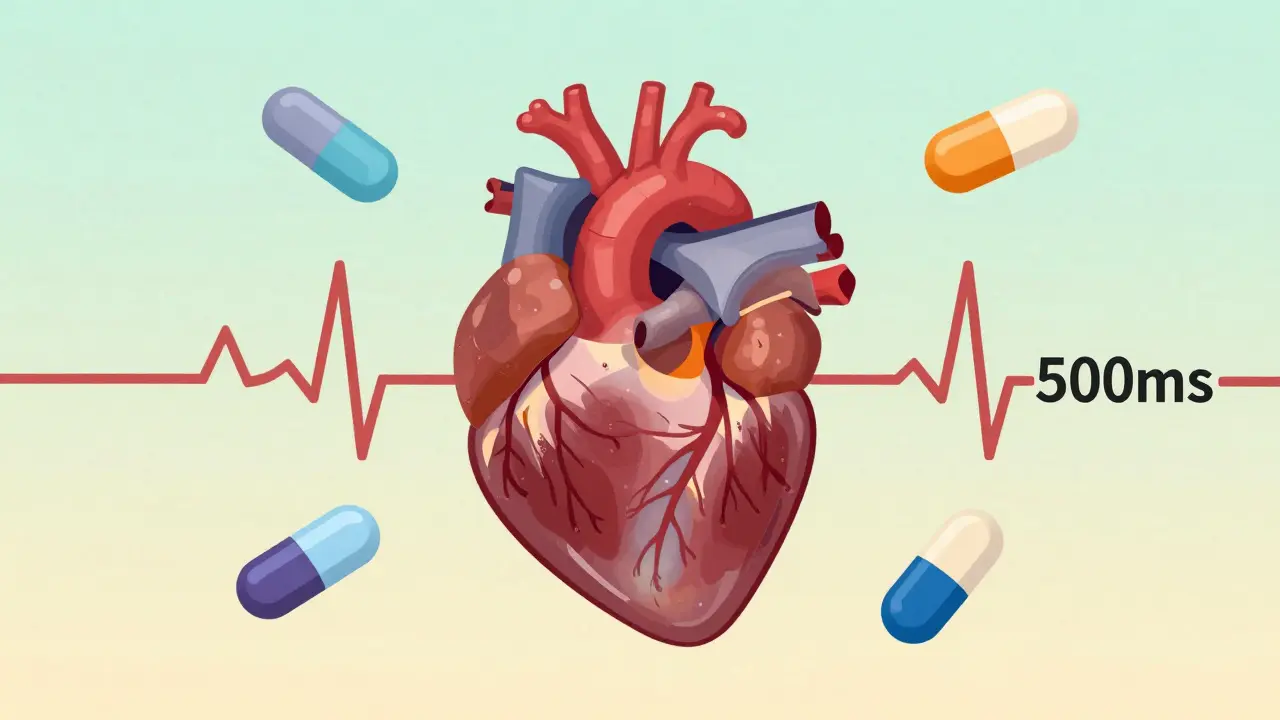
When you take an antidepressant, you’re not just treating sadness or anxiety-you’re changing how your heart beats. Citalopram and escitalopram, two commonly prescribed SSRIs, are effective for depression and anxiety. But they also carry a quiet, serious risk: QT prolongation. This isn’t just a lab number. It’s a potential trigger for life-threatening heart rhythms like Torsade de Pointes, which can lead to sudden cardiac arrest.
The FDA, Health Canada, and the UK’s MHRA all issued safety alerts in 2011 after reviewing data showing these drugs could stretch the heart’s electrical recovery time. That stretch? Measured as the QTc interval on an ECG. When it hits 500 milliseconds or more, or jumps up by 60ms from your baseline, the risk spikes. And it’s not theoretical. Real cases have been documented.
How Much Do These Drugs Really Stretch the QT Interval?
The numbers tell a clear story. Citalopram, at 20mg daily, increases QTc by about 8.5ms. At 40mg, that jumps to 12.6ms. At 60mg-a dose once common-it pushes up by 18.5ms. That’s a significant change, especially if you’re already at risk.
Escitalopram, the purified form of citalopram, is gentler. At 10mg, it adds just 4.5ms. At 20mg, it’s 6.6ms. Even at 30mg (a higher-than-standard dose), it only increases QTc by 10.7ms. That’s less than half the effect of 60mg citalopram.
Why the difference? Citalopram is a mix of two mirror-image molecules (enantiomers). Only one-S-citalopram-is active against depression. Escitalopram is just that one molecule. The other half of citalopram doesn’t help with mood and may actually worsen heart effects. That’s why escitalopram has a better safety profile.
Dose Limits You Can’t Ignore
After the 2011 warnings, dose caps were put in place worldwide-but not everywhere the same way.
- Citalopram: Maximum 20mg/day for patients over 65. For younger adults, 40mg/day is the upper limit. Doses above 40mg are no longer approved in the U.S., Canada, or the UK.
- Escitalopram: Max 10mg/day for patients over 65. For adults under 65, 20mg/day is the highest recommended dose.
These limits aren’t arbitrary. Older adults clear these drugs slower. Their kidneys and liver don’t work as well. That means more drug builds up in their system, raising the chance of QT prolongation even at lower doses.
And if you have liver problems? Doses need to be cut even further. No exceptions.
Who’s at Highest Risk?
It’s not just about the dose. Your personal health matters more.
- People with congenital long QT syndrome
- Those with a history of heart failure, heart attack, or slow heart rate (bradycardia)
- Patients taking other QT-prolonging drugs-like certain antibiotics (macrolides), antifungals, or antiarrhythmics
- People with low potassium, low magnesium, or low calcium levels
- Those on multiple medications that slow down liver metabolism (like some antifungals or HIV meds)
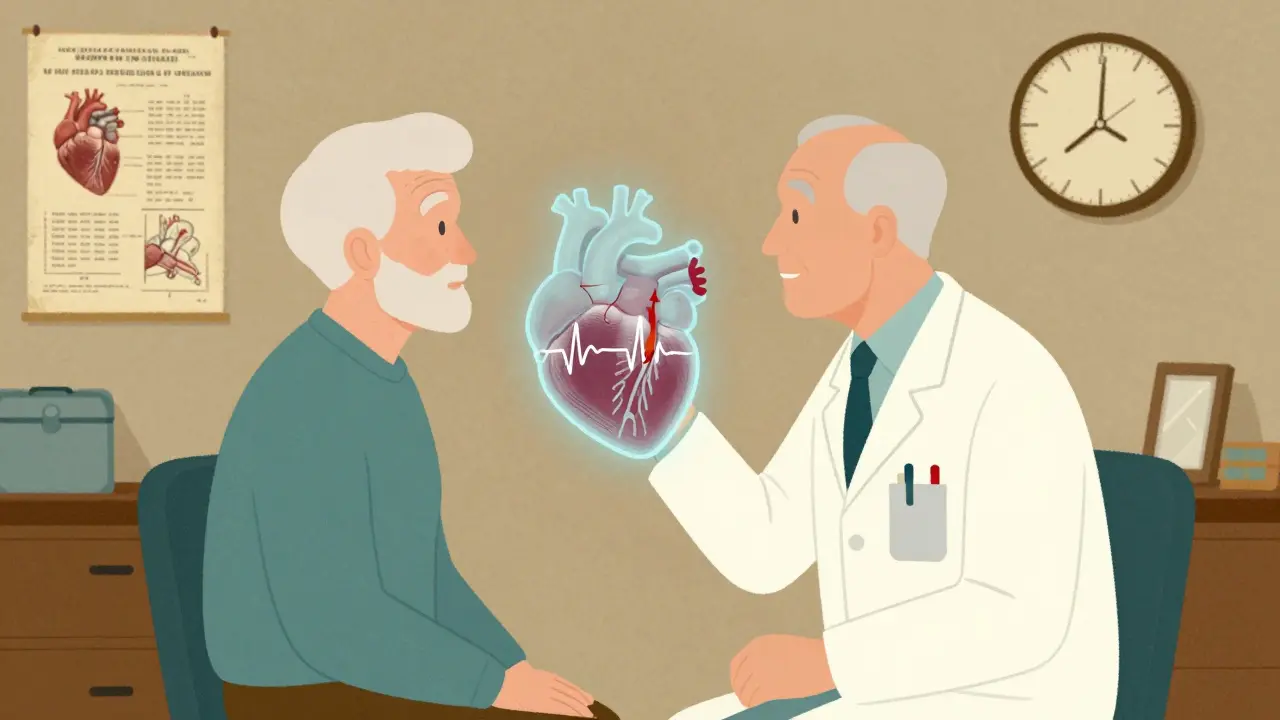
If you have even one of these risk factors, your doctor should avoid citalopram entirely. Escitalopram may still be an option-but only at the lowest effective dose, with close monitoring.
How Do Other Antidepressants Compare?
Not all SSRIs are equal when it comes to heart risks.
| Drug Class | Examples | QT Prolongation Risk |
|---|---|---|
| SSRIs | Citalopram | High (dose-dependent) |
| SSRIs | Escitalopram | Moderate (low at standard doses) |
| SSRIs | Fluoxetine, Sertraline, Paroxetine | Low to negligible |
| SNRIs | Venlafaxine | Low at normal doses; caution in overdose |
| TCAs | Amitriptyline, Maprotiline | High-higher than most SSRIs |
Tricyclic antidepressants like amitriptyline are actually riskier than escitalopram. But they’re rarely used first-line anymore because of their side effects. For most patients with heart concerns, sertraline or fluoxetine are safer choices than citalopram.
What Does Monitoring Look Like in Practice?
Doctors don’t just write a script and forget it. For anyone starting citalopram or escitalopram-especially if they’re over 65, on other meds, or have heart issues-monitoring is part of the plan.
- An ECG before starting, to check your baseline QTc
- A repeat ECG 1-2 weeks after reaching the target dose
- Checking electrolytes (potassium, magnesium) if you’re on diuretics or have kidney issues
- Asking about symptoms: dizziness, fainting, palpitations, shortness of breath
If your QTc goes over 500ms or increases by more than 60ms from baseline, the drug should be stopped. No waiting. No hoping it gets better.
Is the Risk Really That High?
Sure, some argue that an 18ms increase isn’t a big deal. And yes, most people on these drugs never have a heart problem. But risk isn’t about what happens to most people. It’s about what can happen to one.
The FDA didn’t issue a warning because hundreds of people died. They did it because even one preventable death is too many. And in clinical trials, there were cases of Torsade de Pointes linked to high-dose citalopram.
What’s changed since 2011? Fewer people are getting 60mg of citalopram. Fewer elderly patients are on doses that push their QTc too far. The number of cardiac events has dropped-not because the drugs are safer, but because doctors now know the limits.
Why Escitalopram Is Often the Better Choice
Escitalopram costs more than generic citalopram. But when you factor in the risk of hospitalization, ECGs, electrolyte checks, and potential cardiac events, the cost difference shrinks.
For patients with heart disease, older adults, or those on multiple medications, escitalopram at 10-20mg is often the smarter pick. It’s just as effective for depression, with less heart risk. And if you’re switching from citalopram to escitalopram, you can usually do it directly-no taper needed, since they’re chemically related.
What to Do If You’re Already on One of These Drugs
If you’re taking citalopram at 40mg or higher, talk to your doctor. Don’t stop cold turkey. But do ask: Is this dose still necessary? Could escitalopram or another SSRI work just as well?
If you’re on escitalopram at 20mg and you’re over 65, check your dose. You might be on too much.
And if you’ve ever fainted, felt your heart race unexpectedly, or have a family history of sudden cardiac death before age 50-get an ECG. Even if you’ve been on the drug for years.
The Bottom Line
Citalopram and escitalopram aren’t dangerous for everyone. But they’re not risk-free either. The key is matching the drug to the person.
For healthy adults under 65: escitalopram at 10-20mg is a solid, safe choice. Citalopram at 20-40mg is acceptable-but only if nothing else works.
For anyone over 65, with heart disease, or on other meds: avoid citalopram. Use escitalopram at 10mg max, or switch to sertraline or fluoxetine.
And always, always get your QTc checked if you’re on high doses or have risk factors. A simple 10-minute ECG can prevent a cardiac emergency.





Jackie Be
22 December 2025 - 15:19 PM
I was on 40mg of citalopram for years and never thought twice about it until my ECG came back with a QTc of 510... holy hell I almost died from a skipped beat that felt like my heart was trying to escape my chest
Doctors act like its no big deal but it is. I switched to sertraline and now I feel better and my heart isnt trying to kill me
John Hay
22 December 2025 - 16:38 PM
This is exactly why you dont just trust pharma reps. The FDA didn't act until people started dropping dead. Citalopram was pushed hard because it was cheap. Now they want you to pay more for escitalopram like its some miracle drug. Same molecule half the dose. Wake up.
Jon Paramore
24 December 2025 - 04:14 AM
QTc prolongation is a class effect with SSRIs but the risk stratification here is clinically sound. Citalopram > escitalopram in torsadogenic potential due to R-enantiomer interference with hERG channels. At >40mg, citalopram significantly increases risk of polymorphic VT. Escitalopram at 20mg remains within acceptable limits for low-risk patients. Baseline ECG and electrolyte monitoring are non-negotiable in high-risk cohorts.
Swapneel Mehta
24 December 2025 - 15:27 PM
I live in India and my psychiatrist here still prescribes 60mg citalopram like its nothing. No ECGs, no questions asked. I was shocked when I read this. We need better awareness here. Maybe someone should translate this into Hindi or Tamil.
Cameron Hoover
25 December 2025 - 00:05 AM
I used to think depression was the only thing I had to worry about. Then I got dizzy during a walk and my cardiologist said "you almost had a cardiac event". I was on 40mg citalopram. Now I'm on fluoxetine. I feel calmer. My heart feels calmer. I wish I'd known this sooner.
Stacey Smith
25 December 2025 - 11:03 AM
This is why America needs to stop letting foreign drug companies dictate our meds. Citalopram was fine until the FDA panicked. We're overreacting because of a few cases. My grandma took 60mg for 10 years and she's fine.
Ben Warren
27 December 2025 - 03:25 AM
It is incumbent upon the medical practitioner to exercise due diligence when prescribing pharmacological agents with known torsadogenic potential. The pharmacokinetic and pharmacodynamic profiles of citalopram and escitalopram are not equivalent, and the elevation of the QTc interval is not a trivial statistical artifact but a quantifiable electrophysiological deviation with clinical consequence. The failure to adhere to established dosing guidelines constitutes a breach of the standard of care, and any resultant arrhythmia may be deemed iatrogenic and actionable under tort law.
Teya Derksen Friesen
29 December 2025 - 02:54 AM
I work in a hospital pharmacy. We stopped stocking citalopram over 40mg two years ago. We now have a protocol: if the patient is over 65 or on any other QT-prolonging med, we flag it for the prescriber. It's not about fear. It's about responsibility. Escitalopram at 10mg is often all you need. Less is more.
Sandy Crux
29 December 2025 - 09:18 AM
I find it amusing how everyone treats this like a revelation. The hERG channel blockade has been known since the 1990s. The fact that we're still debating this in 2025 is a testament to the pharmaceutical industry's ability to delay regulation through lobbying. And now, of course, escitalopram is the "safe" alternative-because it's patented and profitable. The science hasn't changed. The profit margins have.
Hannah Taylor
30 December 2025 - 12:48 PM
They're lying. Citalopram doesn't cause heart problems. The ECG machines are rigged. The FDA is controlled by Big Pharma. They want you to switch to escitalopram so they can charge you $200 a month. My cousin took citalopram for 15 years and she's still alive. They're just trying to scare you into buying the expensive version
Jason Silva
1 January 2026 - 03:26 AM
bro i was on 60mg citalopram for 3 years and my heart was doing backflips 🫠
switched to sertraline and now i can run up stairs without feeling like im gonna pass out
if your heart feels weird on these meds-listen to it. dont be a hero
mukesh matav
2 January 2026 - 01:57 AM
I'm a nurse in a mental health ward. We see patients on high-dose citalopram all the time. Some don't even know what QT means. We do ECGs before we start any SSRI now. It's not hard. It's just common sense. This post is right. We need to do better.
Peggy Adams
2 January 2026 - 14:18 PM
I'm too lazy to read all this but my doctor said "don't take more than 20mg" so I guess that's it? I'm just here for the mood boost. If my heart stops, I guess that's the price?
Christina Weber
3 January 2026 - 20:15 PM
The data presented is accurate, methodologically sound, and consistent with the published literature from the FDA Adverse Event Reporting System (FAERS) and the WHO Global Individual Case Safety Report database. Furthermore, the distinction between enantiomeric composition and its impact on hERG affinity is not merely pharmacological trivia-it is a foundational principle of stereochemistry in drug safety. Any deviation from the recommended dosing thresholds constitutes a failure of clinical judgment, and clinicians who disregard these guidelines are not practicing evidence-based medicine.