
Most people reach for an OTC nasal spray the moment they feel that stuffy, blocked-up feeling-especially during cold season or allergy flare-ups. It’s quick, it’s easy, and it works like magic: within minutes, your nose opens up and you can breathe again. But here’s the catch: if you use it for more than three days, you’re not fixing your congestion-you’re creating a worse version of it.
Why Your Nose Gets More Blocked After Using Nasal Spray
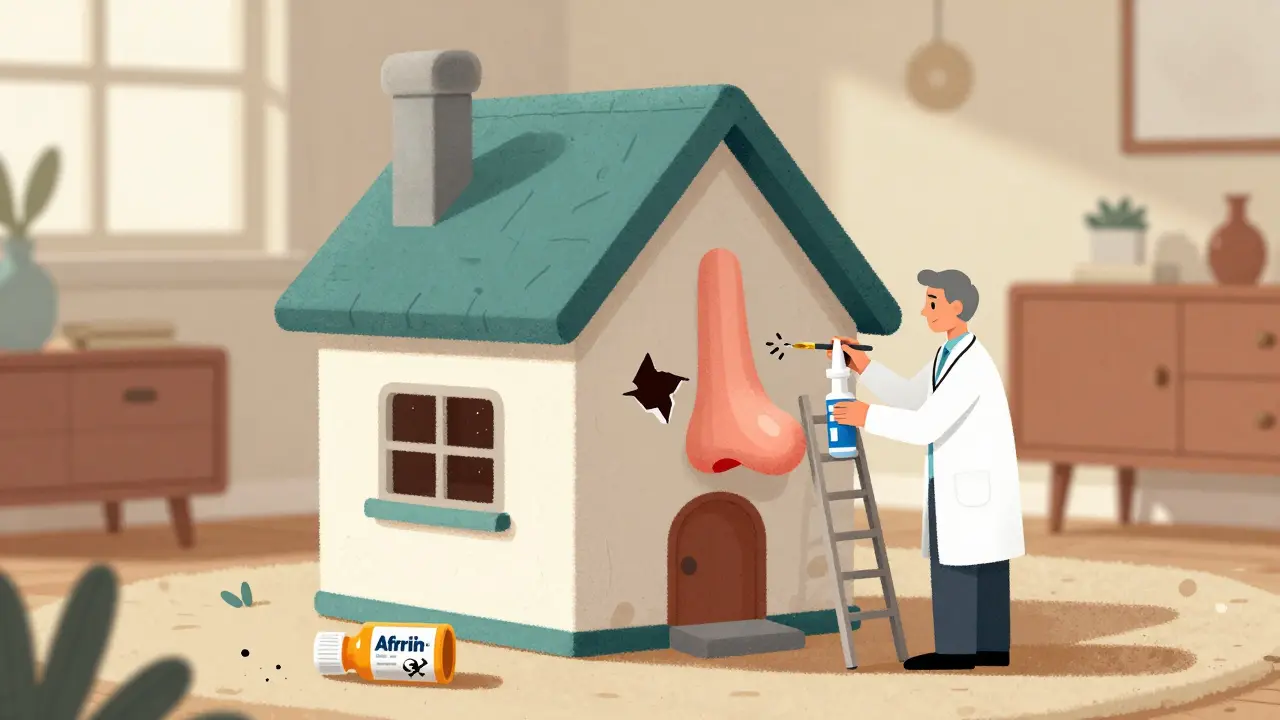
Those fast-acting OTC nasal sprays like Afrin, Neo-Synephrine, or store-brand versions contain chemicals like oxymetazoline or phenylephrine. These are vasoconstrictors, meaning they shrink the swollen blood vessels in your nasal lining. That’s why you feel instant relief. But here’s what happens after the effect wears off: your blood vessels don’t just go back to normal-they overcompensate and swell even more than before. This is called rebound congestion, or rhinitis medicamentosa.
It’s not a myth. It’s a well-documented medical condition. Studies from the NIH and Mayo Clinic confirm that using these sprays for more than three consecutive days triggers this cycle. Some people start feeling worse within 12 hours of their last spray. By day 4 or 5, you’re not just back to square one-you’re worse off. And the more you spray, the more your body demands it.
Imagine your nasal passages as a rubber band. When you squeeze it (with the spray), it tightens. But if you keep squeezing it for days, the rubber band loses its shape and snaps back harder. That’s what’s happening inside your nose.
Who’s Most at Risk for Rebound Congestion
Anyone can get rebound congestion, but some people are more likely to fall into the trap:
- People using nasal sprays for more than 3-5 days straight
- Those with chronic allergies or sinus issues who rely on sprays as a long-term fix
- Users who start with 2 sprays a day and end up using 10 or more because the relief fades faster
- People with high blood pressure, since these sprays can raise blood pressure slightly
According to the Cleveland Clinic, about 1-2% of the general population develops rebound congestion at some point. That might sound low, but consider this: over 1.2 billion OTC nasal sprays are sold in the U.S. every year. Even if only 1% misuse them, that’s over 12 million people at risk.
Reddit communities like r/Allergies are full of posts titled “Afrin hell” or “I can’t stop using my nasal spray.” Many users describe weeks of misery trying to quit, with symptoms lasting 2-4 weeks after stopping. One common thread? They thought their allergies were getting worse-until they realized the spray was the cause.
What’s in These Sprays-and Why They’re So Addictive
Most OTC nasal decongestant sprays contain one of these four active ingredients:
- Oxymetazoline (0.05%) - Found in Afrin, Otrivin
- Phenylephrine (0.25%) - Found in Neo-Synephrine
- Xylometazoline (0.05%) - Common outside the U.S.
- Naphazoline (0.1%) - Found in Privine
All of these work the same way: they stimulate alpha-1 receptors in nasal blood vessels, causing them to tighten. Relief comes in 5-10 minutes and lasts 8-12 hours. That’s why they’re so popular. But the body adapts. After 72 hours of continuous use, your nasal tissue starts to resist the effect. You need more spray to get the same result. That’s the beginning of dependence.
Even though manufacturers claim modern formulations like oxymetazoline are “less likely” to cause rebound, the NIH StatPearls database and multiple ENT specialists confirm that rebound congestion from oxymetazoline is not only possible-it’s common.

Safe Alternatives That Don’t Cause Rebound
You don’t need to suffer without relief. There are safer, long-term options:
- Saline nasal sprays - Pure salt water. No drugs. No side effects. Can be used daily, even multiple times a day. Great for moisturizing dry nasal passages and flushing out irritants.
- Fluticasone (Flonase Sensimist) - An OTC nasal steroid. Takes 3-7 days to work fully, but once it does, it reduces inflammation without any rebound risk. It’s the go-to for allergies and chronic congestion.
- Ipratropium bromide (Atrovent) - Blocks mucus production. Works well for runny nose (rhinorrhea) but doesn’t help with stuffiness. No rebound. Prescription only in some cases, but often available OTC.
- Oral decongestants - Like pseudoephedrine (Sudafed). Works systemically. Can raise blood pressure and cause jitteriness, so not for everyone-but useful for short-term use if you’re not hypertensive.
Here’s the trade-off: steroid sprays like Flonase don’t give you instant relief. But they fix the root problem-swelling-instead of just hiding it. Decongestant sprays are like putting a bandage on a broken bone. Steroids are the cast.
How to Quit Nasal Spray Without the Crash
If you’ve been using a decongestant spray for more than 5 days and now you’re stuck in the cycle, quitting cold turkey is possible-but it’s rough. Many people experience severe congestion for days, sometimes weeks.
Here’s a smarter, gentler way:
- Start Flonase (fluticasone) immediately - Even if you’re still using the spray. It takes 3-5 days to build up, so give it time.
- Use saline spray 4-6 times a day - Keeps your nasal passages moist and helps flush out irritants. NeilMed Sinus Rinse or simple saline mist both work.
- Reduce spray use slowly - Instead of stopping all at once, cut back by one spray every 48 hours. For example: if you’re using 4 sprays a day, drop to 3 after 2 days, then 2, then 1, then none.
- Expect a 5-7 day withdrawal period - Your nose will feel worse before it gets better. That’s normal. Don’t give in and spray again.
- Use a humidifier - Dry air makes congestion worse. Moist air helps your nasal lining heal.
According to Houston Methodist’s protocol, starting Flonase 2 days before cutting back on decongestants reduces withdrawal severity by nearly 50%. And recovery time drops from 4-6 weeks to just 7-14 days.
What the Labels Don’t Tell You
All OTC nasal decongestant sprays in the U.S. have a warning on the box: “Do not use for more than 3 days.” But here’s the problem: most people don’t read it. A Cleveland Clinic survey found that 38% of users exceed the 3-day limit. Why? Because the relief is so good, and the rebound doesn’t hit until after you’ve stopped.
Also, many users don’t realize that “3 days” means consecutive days-not 3 days total. Using it for 3 days, then skipping a day, then using it again? That still counts as overuse. Your nose doesn’t reset just because you took a break.
And while the FDA has mandated this warning since 2002, there’s no penalty for ignoring it. No pharmacist will stop you from buying a 20-day supply. No pharmacy app will block your cart. It’s all on you.
When to See a Doctor
Most people recover from rebound congestion with self-care. But you should see an ENT specialist if:
- Your congestion lasts more than 3 weeks after quitting the spray
- You notice bleeding, crusting, or a hole in your nasal septum (rare but serious)
- You have chronic sinus pain, fever, or thick yellow/green mucus (signs of infection)
- You’re using other medications like blood pressure pills or antidepressants (interactions possible)
ENTs in the U.S. see 12,000-15,000 cases of rhinitis medicamentosa every year. Most are preventable. The fix isn’t more spray-it’s education.
Real Talk: Why This Keeps Happening
People don’t misuse nasal sprays because they’re careless. They do it because they’re desperate. When you’re stuck in a cycle of breathing through your mouth, sleeping poorly, and feeling foggy all day, the spray feels like your only lifeline. The problem is, it’s a false promise.
There’s a reason these sprays are OTC: they’re safe for short bursts. But they’re not meant to be daily maintenance. That’s what steroids and saline are for. The marketing makes them look like a cure. But they’re just a temporary fix with a hidden cost.
Next time you reach for that spray, ask yourself: Am I treating my symptoms-or creating a new one?
Use it for 3 days. Then switch to Flonase and saline. Your nose will thank you.
Can I use OTC nasal spray every day?
No. OTC decongestant nasal sprays like Afrin should never be used every day. Using them for more than 3 consecutive days triggers rebound congestion, where your nose becomes more blocked than before. Daily use can lead to dependency and long-term damage to nasal tissues. For daily relief, use saline sprays or intranasal corticosteroids like Flonase, which are safe for long-term use.
How long does rebound congestion last?
Rebound congestion typically lasts 1-3 weeks after stopping the spray, but it can stretch to 4-6 weeks if you quit cold turkey without support. Using nasal steroids like Flonase and saline rinses during withdrawal can cut recovery time in half. Symptoms peak around days 2-4 after stopping, then gradually improve.
Is Flonase better than Afrin?
Yes-for long-term use. Afrin gives fast relief but causes rebound if used over 3 days. Flonase (fluticasone) takes 3-7 days to work but reduces inflammation without any rebound risk. It’s ideal for allergies, chronic congestion, or as a replacement after quitting decongestant sprays. Use Afrin only for short-term relief during acute illness.
Can saline spray help with rebound congestion?
Yes. Saline sprays or rinses are one of the most effective tools for managing rebound congestion. They keep nasal passages moist, reduce irritation, flush out irritants, and support healing. Use them 4-6 times daily while tapering off decongestant sprays. They have no side effects and can be used indefinitely.
Why do I feel worse when I stop using nasal spray?
You’re experiencing rebound congestion. The spray shrinks blood vessels in your nose, but after prolonged use, those vessels become dependent on the drug. When you stop, they swell back bigger than before. This isn’t your allergies getting worse-it’s your body reacting to withdrawal. It’s temporary, but it can last days to weeks without proper management.
Next steps: If you’ve been using a nasal spray for more than 3 days, stop today. Start Flonase and saline rinses. Give your nose 7 days to heal. If you’re still struggling after that, talk to your pharmacist or doctor. You don’t have to live with this cycle.





Brian Furnell
21 December 2025 - 04:28 AM
Okay, so let me get this straight: we’re being sold a chemical band-aid that literally rewrites our nasal physiology? Oxymetazoline isn’t just a decongestant-it’s a neuromodulatory hijacker. The vasoconstrictive cascade triggers alpha-1 receptor downregulation, which then induces endothelial hyperplasia and vascular remodeling. This isn’t addiction-it’s pharmacological reprogramming. And the fact that manufacturers bury the 3-day limit in 6-point font? That’s not negligence. That’s predatory design.
And yet, we’re expected to self-regulate? No pharmacist asks if you’ve used it for five days straight. No EHR flags it. No FDA mandate has teeth. This is a public health failure dressed up as consumer autonomy.
Flonase is the only ethical alternative. Steroids don’t just suppress inflammation-they modulate cytokine expression. They’re slow, yes, but they’re restorative. Saline? Hydration therapy. No pharmacokinetics. No receptors. Just osmotic equilibrium. Why are we still treating nasal congestion like a sprint when it’s a marathon?
And don’t get me started on the ‘I just use it at night’ crowd. You’re not exempt. Your nasal mucosa doesn’t have a circadian override. 72 hours is 72 hours. Period.
Siobhan K.
22 December 2025 - 16:55 PM
Wow. So the solution to breathing is to buy a different spray that takes a week to work and costs three times as much? Brilliant. I’ve been using Afrin for 12 years because my allergies are chronic and my doctor doesn’t care enough to help. Now you want me to suffer for two weeks while waiting for Flonase to ‘work’? Good luck with that. I’ve got a toddler who wakes up screaming because I can’t breathe through my nose. Your ‘safe alternatives’ sound like a luxury for people who don’t live in the real world.
Stacey Smith
24 December 2025 - 11:22 AM
This is why America is falling apart. People can’t even follow a 3-day warning label. You want relief? Use Sudafed. It’s not perfect, but at least it doesn’t turn your sinuses into a drug dealer’s playground. Stop being lazy. Your nose isn’t special. Stop treating it like a VIP.
Ben Warren
25 December 2025 - 16:26 PM
It is both lamentable and profoundly concerning that the American public, having been explicitly warned by the Food and Drug Administration since 2002, continues to demonstrate a systemic disregard for evidence-based pharmacological guidelines. The phenomenon of rhinitis medicamentosa, as documented in the StatPearls database and corroborated by the Mayo Clinic, represents not merely a pharmacological misadventure, but a societal failure of health literacy.
Moreover, the casual invocation of "Flonase" as a panacea ignores the fact that intranasal corticosteroids require consistent, daily administration over a minimum of five days to achieve therapeutic efficacy-conditions which are rarely adhered to by the non-compliant populace.
Furthermore, the conflation of saline irrigation with therapeutic intervention is a dangerous oversimplification. While saline may provide symptomatic relief, it does not address the underlying inflammatory cascade. A comprehensive, multidisciplinary approach-encompassing allergen avoidance, immunotherapy evaluation, and structural nasal assessment-is required, yet is almost universally neglected in favor of the immediate gratification offered by vasoconstrictors.
One must ask: is the erosion of personal responsibility in health management not the true epidemic here?
Teya Derksen Friesen
27 December 2025 - 01:25 AM
I’ve been using saline rinses daily for 8 years. No rebound. No drama. Just clean sinuses. I use NeilMed twice a day, Flonase every other day, and I haven’t touched a decongestant spray since 2016. It’s not hard. It’s just not sexy. People want magic. But medicine isn’t magic. It’s consistency. And patience. And maybe a little bit of self-control.
Also, humidifier. Always. Dry air is the silent killer of nasal health.
Sandy Crux
28 December 2025 - 10:56 AM
...And yet, no one mentions that oxymetazoline’s half-life is 11 hours, and that the "3-day limit" was arbitrarily chosen by a committee in 1987 after a 12-patient pilot study. The real reason? Because the FDA didn’t want to classify it as a controlled substance. So they slapped on a warning that’s as legally binding as a "may contain nuts" label.
Also, Flonase? It’s just a cheaper version of Nasonex. And guess who owns the patent? Novartis. The same company that makes Afrin. Coincidence? I think not.
And don’t get me started on the "saline is safe" myth-tap water rinses have killed people. Use distilled. Always. Or you’re just playing Russian roulette with your sinuses.
Hannah Taylor
28 December 2025 - 15:28 PM
lol i used afrin for 3 months straight and now i cant breathe without it but my friend said its all in my head and im just weak. also i think the gov is hiding the truth bc they want us to buy flonase. its all a scam. i read on a forum that nasal sprays are linked to alien mind control. i think the spray is making me dream about space aliens. help.
Michael Ochieng
30 December 2025 - 15:01 PM
Back home in Kenya, we use a herbal steam with eucalyptus and ginger for congestion. No chemicals. No dependency. Just heat, steam, and tradition. I know it’s not as fast as a spray-but your body remembers what it’s meant to do. We don’t need to chemically rewire our noses to breathe. We just need to listen to them.
Also, in Lagos, they sell a nasal oil made from neem and coconut. Works better than anything I’ve tried in the States. Maybe we’ve been looking at this wrong. Maybe the problem isn’t the spray-it’s that we’ve forgotten how to heal naturally.
Dan Adkins
1 January 2026 - 10:59 AM
While I acknowledge the empirical validity of the aforementioned pharmacological observations, I must emphasize that the root cause of this phenomenon lies not in the chemical composition of oxymetazoline, but in the systemic erosion of personal discipline within contemporary Western societies. The proliferation of instant gratification culture has rendered the populace incapable of enduring even transient discomfort. The human organism, having evolved over millennia to tolerate physiological stressors, is now pathologically conditioned to seek chemical cessation of all discomfort. This is not a medical issue-it is a moral failure. The solution is not pharmacological substitution, but the re-establishment of stoic resilience. One must learn to endure. To suffer. To breathe through the obstruction. Only then shall the body reclaim its innate regulatory capacity. The spray is not the enemy. Complacency is.