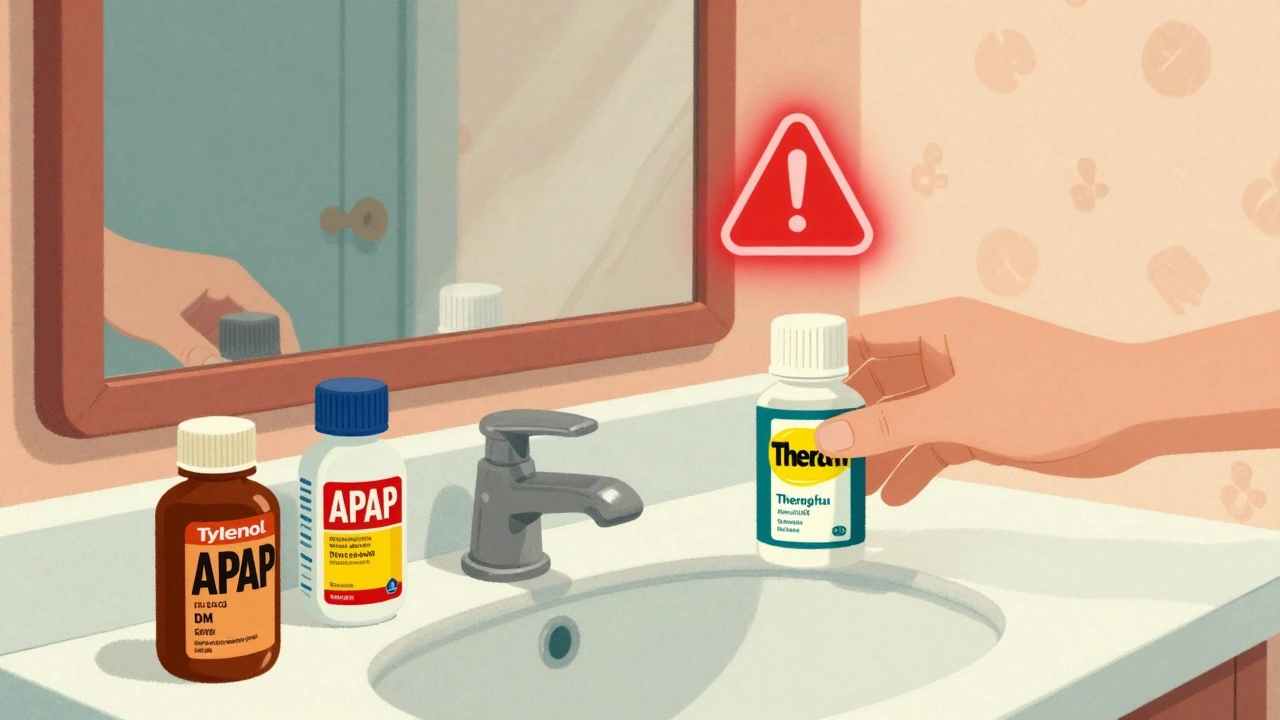
Every winter, millions of people reach for OTC cold and flu combinations thinking they’re making things easier. One pill for fever, one for cough, one for congestion - all in a single box. But here’s the problem: you’re not taking one pill. You’re taking three, four, or even five active ingredients - and you might not even know it.
What’s Actually in Those Cold Pills?
Most OTC cold and flu combos pack multiple ingredients into one tablet or liquid. The most common ones? Acetaminophen (for fever and pain), dextromethorphan (for cough), phenylephrine (for stuffy nose), and an antihistamine like doxylamine or chlorpheniramine (to dry up runny nose and help you sleep). Take Tylenol Cold & Flu Nighttime: it has 325mg of acetaminophen, 10mg of phenylephrine, and 2mg of chlorpheniramine. NyQuil? 325mg acetaminophen, 15mg dextromethorphan, and 12.5mg doxylamine. Theraflu? Same story - acetaminophen, dextromethorphan, phenylephrine. And here’s the kicker: acetaminophen is in 73% of these combination products, according to GoodRx’s 2023 review. That’s not a coincidence. Manufacturers know people want fast relief. But they don’t always make it clear that if you take Tylenol for your headache on top of Tylenol Cold & Flu, you’re already over the safe limit.Why Double Dosing Is a Silent Threat
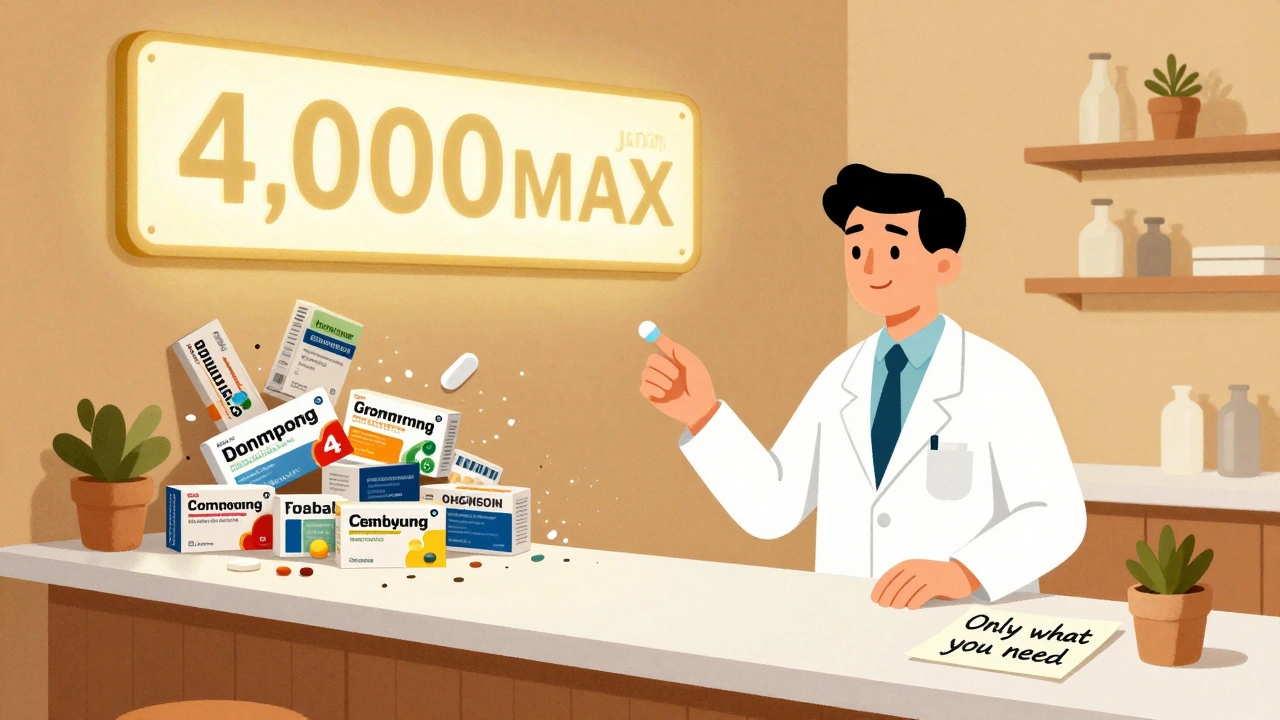
Acetaminophen is safe when you take it right. But take too much - and it doesn’t take much - and your liver starts to die. The FDA says 4,000mg in 24 hours is the max. One caplet of Tylenol Cold & Flu Nighttime has 325mg. That means you can only take 12 of them in a day. But if you also take two regular Tylenol tablets (650mg total), you’re already at 975mg before you even touch the cold medicine. In 2022, poison control centers in the U.S. logged 14,237 cases of acetaminophen overdose tied to cold and flu meds. That’s 12% of all OTC medication poison calls. Most of these weren’t intentional. People didn’t mean to overdose. They just didn’t realize they were doubling up. And it’s not just acetaminophen. Phenylephrine, the main decongestant in most OTC products, has been under fire since 2022. Studies show it doesn’t work at the 10mg dose used in pills. The FDA proposed removing it from the OTC monograph in November 2024. But it’s still everywhere. Meanwhile, doxylamine - the sleep aid in NyQuil - can leave you groggy all day. One Reddit user wrote: “Took NyQuil for a cold. Woke up at 3 p.m. feeling like I’d been hit by a truck.”How You’re Accidentally Double-Dosing
Here’s how it usually happens:- You take NyQuil for your cough and fever at night.
- Next morning, you still feel achy, so you grab a Tylenol tablet.
- You don’t realize NyQuil already had 325mg of acetaminophen.
- You take another dose of NyQuil at night - another 325mg.
- By day three, you’ve hit 2,600mg just from those two products - and you’re still taking ibuprofen for pain.

What Experts Say - And What They Recommend
Dr. Sarah Ketchen, a family physician and spokesperson for the American Academy of Family Physicians, says: “About 65% of patients don’t realize acetaminophen is in multiple cold medications. That’s why we see liver damage in people who thought they were being careful.” The American Medical Association and the American Pharmacists Association both agree: if you have one or two symptoms, use single-ingredient medicines. No more, no less. - Fever and pain? Take acetaminophen or ibuprofen - just one. - Stuffy nose? Use a standalone decongestant like pseudoephedrine (Sudafed) - but check if you have high blood pressure first. - Cough? Dextromethorphan alone - no antihistamines, no acetaminophen. - Trouble sleeping? Diphenhydramine (Benadryl) or doxylamine - but only at night. A 2022 Pharmacy Times survey found that 68% of pharmacists recommend single-ingredient products over combos. Why? Fewer side effects, less risk of interaction, and you only take what you need.How to Read the Drug Facts Label - In 2 Minutes
You don’t need to be a pharmacist. But you do need to read the label. Here’s how:- Look for the Active Ingredients section. That’s the only part that matters.
- Write down each ingredient and how much is in one dose. Example: “Acetaminophen 325mg.”
- Check the Uses section. Does it say “relieves pain”? That’s acetaminophen or ibuprofen.
- Look for hidden names: “APAP” = acetaminophen. “DM” = dextromethorphan. “PE” = phenylephrine.
- Check the Warnings section. If it says “do not take with other acetaminophen products,” that’s your red flag.
- Count how many products you’re taking in 24 hours. Add up the acetaminophen from each one. Don’t go over 4,000mg.
What to Do If You’re Already Taking Multiple Products
If you’re already mixing cold meds, stop. Now. Don’t wait for symptoms to get worse. - If you’ve taken more than 4,000mg of acetaminophen in 24 hours, call Poison Control at 1-800-222-1222. They’re free, confidential, and available 24/7. - If you’re feeling nauseous, dizzy, or have pain in your upper right abdomen - go to the ER. Liver damage doesn’t always hurt right away. - Don’t rely on “I’ve never had a problem before.” Liver damage from acetaminophen is silent until it’s too late.What’s Changing in 2025 and Beyond
The FDA’s move to remove phenylephrine from OTC cold products is a big deal. If it’s finalized, manufacturers will have 18 months to reformulate. That means fewer combo products with ineffective ingredients. Sales data shows the tide is turning. Single-ingredient acetaminophen sales rose 12.7% in 2023. Combination cold medicine sales? Only 2.3%. People are starting to realize: more ingredients don’t mean better relief. They mean more risk. Big brands are responding. Johnson & Johnson is testing new formulas without phenylephrine, replacing it with guaifenesin (an expectorant). Some new products are even coming in dual-chamber tablets - one half for daytime, one for nighttime - to prevent accidental mixing.Bottom Line: Simpler Is Safer
You don’t need a multi-symptom pill to feel better. You need to know what’s in it - and what you’re already taking. - Skip the combo packs unless you have at least three symptoms at once. - Always check the Drug Facts label. Write down the active ingredients. - Never take two products with acetaminophen - ever. - If you’re unsure, ask a pharmacist. They’re trained for this. And they’re not trying to sell you something. The cold and flu season isn’t going away. But you don’t have to risk your liver to get through it. Sometimes, the best medicine is the one you don’t take.Can I take a cold medicine and Tylenol at the same time?
Only if the cold medicine doesn’t already contain acetaminophen. Most do. Check the Drug Facts label. If it says “acetaminophen” or “APAP,” don’t take extra Tylenol. You could hit a dangerous overdose level. If your cold medicine doesn’t have acetaminophen, then yes - you can take Tylenol separately, but stay under 4,000mg total in 24 hours.
Is phenylephrine even effective in cold medicines?
No, not at the 10mg dose used in most OTC products. Multiple studies, including one published in the Journal of Allergy and Clinical Immunology in 2022, show it doesn’t work better than a placebo. The FDA proposed removing it from the OTC monograph in November 2024. If approved, manufacturers will have to replace it with something that actually works - like pseudoephedrine (which is kept behind the pharmacy counter) or guaifenesin.
What’s the difference between doxylamine and diphenhydramine?
Both are antihistamines that cause drowsiness, but they work differently. Doxylamine (found in NyQuil) lasts longer - up to 8 hours - and can leave you groggy the next day. Diphenhydramine (Benadryl) wears off faster but can cause more dry mouth and confusion in older adults. Neither is meant for daily use. If you’re using them for sleep every night, talk to a doctor.
Are store-brand cold medicines the same as name-brand ones?
Yes - if they have the same active ingredients in the same amounts. Store brands are required to match the name-brand formula. The difference is in the inactive ingredients (like flavoring or dyes) and the price. Always compare the Drug Facts label. If the active ingredients and doses match, the store brand is just as safe and effective - and cheaper.
What should I do if I think I’ve taken too much acetaminophen?
Call Poison Control immediately at 1-800-222-1222. Don’t wait for symptoms. Acetaminophen overdose doesn’t always cause pain right away. Liver damage can start within hours and may not show symptoms for days. If you’re dizzy, nauseous, or have pain under your right ribs, go to the ER. Time matters.
Why do cold medicines have so many ingredients if they’re not all needed?
Because it sells better. Companies design combo products to treat every possible symptom - even ones you don’t have - so you’ll buy one box instead of three. It’s convenience marketing. But it’s not medical sense. If you only have a cough, you don’t need a decongestant or an antihistamine. Those just add side effects. The best cold medicine is the one that matches your symptoms - no more, no less.



Gareth Storer
4 December 2025 - 01:01 AM
So let me get this straight - we’re paying $12 for a pill that contains three ingredients we don’t need, one that doesn’t work, and one that can kill us if we blink wrong? And the FDA’s only now getting around to fixing it? Classic. I’d rather swallow a handful of aspirin and pray than buy another bottle of this snake oil.
Also, ‘APAP’? Really? Who thought that was a good idea? Like, ‘Hey, let’s make the ingredient that kills your liver look like a secret code!’
Pavan Kankala
5 December 2025 - 17:02 PM
They’ve been doing this since the 70s. Big Pharma doesn’t care if you live or die - they care if you keep buying. The FDA? Totally bought and paid for. You think they’re gonna ban phenylephrine because it doesn’t work? Nah. They’re waiting for the patent on pseudoephedrine to expire so they can repackage it as ‘premium decongestant’ and charge $20 a bottle.
And don’t get me started on acetaminophen. It’s not an accident you’re overdosing - it’s a feature. They want you hooked on the combo packs because you’ll never read the label. That’s the business model. You’re not dumb. You’re being engineered.
Next they’ll add caffeine to make you paranoid enough to buy more. I’m not even surprised anymore.
Martyn Stuart
7 December 2025 - 04:11 AM
Thank you for this incredibly clear, vital, and long-overdue breakdown. Seriously - this should be mandatory reading before anyone buys OTC cold medicine.
Just to reinforce: always, always, always - check the ACTIVE INGREDIENTS section. Not the brand name. Not the packaging. Not the “relieves everything!” marketing. The ACTIVE INGREDIENTS.
And if you see “APAP” - that’s acetaminophen. If you see “DM” - that’s dextromethorphan. If you see “PE” - that’s phenylephrine (and you’re being scammed).
Also: store brands are 100% identical in active ingredients. Save your money. And if you’re taking more than one product? Stop. Now. Write it down. Use a notes app. Set a reminder. Your liver will thank you.
And yes - pharmacists are your friends. They’re not trying to upsell you. They’re trained to prevent this exact scenario. Ask them. They’ll love you for it.
Yasmine Hajar
7 December 2025 - 07:09 AM
I just want to say - this post made me cry. Not because I’m dramatic, but because I’ve been there. I took NyQuil for a cough, then took Tylenol because my head hurt, then took another NyQuil because I felt worse the next night… and I didn’t realize until I was dizzy and nauseous that I’d hit 3,900mg in 18 hours.
I called Poison Control. They were so calm. So kind. They didn’t judge me. They just said, ‘You’re not alone.’ And then they walked me through what to do.
To anyone reading this: you are not stupid. You’re just human. We’ve all been sold a lie that ‘more is better.’ But your body doesn’t work that way. Please, please, please - read the label. Write it down. Ask your pharmacist. You deserve to be safe.
And if you’re reading this and you’re still using combo packs… I’m not mad. I’m just here. I’ve been there. Let’s help each other.
Karl Barrett
8 December 2025 - 18:30 PM
From a pharmacokinetic standpoint, the real issue is polypharmacy in self-medication contexts - particularly when the pharmacodynamic profiles of OTC agents are not properly deconflicted.
Acetaminophen, as a CYP2E1 substrate, exhibits non-linear kinetics at supratherapeutic doses, leading to saturation of glucuronidation pathways and subsequent oxidative stress via NAPQI accumulation - which is hepatotoxic.
Meanwhile, phenylephrine’s poor oral bioavailability (due to first-pass metabolism) renders its 10mg dose pharmacologically inert, which is why it persists as a placebo agent in combo formulations - a classic example of regulatory capture and profit-driven formulation inertia.
Bottom line: the system is broken. But individual agency - via label literacy - remains the most effective countermeasure.
Jake Deeds
9 December 2025 - 16:26 PM
Can we just talk about how pathetic it is that we’ve become this lazy? We used to just… rest. Drink tea. Sleep. Now? We need a pill for every single feeling. You have a runny nose? Take three pills. You’re tired? Take another. You’re bored? Take a fourth.
It’s not medicine - it’s a spiritual crisis. We’ve outsourced our ability to endure discomfort. We don’t want to feel sick - we want to feel normal. But sickness is part of being alive.
And now we’re poisoning ourselves because we’re too entitled to just… wait it out.
Also, APAP? Who thought that was a good idea? It’s like they’re trying to make us feel like we’re in a spy movie. ‘The code… is APAP…’
It’s embarrassing. We deserve better.
Isabelle Bujold
11 December 2025 - 13:44 PM
Let me tell you something - I’m a nurse, and I’ve seen too many people come in with liver failure because they thought ‘it’s just a cold medicine’ and didn’t realize they were stacking acetaminophen from three different bottles. One guy took Tylenol Cold, NyQuil, and then a generic pain reliever - all in the same day. He was 38. He needed a transplant. He didn’t even know APAP meant acetaminophen.
And yes, phenylephrine? Useless. I’ve had patients ask me why their nose isn’t clearing up - and I have to tell them, ‘Because the ingredient in your medicine doesn’t work.’ They’re shocked. They think it’s just ‘not strong enough.’ No. It’s not there. It’s placebo.
And doxylamine? It’s like taking a sleeping pill and then trying to drive. You’re not ‘just sleepy’ - you’re impaired. Don’t pretend it’s harmless.
Read the label. Write it down. Ask someone. Your body isn’t a vending machine. Don’t just press buttons and hope for the best.
George Graham
12 December 2025 - 23:23 PM
I’ve been in your shoes. I used to grab those combo packs because they seemed easier - one bottle, one dose, done. But then I realized I was taking stuff I didn’t need, and missing the stuff I did.
Now? I keep a little notepad on my fridge. When I feel a cold coming on, I write down: ‘What am I actually feeling?’
Just a sore throat? Warm tea + salt gargle.
Just a stuffy nose? Saline spray.
Just a headache? One Tylenol - and that’s it.
It’s not glamorous. But it works. And I’m alive. No ER visits. No scary calls to Poison Control.
You don’t need to be a superhero. You just need to be a little more thoughtful. And that’s enough.
John Filby
14 December 2025 - 15:22 PM
Y’all are gonna think I’m crazy but I just started using a spreadsheet for my meds 😅
Every time I take something - I log it: what it is, how much, when. I even color-code: red for acetaminophen, blue for decongestants, green for sleep aids.
It’s weird, I know. But last week I almost took NyQuil AND a generic cold pill… and my spreadsheet screamed at me. Like, literally - I have a warning pop-up.
Best decision I ever made. I feel like a nerd, but I’m alive. And my liver? It’s thanking me. 💙
Elizabeth Crutchfield
16 December 2025 - 09:52 AM
i just realized i’ve been taking nyquil and tylenol together for 3 winters and never knew apap was acetaminophen 😭 i’m so dumb. thanks for this post. gonna start reading labels now. also i’m gonna throw out all my combo packs. no more. never again.
Ben Choy
17 December 2025 - 09:32 AM
Man, I used to think this was just me being paranoid. Then I saw my dad take NyQuil and then a Tylenol because he said ‘I just need a little extra.’
He ended up in the hospital. He didn’t even know what APAP meant.
I’m not mad. I’m just… heartbroken. We’ve been sold a lie. And now we’re paying for it with our health.
Let’s stop pretending this is normal. It’s not. We deserve better.
❤️
Emmanuel Peter
19 December 2025 - 05:15 AM
Let’s be real - this post is just fearmongering dressed up as public service. You think people are stupid? They’re not. They just don’t care. The fact that you need a 2,000-word essay to explain that you shouldn’t take two things with the same ingredient? That’s the problem.
And don’t get me started on ‘ask your pharmacist.’ Most of them are just paid sales reps for Big Pharma. They’ll tell you to buy the combo pack because it’s ‘more convenient.’
Also - acetaminophen overdose? Rare. Like, less than 0.001% of users. But you’re acting like everyone’s gonna die tomorrow. Chill.
Stop treating adults like children. We’re not babies. We can read. We can decide. Stop the panic.