SSRI Dose Safety Checker
This tool checks if your prescribed dose of citalopram or escitalopram is within safe limits based on your age. It follows FDA and MHRA guidelines to help identify potential QT prolongation risks.
Important: This is for informational purposes only. Always consult your healthcare provider for medical advice.
When you’re prescribed an SSRI for depression or anxiety, you’re usually focused on how it will help your mood - not your heart. But for citalopram and escitalopram, the heart can’t be ignored. Both drugs are effective for treating depression, but they carry a quiet, serious risk: prolonging the QT interval on your ECG. This isn’t theoretical. It’s a documented, regulated, and clinically significant issue that changed how doctors prescribe these medications - especially after 2011.
What Exactly Is QT Prolongation?
Your heart beats because of electrical signals. The QT interval on an ECG measures how long it takes for the heart’s lower chambers (ventricles) to recharge between beats. If that interval gets too long, your heart can develop a dangerous rhythm called Torsade de Pointes. It’s rare, but it can lead to fainting, seizures, or sudden cardiac death. The risk goes up with higher doses, older age, existing heart conditions, or when other QT-prolonging drugs are taken together.Citalopram and Escitalopram: The Difference That Matters
Citalopram is a mix of two mirror-image molecules - R and S enantiomers. Only the S-enantiomer is active against serotonin. Escitalopram is just that active part. Sounds simple, right? But that small difference has big consequences. Studies show citalopram causes more QT prolongation than escitalopram. At 20 mg daily, citalopram increases the QTc interval by about 8.5 milliseconds. At 40 mg, it jumps to 12.6 ms. At 60 mg - a dose once commonly used - it spikes to 18.5 ms. That’s more than double the effect of the lower dose. Escitalopram? At 10 mg, it adds just 4.5 ms. At 20 mg, it’s 6.6 ms. Even at 30 mg, it only reaches 10.7 ms. That’s still measurable, but significantly less than citalopram at equivalent doses. The reason? Citalopram’s inactive R-enantiomer appears to block the hERG potassium channel more aggressively, slowing down the heart’s electrical recovery.Regulatory Changes After 2011: What Changed?
In August 2011, the FDA issued a safety alert: don’t use citalopram above 40 mg daily. For patients over 65, the limit dropped to 20 mg. The same year, the UK’s MHRA and New Zealand’s Medsafe followed suit - but they also applied restrictions to escitalopram. The UK set a 20 mg daily cap for adults and 10 mg for older adults. Why the difference? The FDA focused on citalopram because its data was clearer. European regulators took a more cautious approach, treating both drugs similarly since escitalopram still carried risk. Neither agency said these drugs are unsafe - they said use them carefully.Dose Limits Today: What’s Safe?
Current prescribing guidelines are clear:- Citalopram: Max 20 mg/day for patients over 65; max 40 mg/day for adults under 65. Never exceed 40 mg.
- Escitalopram: Max 10 mg/day for patients over 65; max 20 mg/day for adults under 65.
Who’s at Highest Risk?
It’s not just about the dose. Certain people are more vulnerable:- Patients over 65 - slower metabolism means more drug in the bloodstream.
- People with existing heart disease, bradycardia, or a history of arrhythmias.
- Those with congenital long QT syndrome - this is a hard stop for both drugs.
- People taking other QT-prolonging medications: certain antibiotics (like moxifloxacin), antifungals, antiarrhythmics, or even some antipsychotics.
- Those with low potassium, low magnesium, or severe dehydration - electrolyte imbalances make the heart more sensitive.
- Patients with liver impairment - both drugs are processed by the liver. Poor function = higher drug levels.
How Do Other Antidepressants Compare?
Not all SSRIs are equal when it comes to heart risk:- Fluoxetine, sertraline, paroxetine: Minimal QT prolongation. Often safer choices for patients with cardiac concerns.
- Fluvoxamine: Low risk, similar to sertraline.
- Venlafaxine (SNRI): Low risk at standard doses, but caution in overdose or in elderly patients.
- TCAs (amitriptyline, maprotiline): Higher risk than SSRIs. Often avoided in patients with heart conditions.
Is the Risk Really That High?
Some critics argue that a 10-20 ms increase in QTc is just a number - not proof of real danger. And yes, most people on these drugs won’t have a cardiac event. The absolute risk of Torsade de Pointes is very low - estimated at less than 1 in 10,000 patients. But here’s the thing: when it happens, it’s often sudden. No warning. No second chance. And we know the risk climbs with dose. So even if the chance is small, why take it if you don’t have to? The key isn’t fear - it’s awareness. If you’re on citalopram at 40 mg and have no risk factors, your doctor may still consider it appropriate. But if you’re 70, have high blood pressure, and take a statin? That’s a different story.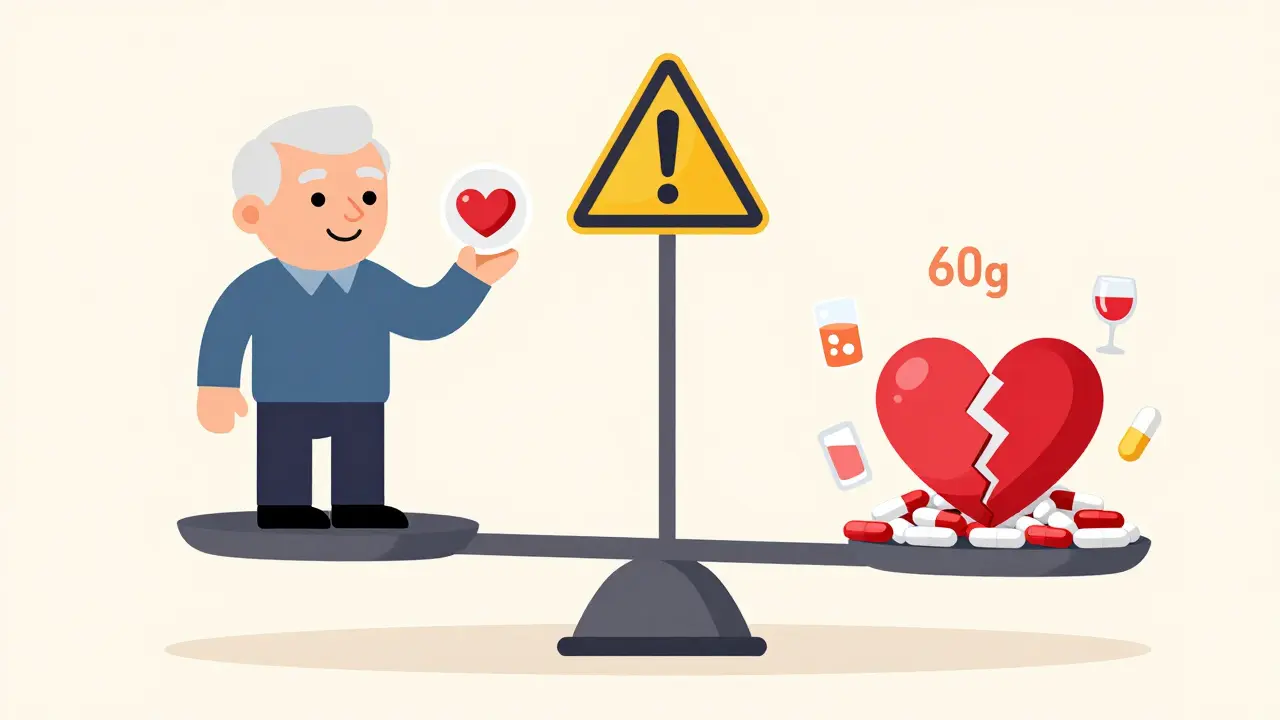
What Should You Do If You’re on One of These Drugs?
If you’re taking citalopram or escitalopram:- Know your dose. Don’t take more than prescribed.
- Tell your doctor about every other medication - including over-the-counter and herbal products.
- Ask if you need an ECG. Especially if you’re over 65, have heart issues, or are on other QT-prolonging drugs.
- Watch for symptoms: dizziness, palpitations, fainting, or unexplained fatigue. Report them immediately.
- Don’t stop suddenly. Depression can worsen. Talk to your doctor before changing anything.
Why Escitalopram Is Often Preferred - Even If It Costs More
Escitalopram is usually more expensive than generic citalopram. But in clinical practice, many psychiatrists now choose it over citalopram - especially for older adults or those with heart disease. Why? Because the risk profile is better. The same antidepressant effect, with less QT prolongation. It’s not a perfect drug. But when you’re weighing mood improvement against heart risk, the math often favors escitalopram.Bottom Line: Use Smart, Don’t Avoid
Citalopram and escitalopram aren’t dangerous drugs. They’re powerful tools - but like any tool, they need proper handling. The 2011 warnings didn’t ban them. They just added rules: lower doses, more caution, better monitoring. If you’re prescribed one of these, ask: Is this the safest option for me? If you’re over 65, have heart issues, or take other meds, there may be better choices. But if you’re young, healthy, and responding well to escitalopram at 10 mg? There’s no reason to switch. The goal isn’t to avoid these medications. It’s to use them wisely - with eyes wide open to the risks, and with a doctor who knows your full health picture.Can I take citalopram if I have a pacemaker?
Having a pacemaker doesn’t automatically mean you can’t take citalopram, but it does raise caution. Pacemakers help control slow heart rhythms, but they don’t prevent dangerous fast rhythms like Torsade de Pointes. Your doctor will likely check your QT interval with an ECG before prescribing and may prefer escitalopram at a lower dose or switch to another antidepressant like sertraline if your heart rhythm is unstable.
Is escitalopram safe for elderly patients?
Yes, but only at low doses. For patients over 65, the maximum recommended dose is 10 mg daily. Older adults metabolize drugs slower, so even standard doses can lead to higher blood levels and increased QT prolongation risk. An ECG before starting and monitoring for dizziness or fainting is strongly advised.
What if I accidentally took 60 mg of citalopram?
This is a medical emergency. Take yourself or the person to the nearest emergency room immediately. A dose of 60 mg of citalopram significantly increases the risk of dangerous heart rhythms. Emergency teams will monitor your ECG, check electrolytes, and may give magnesium sulfate to stabilize your heart rhythm. Do not wait for symptoms - act fast.
Can I drink alcohol while taking escitalopram or citalopram?
Alcohol can worsen dizziness and drowsiness from these medications and may also affect your heart rhythm. While a small amount might be okay for some people, it’s best to avoid alcohol entirely, especially if you’re on the higher end of the dose range or have any heart condition. The combined effect could increase QT prolongation risk.
Do I need regular ECGs if I’m on escitalopram?
For most healthy adults on 10-20 mg of escitalopram, routine ECGs aren’t required. But if you’re over 65, have heart disease, are on other QT-prolonging drugs, or have electrolyte imbalances, your doctor should order a baseline ECG before starting and possibly repeat it after a few weeks. If your QTc stays below 450 ms (men) or 470 ms (women), you’re likely safe.


Jason Silva
22 December 2025 - 10:07 AM
Bro this is wild 🤯 I swear Big Pharma is hiding the real danger - they want you on these drugs forever so you keep coming back for ECGs and heart monitors. They’re not worried about your heart… they’re worried about your wallet. 💸 #CitalopramCoverup
mukesh matav
24 December 2025 - 00:06 AM
Interesting read. I’ve been on escitalopram for 3 years at 10mg. No issues. My doctor did an ECG before starting - just being safe. Good to know the numbers behind it.
Peggy Adams
24 December 2025 - 23:19 PM
I don’t even trust doctors anymore. They just push pills. What’s next? They’ll say caffeine is dangerous because it ‘might’ affect QT? 😴
Christina Weber
26 December 2025 - 02:23 AM
The FDA’s 2011 warning was not arbitrary. It was based on statistically significant QTc prolongation in dose-response studies. To dismiss this as 'fearmongering' is medically irresponsible. Also, 'citalopram' is spelled with two 't's. Please proofread before posting misinformation.
Cara C
27 December 2025 - 22:47 PM
I appreciate how balanced this is. It’s not about scaring people off meds - it’s about knowing your body and your risks. If you’re young and healthy and responding well, there’s no need to panic. But if you’re over 65 or on other meds? Definitely get that ECG.
Dan Adkins
29 December 2025 - 17:36 PM
The regulatory divergence between the FDA and MHRA reflects a fundamental epistemological discrepancy in pharmacovigilance paradigms. The FDA prioritizes dose-specific pharmacokinetic data, whereas European agencies adopt a precautionary principle grounded in enantiomeric pharmacodynamic overlap. Ergo, escitalopram’s marginal risk profile remains non-trivial.
Meina Taiwo
30 December 2025 - 03:44 AM
Escitalopram at 10mg is fine for elderly. Just check electrolytes and avoid macrolides. Simple.
Adrian Thompson
30 December 2025 - 21:54 PM
So let me get this straight - the government says 40mg of citalopram is dangerous… but 60mg of Adderall is fine? Yeah right. This is just another way to control the masses. Wake up, sheeple.
Southern NH Pagan Pride
1 January 2026 - 14:57 PM
i heard the FDA banned citalopram because they dont want us to be too happy... the pharma giants are in bed with the FDA... and the ECG machines? totally rigged. 🕵️♀️⚡
Orlando Marquez Jr
2 January 2026 - 05:37 AM
The clinical implications of hERG channel inhibition by the R-enantiomer of citalopram are well documented in peer-reviewed literature. It is imperative that prescribers remain cognizant of polypharmacy interactions, particularly in geriatric populations with comorbidities.
Jackie Be
2 January 2026 - 19:20 PM
I took 60mg once by accident and my heart felt like it was gonna explode 💥 I ran to the ER and they gave me magnesium and said I was lucky to be alive. Don’t be stupid. This isn’t a game.
John Hay
3 January 2026 - 02:15 AM
I’ve been on escitalopram 20mg for 5 years. No ECGs, no issues. But I also don’t drink, don’t take other meds, and I’m 32. So yeah - context matters. Don’t freak out if you’re healthy.
Jon Paramore
4 January 2026 - 06:39 AM
QTc >500ms or delta >60ms = red flag. That’s the clinical threshold. Below that, risk is low. But if you’re on fluoxetine + citalopram + amiodarone? You’re playing Russian roulette with your ventricles. Don’t.
Swapneel Mehta
5 January 2026 - 15:31 PM
This is actually really helpful. I was scared to start anything because I heard 'heart risk' and thought it meant 'never take it.' But now I see it’s more about smart use. Thanks for breaking it down.