FDA Office of Generic Drugs: How Generic Medicines Get Approved and Why It Matters
When you pick up a generic pill at the pharmacy, you’re relying on the FDA Office of Generic Drugs, The division within the U.S. Food and Drug Administration responsible for reviewing and approving generic medications to ensure they are safe, effective, and identical in performance to brand-name drugs. Also known as OGD, it’s the quiet engine behind most of the medications you take every day—cheaper, just as powerful, and held to the same strict standards. Without it, generic drugs wouldn’t exist at all. And without generics, millions of people couldn’t afford their prescriptions.
The ANDA pathway, The abbreviated new drug application process used by manufacturers to get generic drugs approved without repeating costly clinical trials is how this works. Companies don’t need to prove the drug works from scratch. Instead, they prove their version behaves exactly like the brand-name drug in the body—same absorption, same breakdown, same effect. That’s called bioequivalence, The scientific standard that ensures a generic drug delivers the same amount of active ingredient at the same rate as the brand-name version. The FDA doesn’t just accept claims. They test batches, inspect factories, and check every step. A generic drug approved by the FDA Office of Generic Drugs isn’t a copy—it’s a verified twin.
The whole system runs on the Hatch-Waxman Act, A 1984 U.S. law that balanced innovation and access by letting generic makers enter the market after brand-name patents expire, while giving brand companies limited exclusivity to recoup R&D costs. Before this law, generics were rare and unreliable. Now, they make up 90% of U.S. prescriptions. And they’re not just cheaper—they’re safer because they’re regulated. The same people who review Viagra also review sildenafil. The same labs that check insulin check metformin. No shortcuts. No exceptions.
But it’s not just about price. It’s about trust. When you take a generic, you’re trusting that the FDA didn’t cut corners. That the pill in your hand does exactly what it’s supposed to. That’s why the FDA Office of Generic Drugs doesn’t just approve drugs—it protects patients. Every approval is a promise: you get the same result, for a fraction of the cost. And if something goes wrong? They track it. They investigate. They act.
What you’ll find below are real stories and deep dives into how this system touches your life. From how metformin and vitamin B12 interact, to why women get more side effects, to how counterfeit drugs are blocked before they reach you—every post connects back to the same foundation: the FDA’s oversight of medicines. Whether you’re on a generic, thinking about switching, or just wondering why your prescription costs less this month, the answers start here.
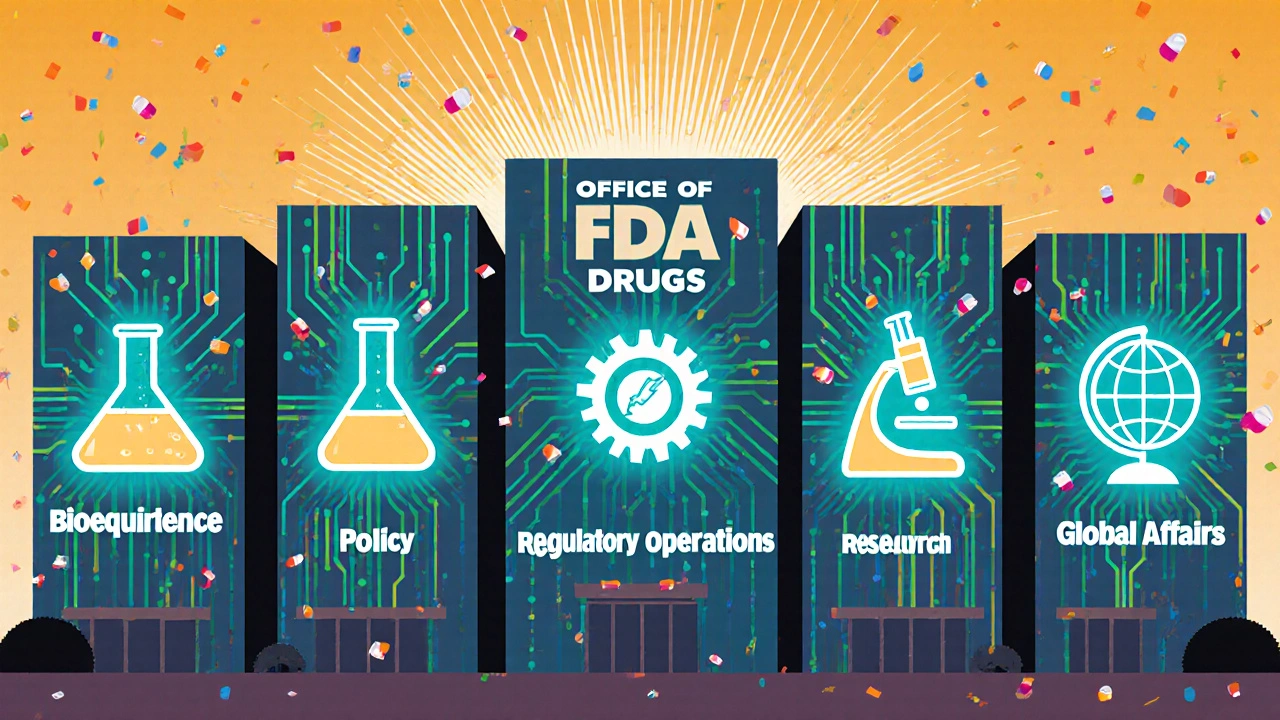
FDA Office of Generic Drugs: Role, Responsibilities, and Structure Explained
The FDA's Office of Generic Drugs ensures safe, affordable generic medications reach patients by reviewing applications, enforcing bioequivalence standards, and managing regulatory policy under GDUFA and the Hatch-Waxman Act.
Read More